火
| ||||||||
Translingual
| Stroke order | |||
|---|---|---|---|
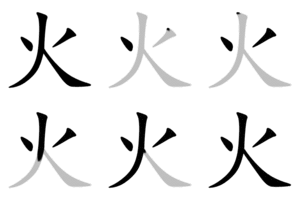 | |||
Alternative forms
- 灬 (when used as a bottom Chinese radical)
Han character
火 (radical 86, 火+0, 4 strokes, cangjie input 火 (F), four-corner 90800, composition ⿱八人)
- Kangxi radical #86, ⽕.
Derived characters
References
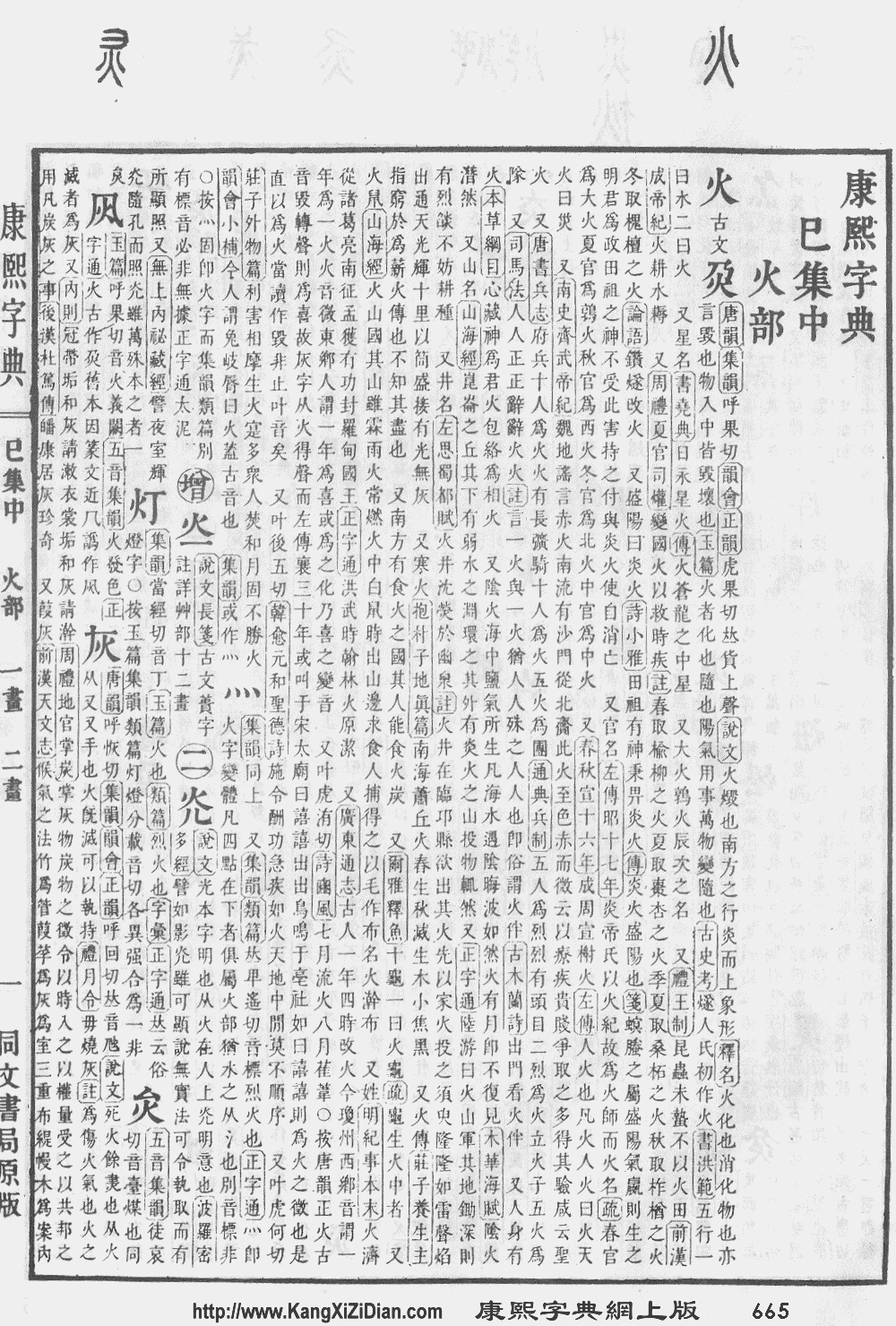
- KangXi: page 665, character 1
- Dai Kanwa Jiten: character 18850
- Dae Jaweon: page 1073, character 19
- Hanyu Da Zidian: volume 3, page 2187, character 1
- Unihan data for U+706B
Chinese
| simp. and trad. |
火 | |
|---|---|---|
Glyph origin
| Historical forms of the character 火 | ||||||
|---|---|---|---|---|---|---|
| Shang | Western Zhou | Spring and Autumn | Warring States | Shuowen Jiezi (compiled in Han) | Liushutong (compiled in Ming) | |
| Oracle bone script | Bronze inscriptions | Bronze inscriptions | Chu Slip and silk script | Qin slip script | Small seal script | Transcribed ancient scripts |
 |
 |
 |
 |
 |
 |
 |
| Characters in the same phonetic series (火) (Zhengzhang, 2003) | |
|---|---|
| Old Chinese | |
| 火 | *qʰʷaːlʔ |
| 邩 | *qʰʷaːlʔ |
| 伙 | *qʰʷaːlʔ |
Pictogram (象形) – pictographic representation of a fire.
Etymology
Possibly from Proto-Sino-Tibetan *mej.
Pronunciation
Definitions
火
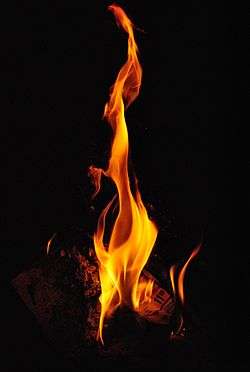
- fire; flame
- fire (as a disaster); inferno
- red; fiery; bright; brilliant
- to burn down
- light; torch
- anger; rage; wrath
- to become enraged
- angry; furious
- (traditional Chinese medicine) internal heat
- firearm; ammunition; weapon
- war; warfare
- thriving; brisk
- urgent; pressing
- (neologism) to become popular; to go viral
- (Cantonese) watt (unit of power)
- Short for 火星 (Huǒxīng, “Mars”).
Compounds
Derived terms from 火
|
|
|
Descendants
Japanese
Kanji
火
Readings
Compounds
Compounds
- 火炎 (kaen, “flame”)
- 火気 (kaki, “fire”)
- 火器 (kaki, “firearms”)
- 火急 (kakyū, “emergency”)
- 火球 (kakyū, “fireball”)
- 火口 (kakō): crater
- 火鼠 (kaso): fire rat
- 火災 (kasai): conflagration
- 火山 (kazan): volcano
- 火事 (kaji): fire
- 火傷 (kashō, “burn”)
- ^火星 (kasei, “Mars”)
- 火勢 (kasei): force of flames
- 火成 (kasei)
- 火葬 (kasō): cremation
- 火中 (kachū)
- 火難 (kanan): fire calamity
- 火薬 (kayaku, “gunpowder”)
- 火曜 (Kayō), 火曜日 (Kayōbi, “Tuesday”):
- 火力 (karyoku): steam power, firepower
- 煙火 (enka)
- 火鈴 (korin): (Zen) fire bell
- 狐火 (kitsunebi): will o' the wisp, foxfire
- 業火 (gōka): hellfire
- 小火 (shōka)
- 花火, 煙火 (hanabi, “fireworks”)
- 野火 (yaka): wildfire
- 小火 (boya)
- 火傷 (yakedo)
Etymology 1
| Kanji in this term |
|---|
| 火 |
| ひ Grade: 1 |
| kun’yomi |
⟨hi2⟩ → */pɨ/ → */fɨ/ → /fi/ → /hi/
From Old Japanese.[1]
Apophonic form of ho (see below), possibly by fusion with emphatic particle い (i). Compare the development of 木 (ko → ki, “tree”).
Pronunciation
Noun
Derived terms
Derived terms
- 火遊び (hi asobi, “playing with fire”)
- 火口 (higuchi): torch head, welding tip
- 火先 (hisaki, “tip of a flame”)
- 火縄 (hinawa)
- 火鼠 (hinezumi), A fire rat/mouse
- 火の車 (hi no kuruma): a fire-spouting cart in Hell, in which sinners are transported: a metaphor for being in a difficult situation, usually financially
- 火の手 (hi no te, “flames”)
- 火の鳥 (hi no tori, “phoenix”)
- 火花 (hibana)
- 火箸 (hibashi, “tongs”)
- 火蓋 (hibuta)
- 火偏 (hihen): the fire radical (portion of a kanji character)
- 火元 (himoto, “origin of a fire”)
- 火矢, 火箭 (hiya, “fire arrow”)
- 葦火 (ashibi)
- 鬼火 (onibi): devilfire; will-o'-the-wisps; a jack-o'-lantern
- 篝火 (kagaribi): a fire set in an iron cage-like bucket and used as illumination by guards or hunters; a capable person who gets things done
Idioms
- 火を見るよりも明らか (hi o miru yori mo akiraka): "clearer than seeing the fire" → as plain as day, as plain as the nose on one's face, as clear as a bell
Etymology 2
| Kanji in this term |
|---|
| 火 |
| ほ Grade: 1 |
| kun’yomi |
/po/ → /fo/ → /ho/
From Old Japanese.[1]
Combining form of hi (see above). Probably the oldest form, possibly cognate with Korean 불 (bul, “fire”).
Pronunciation
Noun
- a fire
Derived terms
Derived terms
- 火影 (hokage, “firelight/fire shadow”)
- 火口 (hokuchi): tinder, fire starter
- 火気 (hoke, “flame; heat; smoke”)
- 火先 (hosaki, “tip of a flame”)
- 火照る (hoteru, “to feel hot or flushed”)
- 火中 (honaka)
- 炎 (honō, “flame”)
- 火の神 (ho no kami)
- 炎, 焔 (homura): flames; metaphorical flames, connoting strong emotions such as anger or jealousy, or such as ambition or passion
Etymology 3
| Kanji in this term |
|---|
| 火 |
| ふ Grade: 1 |
| kun’yomi |
/pu/ → /fu/
From Old Japanese. Ancient dialect form in eastern Japan,[1] attested in only one source (see derivative term 葦火 (ashifu)).
Pronunciation
Noun
- (regional) a fire
Derived terms
Etymology 4
| Kanji in this term |
|---|
| 火 |
| か Grade: 1 |
| on’yomi |
/kwa/ → /ka/
From Middle Chinese 火 (MC huɑX).[1]
Pronunciation
Noun

Proper noun
References
Korean
Hanja
Compounds
Noun
火 • (hwa) (hangeul 화)
Synonyms
- (Tuesday): 화요일 (hwayoil, “Tuesday”)
Vietnamese
Han character
- This term needs a translation to English. Please help out and add a translation, then remove the text
{{rfdef}}.
This article is issued from
Wiktionary.
The text is licensed under Creative Commons - Attribution - Sharealike.
Additional terms may apply for the media files.