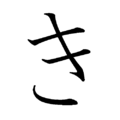
き
 | ||||||||
Japanese
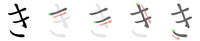
| Stroke order | |||
|---|---|---|---|
 | |||
Pronunciation
- IPA(key): [kʲi]
Etymology 1
Derived in the Heian period from writing the man'yōgana kanji 幾 in the cursive sōsho style. Variants include those derived by similar process from 支, 起, 木, 祈, 貴 and 喜.
Syllable
き (romaji ki)
- The hiragana syllable き (ki). Its equivalent in katakana is キ (ki). It is the seventh syllable in the gojūon order; its position is か行い段 (ka-gyō i-dan, “row ka, section i”).
Derived terms
- ぎ (gi)
See also
Etymology 2
Noun
き (rōmaji ki)
Suffix
き (rōmaji -ki)
Counter
き (rōmaji -ki)
Etymology 3
Suffix
き (rōmaji -ki)
- (Classical Japanese, auxiliary) Indicates past tense.
Usage notes
Follows the 連用形 (ren'yōkei, “continuative or stem form”) of verbs and some auxiliaries. Conjugation:
| 未然形 | 連用形 | 終止形 | 連体形 | 已然形 | 命令形 |
|---|---|---|---|---|---|
| せ (se) | き (ki) | し (shi) | しか (shika) |
Related terms
- けむ (kemu)
See also
- けり (keri)
This article is issued from
Wiktionary.
The text is licensed under Creative Commons - Attribution - Sharealike.
Additional terms may apply for the media files.