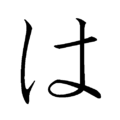
は
 | ||||||||
Japanese
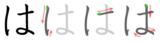
| Stroke order | |||
|---|---|---|---|
 | |||
Etymology 1
Derived in the Heian period from writing the man'yōgana kanji 波 in the cursive sōsho style.[1][2]
Pronunciation
- IPA(key): [ha̠]
Syllable
は (romaji ha)
- The hiragana syllable は (ha). Its equivalent in katakana is ハ (ha). It is the twenty-sixth syllable in the gojūon order; its position is は行あ段 (ha-gyō a-dan, “row ha, section a”).
Derived terms
See also
Etymology 2
/pa/ → /ɸa/ → /wa/
From Old Japanese. Used in the oldest Japanese writings, including the Man'yōshū finished some time after 759 CE.[1][2]
The spelling was preserved as は (usually read as ha) in the script reform, rather than changed to わ (wa) as would otherwise be expected from the phonetics.
Pronunciation
- IPA(key): [ɰᵝa̠]
Particle
は (rōmaji wa)
- a particle that acts as a topic marker
- これは犬です。
- Kore wa inu desu.
- This [the topic, about which we are speaking] is a dog.
- これは犬です。
- Inserted between て (te) and a negative suffix for emphasis.
- そう思ってはいないでしょうか。
- Sō omotte wa inai deshō ka.
- Do you not think so?
- 勝てるとは思ってはいない
- kateru to wa omotte wa inai
- does not think that one can win
- そう思ってはいないでしょうか。
Usage notes
Note that English has no direct counterpart. For illustrative purposes, it may be translated as "as for" or a similar phrase. For example, "As for this, it is a dog". This often does not produce very natural English, however.
Derived terms
See also
- は as a Japanese topic marker
- が (ga): the subject marker
Etymology 3
The reading of various kanji terms.
Pronunciation
- IPA(key): [ha̠]
Noun
は (rōmaji ha)
References
This article is issued from
Wiktionary.
The text is licensed under Creative Commons - Attribution - Sharealike.
Additional terms may apply for the media files.