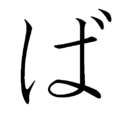
ば
 | ||||||||||
Japanese
| Stroke order | |||
|---|---|---|---|
 | |||
Pronunciation
- IPA(key): [ba̠]
Etymology 1
The hiragana character は (ha) with a dakuten (゛).
Syllable
ば (romaji ba)
- The hiragana syllable ば (ba). Its equivalent in katakana is バ (ba).
See also
Etymology 2
Noun
ば (rōmaji ba)
Counter
ば (rōmaji -ba)
Etymology 3
Particle
ば (rōmaji ba)
- if; when
- c. late 9th – mid-10th century, Taketori Monogatari
- それを見れば、三寸ばかりなる人いと美しうて居たり。
- When he looked at it, there sat a very lovely human being about three sun long.
- それを見れば、三寸ばかりなる人いと美しうて居たり。
- 2007, yura (lyrics), Satoru Kousaki (music), “キラメキラリ”, in THE IDOLM@STER MASTER ARTIST 02 Takatsuki Yayoi:
- 宇宙から見れば地球も流れ星
- uchū kara mireba chikyū mo nagareboshi
- If you see from the universe the earth is also a shooting star
- 宇宙から見れば地球も流れ星
- 私はあなたが隣に居てくれればそれで幸せなの!
- Watashi wa anata ga tonari ni ite kurereba sore de shiawase nano!
- I'll be happy as long as you are by my side.
- c. late 9th – mid-10th century, Taketori Monogatari
- (used with ほど) the more ..., the more
- 学べば学ぶほど、何も知らなかった事に気づく
- Manabeba manabu hodo, nani mo shiranakatta koto ni kizuku
- The more I learned, the more I felt I didn't know anything.
- 学べば学ぶほど、何も知らなかった事に気づく
- (used with も) Links items in parallel; ... and ...
- 日本語もできれば英語もできる
- nihongo mo dekireba eigo mo dekiru
- to be able to speak both Japanese and English
- 日本語もできれば英語もできる
Usage notes
- The hypothetical conditional is formed by attaching ば (ba) to the 仮定形 of a verb or adjective in modern Japanese. This is done to the 未然形 in classical Japanese, which persists in a few set phrases like ならば (nara ba) and 例えば (tatoeba) in modern Japanese.
- There is also 已然形 + ば in classical Japanese, which looks like 仮定形 + ば in modern Japanese, but introduces something occurred as a cause, occasion or circumstance.
This article is issued from
Wiktionary.
The text is licensed under Creative Commons - Attribution - Sharealike.
Additional terms may apply for the media files.