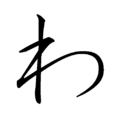
わ
See also: わ゙
 | ||||||||
Japanese
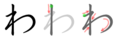
| Stroke order | |||
|---|---|---|---|
 | |||
Pronunciation
- IPA(key): [ɰᵝa̠]
Etymology 1
Derived in the Heian period from writing the man'yōgana kanji 和 in the cursive sōsho style.
Syllable
わ (romaji wa)
- The hiragana syllable わ (wa). Its equivalent in katakana is ワ (wa). It is the forty-fourth syllable in the gojūon order; its position is わ行あ段 (wa-gyō a-dan, “row wa, section a”).
See also
Etymology 2
From Old Japanese.
Particle
わ (rōmaji wa)
- (women's speech) a particle used in the end of sentences to indicate admiration or emotion
- あなたの髪は長いわね!
- Anata no kami wa nagai wa ne!
- Wow, your hair is so long!
- 今、行くわ。
- Ima, iku wa.
- I'm coming.
- 知らないわ。
- Shiranai wa.
- I don't know.
- あなたの髪は長いわね!
Usage notes
- In common Japanese, this particle is mainly used by women. In various dialects, particularly western, it is used by both men and women, but with a different pitch accent.
Etymology 3
Reading for various kanji.
Counter
わ (rōmaji -wa)
Noun
わ (rōmaji wa)
Proper noun
わ (rōmaji Wa)
Pronoun
わ (rōmaji wa)
References
- Horiuchi, Hideaki; Akiyama Ken (1997) Shin Nihon Koten Bungaku Taikei 17: Taketori Monogatari, Ise Monogatari (in Japanese), Tōkyō: Iwanami Shoten, →ISBN
- Yamagishi, Tokuhei (1958) Koten Bungaku Taikei 14: Genji Monogatari 1 (in Japanese), Tōkyō: Iwanami Shoten, →ISBN
This article is issued from
Wiktionary.
The text is licensed under Creative Commons - Attribution - Sharealike.
Additional terms may apply for the media files.