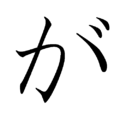
が
See also: か
 | ||||||||||
Japanese
| Stroke order | |||
|---|---|---|---|
 | |||
Pronunciation
Etymology 1
The hiragana character か (ka) with a dakuten (゛).
Syllable
が (romaji ga)
- The hiragana syllable が (ga). Its equivalent in katakana is ガ (ga).
See also
Etymology 2
Particle
が (rōmaji ga)
- Indicates the subject of a sentence.
- 猫が餌を食べた。
- Neko ga esa o tabeta.
- The cat [is the thing that] ate the cat food.
- 猫が餌を食べた。
- conjunction ("but")
- 犬は好きだが、猫は嫌いだ。
- Inu wa suki da ga, neko wa kirai da.
- I like dogs but I hate cats.
- 犬は好きだが、猫は嫌いだ。
- Historical possessive used to connect nouns, most often seen in place names as ヶ.
- 我々が心
- wareware ga kokoro
- our [collective] heart
- 富士見ヶ丘
- Fujimigaoka
- Fuji View Hill
- 関ヶ原
- Sekigahara
- Gateway Plains (site of the Battle of Sekigahara)
- 我々が心
Alternative forms
- (historical possessive): ヶ (ga)
See also
Adjectival noun
が (-na inflection, rōmaji ga)
Noun
が (rōmaji ga)
This article is issued from
Wiktionary.
The text is licensed under Creative Commons - Attribution - Sharealike.
Additional terms may apply for the media files.