wheat
English
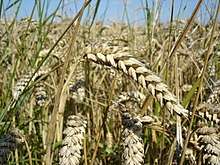
Wheat.
Etymology
From Middle English whete, from Old English hwǣte, from Proto-Germanic *hwaitijaz (compare West Frisian weet, Dutch weit, Low German Weten, German Weizen, Danish hvede, Swedish vete, Icelandic hveiti), from *hwītaz (“white”). More at white.
Pronunciation
- IPA(key): /wiːt/
- (without the wine–whine merger) IPA(key): /hwiːt/
Audio (US) (file) Audio (UK) (file) - Rhymes: -iːt
Noun
wheat (countable and uncountable, plural wheats)
- (countable) Any of several cereal grains, of the genus Triticum, that yields flour as used in bakery.
- (uncountable) A light brown colour, like that of wheat.
- wheat colour:
Coordinate terms
Translations
grain
|
|
colour
|
|
Adjective
wheat (not comparable)
- Wheaten, of a light brown colour, like that of wheat.
Translations
colour
Derived terms
Terms derived from wheat
Related terms
See also
- aleurone
- bulgur
- dermatitis herpetiformis
- einkorn wheat (Triticum boeoticum (wild), Triticum monococcum (domesticated))
- emmer (Triticum turgidum)
- farina
- flour
- frumentaceous
- frumenty
- leghorn
- pani puri
Anagrams
This article is issued from
Wiktionary.
The text is licensed under Creative Commons - Attribution - Sharealike.
Additional terms may apply for the media files.