enter
English
Alternative forms
- entre (archaic, before circa 1700)
Etymology
From Middle English entren, from Old French entrer, from Latin intrō (“enter”, verb), from intrā (“inside”). Has been spelled as "enter" for several centuries even in the United Kingdom, although British English and the English of many Commonwealth Countries (e.g. Australia, Canada) retain the "re" ending for many words such as centre, fibre, spectre, theatre, calibre, sombre, lustre, and litre.
Pronunciation
- (UK) IPA(key): /ˈɛntə(ɹ)/
- (US) IPA(key): /ˈɛntɚ/, [ˈɛɾ̃ɚ]
- (pin–pen merger) IPA(key): [ˈɪɾ̃ɚ]
Audio (UK) (file) Audio (US) (file) - Rhymes: -ɛntə(r)
- Homophone: inner (pin-pen merger)
- Hyphenation: en‧ter
Verb
enter (third-person singular simple present enters, present participle entering, simple past and past participle entered)
- (intransitive) To go or come into an enclosed or partially enclosed space.
- You should knock before you enter, unless you want to see me naked.
- 1555, John Proctor, The historie of Wyates rebellion, with the order and maner of resisting the same, …, page 86:
- […] you can fynde in youre heartes to assaulte her with rebellion, or in any wise [ways] suffer any one eyvil motion to enter into your thoughtes against her?
- 1611, Bible (King James Version), John 3:5:
- Except a man be born of water and of the Spirit, he cannot enter into the kingdom of God.
- 1892, Walter Besant, chapter III, in The Ivory Gate: A Novel, New York, N.Y.: Harper & Brothers, Franklin Square, OCLC 16832619:
- In former days every tavern of repute kept such a room for its own select circle, a club, or society, of habitués, who met every evening, for a pipe and a cheerful glass. […] Strangers might enter the room, but they were made to feel that they were there on sufferance: they were received with distance and suspicion.
- (transitive) To cause to go (into), or to be received (into); to put in; to insert; to cause to be admitted.
- to enter a knife into a piece of wood; to enter a boy at college, a horse for a race, etc.
- (figuratively) To go or come into (a state or profession).
- My twelve-year-old son will be entering his teens next year. She had planned to enter the legal profession.
- 2013 June 28, Joris Luyendijk, “Our banks are out of control”, in The Guardian Weekly, volume 189, number 3, page 21:
- Until 2008 there was denial over what finance had become. … But the scandals kept coming, and so we entered stage three – what therapists call "bargaining".
- (transitive) To type (something) into a computer; to input.
- Enter your user name and password.
- (transitive) To record (something) in an account, ledger, etc.
- 2003, A. Mukherjee and M. Hanif, Financial Accounting, →ISBN, pages 27:
- Each amount entered in the debit column of the journal is posted by entering it on the credit side/column of of an account in the ledger.
-
- (intransitive, law) To become a party to an agreement, treaty, etc.
- 2003 February 4, The President of the United States, “NOTIFICATION TO ENTER INTO A FREE TRADE AGREEMENT WITH THE GOVERNMENT OF SINGAPORE”, in U.S. Government Printing Office, retrieved 2013-9-9:
- I am pleased to notify the Congress of my intent to enter into a Free Trade Agreement (FTA) with the Government of Singapore.
-
- (law, intransitive) To become effective; to come into effect.
- 2005, United Nations, Dispositions Législatives Et Réglementaires Nationales Relatives À la Prévention Et À L'élimination Du Terrorisme International, →ISBN, page 215:
- This Act shall enter into force on 01 March 1998.
-
- (law) To go into or upon, as lands, and take actual possession of them.
- (transitive, law) To place in regular form before the court, usually in writing; to put upon record in proper from and order.
- to enter a writ, appearance, rule, or judgment
- (Can we find and add a quotation of Burrill to this entry?)
- to make report of (a vessel or its cargo) at the custom house; to submit a statement of (imported goods), with the original invoices, to the proper customs officer for estimating the duties. See entry.
- (transitive, US, dated, historical) To file, or register with the land office, the required particulars concerning (a quantity of public land) in order to entitle a person to a right of preemption.
- 1887, United States General Land Office, Annual Report of the Commissioner of General Land Office, US Government Printing Office, page 82:
- Under existing laws governing the qualifications of an alien to enter 160 acres or more of the public domain he is only required to file his declaration of intent to become a citizen.
-
- to deposit for copyright the title or description of (a book, picture, map, etc.).
- entered according to act of Congress
- (transitive, obsolete) To initiate; to introduce favourably.
- c. 1606–1607, William Shakespeare, “The Tragedie of Anthonie and Cleopatra”, in Mr. William Shakespeares Comedies, Histories, & Tragedies: Published According to the True Originall Copies (First Folio), London: Printed by Isaac Iaggard, and Ed[ward] Blount, published 1623, OCLC 606515358, (please specify the act number in uppercase Roman numerals):
- This sword but shown to Caesar, with this tidings, / Shall enter me with him.
-
Inflection
| infinitive | enter | ||||||||||
|---|---|---|---|---|---|---|---|---|---|---|---|
| present participle | entering | ||||||||||
| past participle | entered | ||||||||||
| simple | progressive | perfect | perfect progressive | ||||||||
| present | I enter | we enter | I am entering | we are entering | I have entered | we have entered | I have been entering | we have been entering | |||
| you enter | you enter | you are entering | you are entering | you have entered | you have entered | you have been entering | you have been entering | ||||
| he enters | they enter | he is entering | they are entering | he has entered | they have entered | he has been entering | they have been entering | ||||
| past | I entered | we entered | I was entering | we were entering | I had entered | we had entered | I had been entering | we had been entering | |||
| you entered | you entered | you were entering | you were entering | you had entered | you had entered | you had been entering | you had been entering | ||||
| he entered | they entered | he was entering | they were entering | he had entered | they had entered | he had been entering | they had been entering | ||||
| future | I will enter | we will enter | I will be entering | we will be entering | I will have entered | we will have entered | I will have been entering | we will have been entering | |||
| you will enter | you will enter | you will be entering | you will be entering | you will have entered | you will have entered | you will have been entering | you will have been entering | ||||
| he will enter | they will enter | he will be entering | they will be entering | he will have entered | they will have entered | he will have been entering | they will have been entering | ||||
| conditional | I would enter | we would enter | I would be entering | we would be entering | I would have entered | we would have entered | I would have been entering | we would have been entering | |||
| you would enter | you would enter | you would be entering | you would be entering | you would have entered | you would have entered | you would have been entering | you would have been entering | ||||
| he would enter | they would enter | he would be entering | they would be entering | he would have entered | they would have entered | he would have been entering | they would have been entering | ||||
| imperative | enter | ||||||||||
Synonyms
Antonyms
- (intransitive) exit
Derived terms
Translations
|
|


|
|
|
Noun
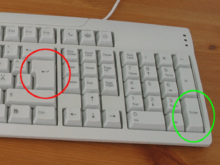
enter (plural enters)
- (computing) Alternative spelling of Enter (“the computer key”)
- (computing) Alternative spelling of Enter (“a stroke of the computer key”)
Translations
Anagrams
Catalan
Etymology
From Old Occitan, inherited from Latin integer, integrum. Compare Occitan entièr, French entier, Spanish entero. Doublet of íntegre, a later borrowing.
Adjective
enter (feminine entera, masculine plural enters, feminine plural enteres)
Derived terms
Noun
enter m (plural enters)
- whole number, integer
- Synonyms: nombre enter, nombre sencer
- a complete lottery ticket (made up of ten dècims)
Related terms
Further reading
- “enter” in Diccionari de la llengua catalana, segona edició, Institut d’Estudis Catalans.
Finnish
Pronunciation
- IPA(key): /ˈentːer/
Noun
enter
- Enter (computer key)
Declension
| Inflection of enter (Kotus type 6/paperi, no gradation) | |||
|---|---|---|---|
| nominative | enter | enterit | |
| genitive | enterin | enterien entereiden entereitten | |
| partitive | enteriä | entereitä enterejä | |
| illative | enteriin | entereihin | |
| singular | plural | ||
| nominative | enter | enterit | |
| accusative | nom. | enter | enterit |
| gen. | enterin | ||
| genitive | enterin | enterien entereiden entereitten | |
| partitive | enteriä | entereitä enterejä | |
| inessive | enterissä | entereissä | |
| elative | enteristä | entereistä | |
| illative | enteriin | entereihin | |
| adessive | enterillä | entereillä | |
| ablative | enteriltä | entereiltä | |
| allative | enterille | entereille | |
| essive | enterinä | entereinä | |
| translative | enteriksi | entereiksi | |
| instructive | — | enterein | |
| abessive | enterittä | entereittä | |
| comitative | — | entereineen | |
French
Etymology
From a Vulgar Latin *imptāre, contraction of *imputō, imputāre (“I graft”) (unrelated to imputō (“I reckon, attribute”)), from inpotus (attested in Salic Law), from Ancient Greek ἔμφυτος (émphutos, “planted”). The Greek word may have actually reached Gaul through traders at the Mediterranean coastal colonies before the Roman conquest.
Verb
enter
- (agriculture) to graft
- to implant
Conjugation
| simple | compound | ||||||
|---|---|---|---|---|---|---|---|
| infinitive | enter | avoir enté | |||||
| gerund | en entant | en ayant enté | |||||
| present participle | entant /ɑ̃.tɑ̃/ | ||||||
| past participle | enté /ɑ̃.te/ | ||||||
| person | singular | plural | |||||
| first | second | third | first | second | third | ||
| indicative | je (j’) | tu | il | nous | vous | ils | |
| simple tenses |
present | ente /ɑ̃t/ |
entes /ɑ̃t/ |
ente /ɑ̃t/ |
entons /ɑ̃.tɔ̃/ |
entez /ɑ̃.te/ |
entent /ɑ̃t/ |
| imperfect | entais /ɑ̃.tɛ/ |
entais /ɑ̃.tɛ/ |
entait /ɑ̃.tɛ/ |
entions /ɑ̃.tjɔ̃/ |
entiez /ɑ̃.tje/ |
entaient /ɑ̃.tɛ/ | |
| past historic1 | entai /ɑ̃.te/ |
entas /ɑ̃.ta/ |
enta /ɑ̃.ta/ |
entâmes /ɑ̃.tam/ |
entâtes /ɑ̃.tat/ |
entèrent /ɑ̃.tɛʁ/ | |
| future | enterai /ɑ̃.tʁe/ |
enteras /ɑ̃.tʁa/ |
entera /ɑ̃.tʁa/ |
enterons /ɑ̃.tʁɔ̃/ |
enterez /ɑ̃.tʁe/ |
enteront /ɑ̃.tʁɔ̃/ | |
| conditional | enterais /ɑ̃.tʁɛ/ |
enterais /ɑ̃.tʁɛ/ |
enterait /ɑ̃.tʁɛ/ |
enterions /ɑ̃.tə.ʁjɔ̃/ |
enteriez /ɑ̃.tə.ʁje/ |
enteraient /ɑ̃.tʁɛ/ | |
| compound tenses |
present perfect | Use the present tense of avoir followed by the past participle | |||||
| pluperfect | Use the imperfect tense of avoir followed by the past participle | ||||||
| past anterior1 | Use the past historic tense of avoir followed by the past participle | ||||||
| future perfect | Use the future tense of avoir followed by the past participle | ||||||
| conditional perfect | Use the conditional tense of avoir followed by the past participle | ||||||
| subjunctive | que je (j’) | que tu | qu’il | que nous | que vous | qu’ils | |
| simple tenses |
present | ente /ɑ̃t/ |
entes /ɑ̃t/ |
ente /ɑ̃t/ |
entions /ɑ̃.tjɔ̃/ |
entiez /ɑ̃.tje/ |
entent /ɑ̃t/ |
| imperfect1 | entasse /ɑ̃.tas/ |
entasses /ɑ̃.tas/ |
entât /ɑ̃.ta/ |
entassions /ɑ̃.ta.sjɔ̃/ |
entassiez /ɑ̃.ta.sje/ |
entassent /ɑ̃.tas/ | |
| compound tenses |
past | Use the present subjunctive tense of avoir followed by the past participle | |||||
| pluperfect1 | Use the imperfect subjunctive tense of avoir followed by the past participle | ||||||
| imperative | – | tu | – | nous | vous | – | |
| — | ente /ɑ̃t/ |
— | entons /ɑ̃.tɔ̃/ |
entez /ɑ̃.te/ |
— | ||
| 1literary tenses | |||||||
Further reading
- “enter” in le Trésor de la langue française informatisé (The Digitized Treasury of the French Language).
Anagrams
Gaulish
Alternative forms
- entar
Etymology
From Proto-Celtic *enter (“between”), from Proto-Indo-European *h₁enter (“between”). Cognates include Celtiberian entara (“between”), Old Irish eter (“between”) (Irish idir (“between, both”)), Latin inter (“between”), Sanskrit अन्तर् (antár, “between, within, into”), Oscan 𐌀𐌍𐌕𐌄𐌓 (anter, “between”), and Old High German untar (“between”).
Preposition
enter
References
- Xavier Delamarre, Dictionnaire de la langue gauloise: Une approche linguistique du vieux-celtique continental, published 2003, →ISBN, page 163.
- Ranko Matasović, Etymological Dictionary of Proto-Celtic, published 2009, →ISBN, page 117.
German
Verb
enter
Polish
Pronunciation
IPA(key): /ˈɛn.tɛr/
Noun
enter m inan