most
English
Etymology
From Middle English most, moste, from Old English mǣst, māst, from Proto-Germanic *maistaz, *maist. Cognate with Scots mast, maist (“most”), Saterland Frisian maast (“most”), West Frisian meast (“most”), Dutch meest (“most”), German meist (“most”), Danish and Swedish mest (“most”), Icelandic mestur (“most”).
Pronunciation
- (Received Pronunciation) enPR: mōst, IPA(key): /ˈməʊst/
- (General American) enPR: mōst, IPA(key): /ˈmoʊst/
Audio (US) (file) - Rhymes: -əʊst
Determiner
most
- superlative degree of much.
- The teams competed to see who could collect the most money.
- superlative degree of many: the comparatively largest number of (construed with the definite article)
- The team with the most points wins.
- superlative degree of many: the majority of; more than half of (construed without the definite article)
- Most bakers and dairy farmers have to get up early.
- Winning was not important for most participants.
Synonyms
Translations
|
|
Adverb
most (not comparable)
- Forms the superlative of many adjectives.
- This is the most important example.
- Correctness is most important.
- 1918, W. B. Maxwell, chapter 7, in The Mirror and the Lamp:
- With some of it on the south and more of it on the north of the great main thoroughfare that connects Aldgate and the East India Docks, St. Bede's at this period of its history was perhaps the poorest and most miserable parish in the East End of London.
- 1922, Ben Travers, chapter 1, in A Cuckoo in the Nest:
- “[…] the awfully hearty sort of Christmas cards that people do send to other people that they don't know at all well. You know. The kind that have mottoes […] . And then, when you see [the senders], you probably find that they are the most melancholy old folk with malignant diseases. […]”
- To a great extent or degree; highly; very.
- This is a most unusual specimen.
- 1895, H. G. Wells, The Time Machine Chapter X
- Now, I still think that for this box of matches to have escaped the wear of time for immemorial years was a strange, and for me, a most fortunate thing.
- (informal, chiefly US) Almost.
- 2000, Jewish Baltimore: A Family Album →ISBN, page 159:
- "We walked there most every day after school."
- 2011, Charlotte Maclay, Wanted: A Dad to Brag About →ISBN:
- “Can't be all that bad if Luke likes it. Most everywhere has air-conditioning, he says.”
- 2000, Jewish Baltimore: A Family Album →ISBN, page 159:
most
- superlative form of many: most many
- superlative form of much: most much
- 2013 August 3, “Boundary problems”, in The Economist, volume 408, number 8847:
- Economics is a messy discipline: too fluid to be a science, too rigorous to be an art. Perhaps it is fitting that economists’ most-used metric, gross domestic product (GDP), is a tangle too. GDP measures the total value of output in an economic territory. Its apparent simplicity explains why it is scrutinised down to tenths of a percentage point every month.
-
Antonyms
- The terms below need to be checked and allocated to the definitions (senses) of the headword above. Each term should appear in the sense for which it is appropriate. Use the templates
{{syn|en|...}}or{{ant|en|...}}to add them to the appropriate sense(s).
Derived terms
Related terms
Translations
|
|
- The translations below need to be checked and inserted above into the appropriate translation tables, removing any numbers. Numbers do not necessarily match those in definitions. See instructions at Wiktionary:Entry layout#Translations.
|
|
Pronoun
most
- The greater part of a group, especially a group of people.
- Most want the best for their children.
- The peach was juicier and more flavourful than most.
Synonyms
- (greater part): the majority
Noun
most (usually uncountable, plural mosts)
- (uncountable) The greatest amount.
- The most I can offer for the house is $150,000.
- (countable, uncountable) The greater part.
- Most of the penguins were friendly and curious.
- 1892, Walter Besant, chapter III, in The Ivory Gate: A Novel, New York, N.Y.: Harper & Brothers, Franklin Square, OCLC 16832619:
- At half-past nine on this Saturday evening, the parlour of the Salutation Inn, High Holborn, contained most of its customary visitors. […] In former days every tavern of repute kept such a room for its own select circle, a club, or society, of habitués, who met every evening, for a pipe and a cheerful glass.
- 1963, Margery Allingham, chapter 20, in The China Governess:
- The story struck the depressingly familiar note with which true stories ring in the tried ears of experienced policemen. […] The second note, the high alarum, not so familiar and always important since it indicates the paramount sin in Man's private calendar, took most of them by surprise although they had been well prepared.
- 2013 August 16, John Vidal, “Dams endanger ecology of Himalayas”, in The Guardian Weekly, volume 189, number 10, page 8:
- Most of the Himalayan rivers have been relatively untouched by dams near their sources. Now the two great Asian powers, India and China, are rushing to harness them as they cut through some of the world's deepest valleys.
- Most of the rice was spoiled.
- (countable) A record-setting amount.
Usage notes
Anagrams
Czech
Etymology
From Proto-Slavic *mostъ (“bridge”)
Pronunciation
- IPA(key): /most/
audio (file)
Noun
most m
Declension
| singular | plural | |
|---|---|---|
| nominative | most | mosty |
| genitive | mostu | mostů |
| dative | mostu | mostům |
| accusative | most | mosty |
| vocative | moste | mosty |
| locative | mostě | mostech |
| instrumental | mostem | mosty |
Derived terms
- můstek
- mostní
- mostový
- přemostit
See also
Further reading
- most in Příruční slovník jazyka českého, 1935–1957
- most in Slovník spisovného jazyka českého, 1960–1971, 1989
Friulian
Etymology
Noun
most m (plural mosts)
- must (unfermented grape juice or wine)
Hungarian
Etymology
From the earlier ma (“now”), which in modern Hungarian means “today” + -st. For the suffix, compare valamelyest.[1]
Pronunciation
- IPA(key): [ˈmoʃt]
Audio (file)
Adverb
most
Derived terms
References
- ↑ Gábor Zaicz, Etimológiai szótár: Magyar szavak és toldalékok eredete, Tinta Könyvkiadó, 2006, →ISBN
Lower Sorbian
Noun
most m (diminutive mosćik)
- superseded spelling of móst.
Declension
| Singular | Dual | Plural | |
|---|---|---|---|
| Nominative | most | mosta | mosty |
| Genitive | mosta | mostowu | mostow |
| Dative | mostoju | mostoma | mostam |
| Accusative | most | mosta | mosty |
| Instrumental | mostom | mostoma | mostami |
| Locative | mosće | mostoma | mostach |
Old High German
Etymology
Noun
most m
Descendants
- German: Most
Polish
Etymology
From Proto-Slavic *mostъ (“bridge”)
Pronunciation
- IPA(key): /mɔst/
most (file)
Noun
most m inan
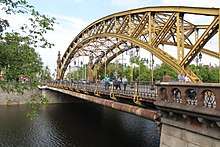
- bridge (building over a river or valley)
Declension
Serbo-Croatian
Etymology
From Proto-Slavic *mostъ (“bridge”)
Pronunciation
- IPA(key): /môːst/
Noun
mȏst m (Cyrillic spelling мо̑ст)
- bridge (construction or natural feature that spans a divide)
Declension
| singular | plural | |
|---|---|---|
| nominative | mȏst | mòstovi |
| genitive | mȍsta | mostova |
| dative | mostu | mostovima |
| accusative | most | mostove |
| vocative | moste | mostovi |
| locative | mostu | mostovima |
| instrumental | mostom | mostovima |
Derived terms
- mòstac
- mostàrina
- mòstić
- mòstiti
Slovak
Etymology
From Proto-Slavic *mostъ (“bridge”)
Pronunciation
- IPA(key): /ˈmɔst/
Noun
most m (genitive singular mosta, nominative plural mosty, genitive plural mostov, declension pattern of dub)
Declension
Derived terms
- mostík
- mostný
- mostový
Further reading
- most in Slovak dictionaries at korpus.sk
Slovene
Etymology
From Proto-Slavic *mostъ (“bridge”)
Pronunciation
- IPA(key): /ˈmóːst/
- Tonal orthography: mọ̑st
Noun
móst m inan (genitive mostú or mósta, nominative plural mostôvi or mósti)
- bridge (construction or natural feature that spans a divide)
Declension
| singular | dual | plural | |
|---|---|---|---|
| nominative | most | mostova | mostovi |
| accusative | most | mostova | mostove |
| genitive | mostu | mostov | mostov |
| dative | mostu | mostovoma | mostovom |
| locative | mostu | mostovih | mostovih |
| instrumental | mostom | mostovoma | mostovi |
Volapük
Noun
most (plural mosts)
Declension
| singular | plural | |
|---|---|---|
| nominative | most | mosts |
| genitive | mosta | mostas |
| dative | moste | mostes |
| accusative | mosti | mostis |
| predicative | mostu | mostus |
| vocative | o most! | o mosts! |