尼
| ||||||||
Translingual
| Stroke order | |||
|---|---|---|---|
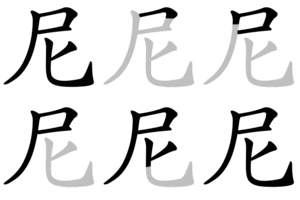 | |||
Han character
尼 (radical 44, 尸+2, 5 strokes, cangjie input 尸心 (SP), four-corner 77211, composition ⿸尸匕)
References
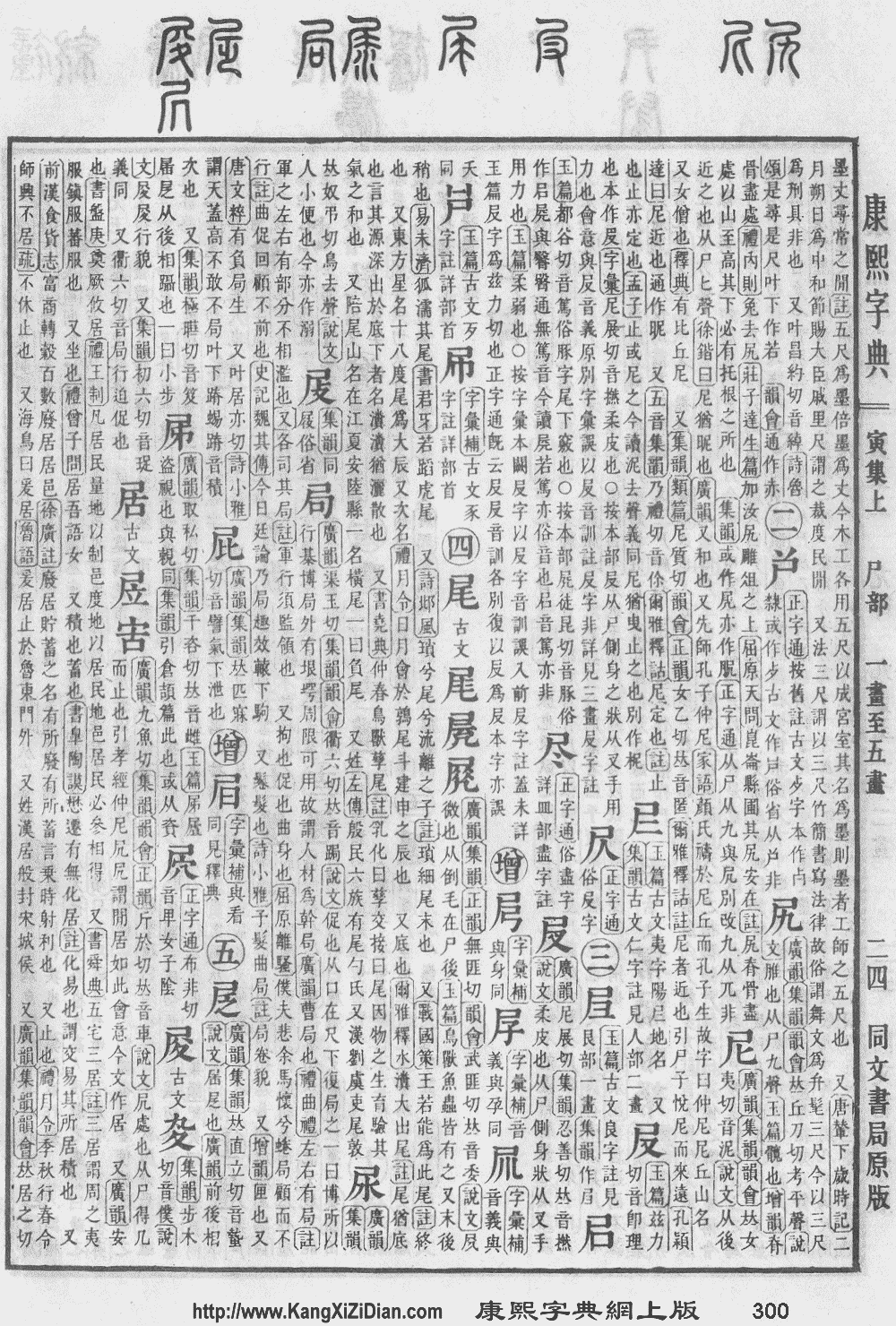
- KangXi: page 300, character 3
- Dai Kanwa Jiten: character 7635
- Dae Jaweon: page 596, character 1
- Hanyu Da Zidian: volume 2, page 965, character 4
- Unihan data for U+5C3C
Chinese
Glyph origin
| Historical forms of the character 尼 | |
|---|---|
| Shuowen Jiezi (compiled in Han) | Liushutong (compiled in Ming) |
| Small seal script | Transcribed ancient scripts |
 |
 |
| Characters in the same phonetic series (尼) (Zhengzhang, 2003) | |
|---|---|
| Old Chinese | |
| 泥 | *niːl, *niːls |
| 屔 | *niːl |
| 苨 | *niːlʔ |
| 坭 | *niːlʔ |
| 迡 | *niːls |
| 埿 | *braːms, *niːl, *niːls |
| 旎 | *nilʔ |
| 狔 | *nilʔ |
| 抳 | *nilʔ |
| 尼 | *nil |
| 呢 | *nil |
| 怩 | *nil |
| 柅 | *nil, *nilʔ |
| 蚭 | *nil |
| 跜 | *nil |
| 秜 | *nil |
| 痆 | *rniːd |
| 昵 | *niɡ |
Ideogrammic compound (會意) . The character does not appear as an independent character in the oracle bone script but appears as a component of 𢓚 and 秜. The character shows a man (尸) sitting on or leaning on another man (匕), giving the original meaning of “to stop” or “close; intimate”; the derivative 昵 refers to the latter meaning.
Etymology 1
| simp. and trad. |
尼 | |
|---|---|---|
Clipping of 比丘尼, from Sanskrit भिक्षुणी (bhikṣuṇī, “female beggar”) or Pali bhikkhunī (“female beggar”). Compare Sanskrit भिक्षु (bhikṣu, “beggar”).
Pronunciation
Definitions
尼
Etymology 2
| simp. and trad. |
尼 | |
|---|---|---|
Unknown. Possibly a variant of 邇 (OC *njelʔ, “near”) (compare Mandarin 你 (nǐ) from 爾 (OC *njelʔ)), or a conflation of 邇 (OC *njelʔ, “near”) and 昵 (OC *niɡ) (Schuessler, 2007).
Pronunciation
Definitions
尼
Etymology 3
| simp. and trad. |
尼 | |
|---|---|---|
Pronunciation
Definitions
尼
- A surname.
Etymology 4
| simp. and trad. |
尼 | |
|---|---|---|
Pronunciation
Definitions
尼
Etymology 5
| simp. and trad. |
尼 | |
|---|---|---|
| alt. forms | 乃 倷 | |
Pronunciation
Definitions
尼
- (Taishanese) a few; a little bit; some
- (Taishanese) the; those
- (Taishanese) more; -er
Synonyms
| Dialectal synonyms of 些 (“some, a few”) [map] | ||
|---|---|---|
| Variety | Location | Words |
| Formal (Written Standard Chinese) | 些 | |
| Mandarin | Beijing | 些 |
| Cantonese | Guangzhou | 啲 |
| Hong Kong | 啲 | |
| Taishan | 尼 | |
| Hakka | Miaoli (N. Sixian) | 兜 |
| Liudui (S. Sixian) | 兜 | |
| Hsinchu (Hailu) | 兜 | |
| Dongshi (Dabu) | 兜 | |
| Zhuolan (Raoping) | 兜 | |
| Wu | Wenzhou | 厘兒 |
Etymology 6
| simp. and trad. |
尼 | |
|---|---|---|
Pronunciation
Definitions
尼
- (Leizhou Min) Prefix in non-face-to-face kinship terms.
Compounds
|
Japanese
Kanji
- This term needs a translation to English. Please help out and add a translation, then remove the text
{{rfdef}}.
Readings
Compounds
Noun
Korean
Hanja
- This term needs a translation to English. Please help out and add a translation, then remove the text
{{rfdef}}.