car
English
Pronunciation
Etymology 1
From Middle English carre, a borrowing from Anglo-Norman carre (from Old Northern French, compare Old French char), from Latin carra, neuter plural of carrus (“four-wheeled baggage wagon”), from Gaulish *karros, from Proto-Celtic *karros (“wagon”), from Proto-Indo-European *ḱr̥sós, zero-grade form of *ḱers- (“to run”).
Noun
car (plural cars)
- A wheeled vehicle that moves independently, with at least three wheels, powered mechanically, steered by a driver and mostly for personal transportation; a motorcar or automobile.
- She drove her car to the mall.
- 2006, Edwin Black, chapter 1, in Internal Combustion:
- If successful, Edison and Ford—in 1914—would move society away from the ever more expensive and then universally known killing hazards of gasoline cars: […] .
- (dated) A wheeled vehicle, drawn by a horse or other animal; a chariot.
- 1594, Christopher Marlowe, Edward II, London: William Jones,
- It shall suffice me to enioy your loue,
- Which whiles I haue, I thinke my selfe as great,
- As Caesar riding in the Romaine streete,
- With captiue kings at his triumphant Carre.
- c. 1606, William Shakespeare, Antony and Cleopatra, Act IV, Scene 8,
- He has deserved it [armour], were it carbuncled
- Like holy Phoebus’ car.
- 1594, Christopher Marlowe, Edward II, London: William Jones,
- (rail transport, chiefly Canada, US) An unpowered unit in a railroad train.
- The conductor coupled the cars to the locomotive.
- (rail transport) an individual vehicle, powered or unpowered, in a multiple unit.
- The 11:10 to London was operated by a 4-car diesel multiple unit.
- (rail transport) A passenger-carrying unit in a subway or elevated train, whether powered or not.
- From the frontmost car of the subway, he filmed the progress through the tunnel.
- A rough unit of quantity approximating the amount which would fill a railroad car.
- We ordered five hundred cars of gypsum.
- The moving, load-carrying component of an elevator or other cable-drawn transport mechanism.
- Fix the car of the express elevator - the door is sticking.
- The passenger-carrying portion of certain amusement park rides, such as Ferris wheels.
- The most exciting part of riding a Ferris wheel is when your car goes over the top.
- The part of an airship, such as a balloon or dirigible, which houses the passengers and control apparatus.
- 1850, John Wise, A System of Aeronautics, page 152:
- Everything being apparently in readiness now, I stepped into the car of the balloon, […]
-
- (sailing) A sliding fitting that runs along a track.
- (uncountable, US) The aggregate of desirable characteristics of a car.
- Buy now! You can get more car for your money.
- (US) A floating perforated box for living fish.
Synonyms
- (private vehicle that moves independently): auto, motorcar, vehicle; automobile (US), motor (British colloquial), carriage (obsolete)
- (non-powered part of a train): railcar, wagon
- (unit of quantity): carload, wagonload
- (passenger-carrying light rail unit): carriage
- (part of an airship): gondola, basket (balloons only)
- See also Thesaurus:automobile
Derived terms
Related terms
Translations
|
|
|
|
- The translations below need to be checked and inserted above into the appropriate translation tables, removing any numbers. Numbers do not necessarily match those in definitions. See instructions at Wiktionary:Entry layout#Translations.
|
See also
Etymology 2
Etymology unclear, but probably from Proto-Germanic *karzijaną (“to turn”), from Proto-Indo-European *gers- (“to bend, turn”). See also cair (“to turn, go”), char (“a turn; a task (a turn of work); to turn; to cause to turn”), Dutch keren (“to turn, change direction”) and German Kehre (“a turn, change of direction; a U-turn, bend”). Shakespeare had something of a fondness for verbalizing nouns, and sometimes even substantivizing verbs. However, anything other than a "turn" does not seem to make any sense within the broader context of the cited Sonnet.
Noun
car (plural cars)
- (obsolete) A turn.
- 1609 William Shakespeare, Sonnet 7,
- But when from highmost pitch, with weary car,
- Like feeble age, he reeleth from the day, (after the sun reaches the zenith it, with a weary turn, begins to reel (“to roll”) (downwards))
- 1609 William Shakespeare, Sonnet 7,
Etymology 3
Acronym of contents of the address part of register number. Note that it was based on original hardware and has no meaning today.
Noun

car (plural cars)
- (computing) The first part of a cons in LISP. The first element of a list
- Matt Kaufmann, Panagiotis Manolios, and J Strother Moore, Computer-aided reasoning: an approach, 2000 :
- The elements of a list are the successive cars along the "cdr chain." That is, the elements are the car, the car of the cdr, the car of the cdr of the cdr, etc.
- Matt Kaufmann, Panagiotis Manolios, and J Strother Moore, Computer-aided reasoning: an approach, 2000 :
Antonyms
Derived terms
Related terms
Gallery
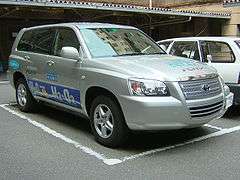 A hydrogen-powered car.
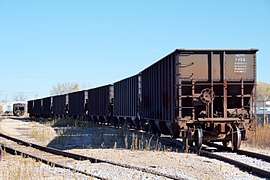 Freight cars.
 A self-propelled passenger car.
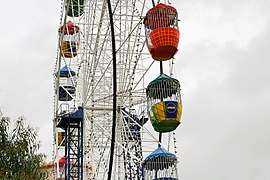 Ferris wheel cars.
.jpg) Car on a sailboat.
Car on a sailboat.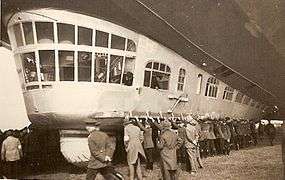 Car of a Zeppelin.
 Elevator cars.
Anagrams
Aromanian
Alternative forms
Etymology
From Latin carrus, from Gaulish karros. Compare Romanian car.
Noun
car n (plural cari)
Related terms
Catalan
Etymology
Pronunciation
Adjective
car (feminine cara, masculine plural cars, feminine plural cares)
Czech
Etymology
From Old Church Slavonic цѣсарь (cěsarĭ), from Ancient Greek Καῖσαρ (Kaîsar), from Latin Caesar.
Pronunciation
- IPA(key): /tsar/
- Rhymes: -ar
Noun
car m
Derived terms
Further reading
- car in Příruční slovník jazyka českého, 1935–1957
- car in Slovník spisovného jazyka českého, 1960–1971, 1989
French
Pronunciation
- IPA(key): /kaʁ/
audio (file) - Rhymes: -aʁ
Etymology 1
From Old French quer (“as, since, because, for”), from Latin quārē (“how; why”).
Conjunction
car
- as, since, because, for
- J’ai ouvert mon parapluie car il pleuvait.
- I opened my umbrella because it was raining.
Synonyms
- parce que (in some contexts)
Etymology 2
Borrowed from English car, itself borrowed from Anglo-Norman and the Old Northern French car, variant of Old French char. Doublet of char.
Noun
car m (plural cars)
Synonyms
Anagrams
Further reading
- “car” in le Trésor de la langue française informatisé (The Digitized Treasury of the French Language).
Interlingua
Adjective
car (comparative plus car, superlative le plus car)
Irish
Etymology
From Old Irish caraid, from Proto-Celtic *kareti (“to love”), from Proto-Indo-European *keh₂- (“to desire, wish”).
Pronunciation
- IPA(key): /karˠ/
Verb
car (present analytic carann, future analytic carfaidh, verbal noun carthain, past participle cartha)
Conjugation
| singular | plural | relative | autonomous | ||||||
|---|---|---|---|---|---|---|---|---|---|
| first | second | third | first | second | third | ||||
| indicative | present | caraim | carann tú; carair† |
carann sé, sí | caraimid | carann sibh | carann siad; caraid† |
a charann; a charas / a gcarann*; a gcaras* |
cartar |
| past | char mé; charas | char tú; charais | char sé, sí | charamar; char muid | char sibh; charabhair | char siad; charadar | a char / ar char* |
caradh | |
| past habitual | charainn | chartá | charadh sé, sí | charaimis; charadh muid | charadh sibh | charaidís; charadh siad | a charadh / ar charadh* |
chartaí | |
| future | carfaidh mé; carfad |
carfaidh tú; carfair† |
carfaidh sé, sí | carfaimid; carfaidh muid |
carfaidh sibh | carfaidh siad; carfaid† |
a charfaidh; a charfas / a gcarfaidh*; a gcarfas* |
carfar | |
| conditional | charfainn | charfá | charfadh sé, sí | charfaimis; charfadh muid | charfadh sibh | charfaidís; charfadh siad | a charfadh / ar charfadh* |
charfaí | |
| subjunctive | present | go gcara mé; go gcarad† |
go gcara tú; go gcarair† |
go gcara sé, sí | go gcaraimid; go gcara muid |
go gcara sibh | go gcara siad; go gcaraid† |
— | go gcartar |
| past | dá gcarainn | dá gcartá | dá gcaradh sé, sí | dá gcaraimis; dá gcaradh muid |
dá gcaradh sibh | dá gcaraidís; dá gcaradh siad |
— | dá gcartaí | |
| imperative | caraim | car | caradh sé, sí | caraimis | caraigí; caraidh† |
caraidís | — | cartar | |
| verbal noun | carthain | ||||||||
| past participle | cartha | ||||||||
* Indirect relative
† Archaic or dialect form
Mutation
| Irish mutation | ||
|---|---|---|
| Radical | Lenition | Eclipsis |
| car | char | gcar |
| Note: Some of these forms may be hypothetical. Not every possible mutated form of every word actually occurs. | ||
Synonyms
Middle French
Conjunction
car
- for (because)
Descendants
- French: car
Occitan
Etymology
Adjective
car m (feminine singular cara, masculine plural cars, feminine plural caras)
Polish
Etymology
From Old Church Slavonic цѣсарь (cěsarĭ), from Ancient Greek Καῖσαρ (Kaîsar), from Latin Caesar.
Pronunciation
- IPA(key): /t͡sar/
audio (file)
Noun
car m pers
Declension
Derived terms
- caryca
- carewicz
- carówna
Romanian
Etymology 1
From Latin carrus, from Gaulish karros.
Noun
car n (plural care)
Declension
Related terms
Etymology 2
Alternative forms
- cariu (dated)
Noun
car m (plural cari)
Declension
Scottish Gaelic
Noun
car m (genitive singular cuir, plural caran)
Derived terms
Adverb
car
- somewhat, quite, rather
- Tha thu car fadalach. ― You're somewhat late.
- Thig an stòiridh gu ceann car obann. ― The story came to an end somewhat abruptly.
Related terms
Serbo-Croatian
Etymology
From Proto-Slavic *cěsarь, *cьsarь, from Gothic 𐌺𐌰𐌹𐍃𐌰𐍂 (kaisar), from Latin Caesar.
Pronunciation
- IPA(key): /tsâr/
Noun
cȁr m (Cyrillic spelling ца̏р)
Declension
Derived terms
Slovene
Etymology
From Serbo-Croatian cȁr, from Proto-Slavic *cьsarь, from Gothic 𐌺𐌰𐌹𐍃𐌰𐍂 (kaisar), from Latin Caesar.
Pronunciation
- IPA(key): /ˈtsàːr/, /ˈtsáːr/
- Tonal orthography: cár, cȃr
Noun
cár m anim (genitive cárja, nominative plural cárji, feminine caríca or cárinja)
Declension
| singular | dual | plural | |
|---|---|---|---|
| nominative | cár | cárja | cárji |
| accusative | cár | cárja | cárje |
| genitive | cárja | cárjev | cárjev |
| dative | cárju | cárjema | cárjem |
| locative | cárju | cárjih | cárjih |
| instrumental | cárjem | cárjema | cárji |
See also
Spanish
Etymology
Adverb
car
- (archaic) why
Volapük
Pronunciation
- IPA(key): [tʃar]
Noun
car (plural cars)
- (weapon) bow
Declension
Welsh
Etymology
From Middle Welsh carr, from Proto-Brythonic *karr, from Proto-Celtic *karros.
Pronunciation
- IPA(key): /kar/
Noun
car m (plural ceir)
Mutation
| Welsh mutation | |||
|---|---|---|---|
| radical | soft | nasal | aspirate |
| car | gar | nghar | char |
| Note: Some of these forms may be hypothetical. Not every possible mutated form of every word actually occurs. | |||