eclipsis
See also: eklipsis
English
Etymology
Borrowed from Ancient Greek ἔκλειψις (ékleipsis, “disappearance, abandoning”).
Pronunciation
- IPA(key): /ɪˈklɪpsɪs/
Noun
eclipsis (countable and uncountable, plural eclipses)
- (obsolete) An omission of words needed to fully express the sense of a phrase
- A line or dash used to show that text has been omitted
- (Irish grammar) A mutation of the initial sound of a word by which voiceless sounds become voiced, voiced stops become nasal consonants, and vowels acquire a prothetic nasal consonant: see Appendix:Irish mutations#Eclipsis.
Synonyms
- (mutation in Irish grammar): nasalization
Translations
Mutation in Irish grammar
|
References
- Oxford English Dictionary, 1884–1928, and First Supplement, 1933
Catalan
Verb
eclipsis
- second-person singular present subjunctive form of eclipsar
Latin
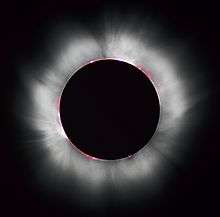
eclīpsis (an eclipse)
Etymology
From Ancient Greek ἔκλειψις (ékleipsis, “absence, abandoning”).
Pronunciation
- (Classical) IPA(key): /eˈkliːp.sis/
Noun
eclīpsis f (genitive eclīpsis); third declension
Inflection
Third declension i-stem.
| Case | Singular | Plural |
|---|---|---|
| nominative | eclīpsis | eclīpsēs |
| genitive | eclīpsis | eclīpsium |
| dative | eclīpsī | eclīpsibus |
| accusative | eclīpsem | eclīpsēs |
| ablative | eclīpse | eclīpsibus |
| vocative | eclīpsis | eclīpsēs |
Related terms
Descendants
References
- eclipsis in Charlton T. Lewis and Charles Short (1879) A Latin Dictionary, Oxford: Clarendon Press
This article is issued from
Wiktionary.
The text is licensed under Creative Commons - Attribution - Sharealike.
Additional terms may apply for the media files.