ape
English
Pronunciation
- enPR: āp, IPA(key): /eɪp/
Audio (US) (file) - Rhymes: -eɪp
Etymology 1
From Middle English ape, from Old English apa (“ape, monkey”), from Proto-Germanic *apô (“monkey, ape”), possibly derived from Proto-Indo-European *h₂ep- (“water”), compare Proto-Celtic *abū (“river”), if the word originally referred to a "water sprite". Traditionally assumed to be an ancient loanword instead, ultimately probably from an unidentified non-Indo-European language of regions in Africa or Asia where monkeys are native. Cognate with Scots aip (“ape”), West Frisian aap (“ape”), Dutch aap (“monkey, ape”), Low German Ape (“ape”), German Affe (“monkey, ape”), Swedish apa (“monkey, ape”), Icelandic api (“ape”).
Noun
ape (plural apes)
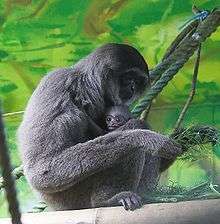
- A primate of the clade Hominoidea, generally larger than monkeys and distinguished from them by having no tail.
- Any such primate other than a human.
- (derogatory) An uncivilised person.
- One who apes; a foolish imitator.
Hyponyms
- See also Thesaurus:ape
Derived terms
Translations
|
|
Verb
ape (third-person singular simple present apes, present participle aping, simple past and past participle aped)
- (intransitive) To behave like an ape.
- (transitive) To imitate or mimic, particularly to imitate poorly.
- 1961, J. A. Philip, "Mimesis in the Sophistês of Plato," Transactions and Proceedings of the American Philological Association, vol. 92, p. 454,
- It is not conceived as a mere “aping” in externals nor as an enacting in the sense of assuming a foreign role.
- 1961, J. A. Philip, "Mimesis in the Sophistês of Plato," Transactions and Proceedings of the American Philological Association, vol. 92, p. 454,
Derived terms
Translations
|
|
|
|
Etymology 2
Clipping of apeshit.
Adjective
ape (not comparable)
See also
Anagrams
Afrikaans
Noun
ape
- plural of aap
Corsican
Noun
ape
- plural of apa
Finnish
(index ap)
Etymology
Noun
ape
Declension
| Inflection of ape (Kotus type 48/hame, pp-p gradation) | |||
|---|---|---|---|
| nominative | ape | appeet | |
| genitive | appeen | appeiden appeitten | |
| partitive | apetta | appeita | |
| illative | appeeseen | appeisiin appeihin | |
| singular | plural | ||
| nominative | ape | appeet | |
| accusative | nom. | ape | appeet |
| gen. | appeen | ||
| genitive | appeen | appeiden appeitten | |
| partitive | apetta | appeita | |
| inessive | appeessa | appeissa | |
| elative | appeesta | appeista | |
| illative | appeeseen | appeisiin appeihin | |
| adessive | appeella | appeilla | |
| ablative | appeelta | appeilta | |
| allative | appeelle | appeille | |
| essive | appeena | appeina | |
| translative | appeeksi | appeiksi | |
| instructive | — | appein | |
| abessive | appeetta | appeitta | |
| comitative | — | appeineen | |
Interlingua
Noun
ape (plural apes)
Related terms
Italian
Etymology
From Latin apis, apem.
Pronunciation
- IPA(key): [ˈaːpe]
Audio (file)
Noun
ape f (plural api)
Synonyms
- (2) ape da miele, ape domestica
Related terms
Latin
Verb
ape
- second-person singular present active imperative of apō
References
- ape in Charlton T. Lewis and Charles Short (1879) A Latin Dictionary, Oxford: Clarendon Press
Neapolitan
Noun
ape
- plural of apa
Norwegian Bokmål
Pronunciation
- IPA(key): /aːpe/
Etymology 1
Noun
ape f, m (definite singular apa or apen, indefinite plural aper, definite plural apene)
Related terms
Etymology 2
Verb
ape (imperative ap, present tense aper, passive apes, simple past apa or apet or apte, past participle apa or apet or apt, present participle apende)
References
- “ape” in The Bokmål Dictionary.
Norwegian Nynorsk
Etymology 1
Noun
ape m (definite singular apen, indefinite plural apar, definite plural apane)
ape f (definite singular apa, indefinite plural aper, definite plural apene)
Related terms
Etymology 2
Alternative forms
Verb
ape (present tense apar or aper, past tense apa or apte, past participle apa or apt, passive infinitive apast, present participle apande, imperative ap)
References
- “ape” in The Nynorsk Dictionary.
Romanian
Pronunciation
- IPA(key): [ˈape]
Noun
ape f pl
- plural of apă