stomach
English
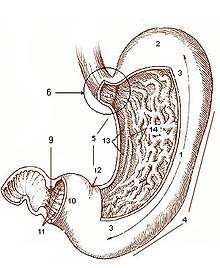
Stomach (with mucosal surface partly exposed)
Alternative forms
- stomack
- stumic
Etymology
From Middle English stomak, from Old French estomac, from Latin stomachus, from Ancient Greek στόμαχος (stómakhos), from στόμα (stóma, “mouth”). Displaced native Middle English mawe (“stomach, maw”) (from Old English maga), Middle English bouk, buc (“belly, stomach”) (from Old English buc (“belly, stomach”), see bucket).
Pronunciation
- IPA(key): /ˈstʌmək/
Audio (US) (file)
Noun
stomach (plural stomachs)
- An organ in animals that stores food in the process of digestion.
- (informal) The belly.
- (obsolete) Pride, haughtiness.
- 1590, Edmund Spenser, The Faerie Queene, II.vii:
- Sterne was his looke, and full of stomacke vaine, / His portaunce terrible, and stature tall […].
- 1613, William Shakespeare, The Life of King Henry the Eighth, IV. ii. 34:
- He was a man / Of an unbounded stomach, ever ranking / Himself with princes;
- John Locke
- This sort of crying proceeding from pride, obstinacy, and stomach, the will, where the fault lies, must be bent.
- 1590, Edmund Spenser, The Faerie Queene, II.vii:
- (obsolete) Appetite.
- a good stomach for roast beef
- 1591, William Shakespeare, The Comedy of Errors, I. ii. 50:
- You come not home because you have no stomach. / You have no stomach, having broke your fast.
- 1595, George Peele, The Old Wives’ Tale, The Malone Society Reprints, 1908, lines 920-922,
- HOST. How say you sir, doo you please to sit downe?
- EUMENIDES. Hostes I thanke you, I haue no great stomack.
- 1621, Democritus Junior [pseudonym; Robert Burton], The Anatomy of Melancholy, Oxford: Printed by Iohn Lichfield and Iames Short, for Henry Cripps, OCLC 216894069; The Anatomy of Melancholy: […], 2nd corrected and augmented edition, Oxford: Printed by John Lichfield and James Short, for Henry Cripps, 1624, OCLC 54573970, (please specify |partition=1, 2, or 3):, II.ii.1.2:
- If after seven hours' tarrying he shall have no stomach, let him defer his meal, or eat very little at his ordinary time of repast.
- (figuratively) Desire, appetite (for something abstract).
- I have no stomach for a fight today.
- 1591, William Shakespeare, The Life of Henry the Fifth, IV. iii. 36:
- That he which hath no stomach to this fight, / Let him depart:
Synonyms
Derived terms
Terms derived from stomach
Related terms
Translations
digestive organ
|
|
belly
|
|
pride, haughtiness — see haughtiness
appetite — see appetite
figuratively: desire, appetite — see appetite
Verb
stomach (third-person singular simple present stomachs, present participle stomaching, simple past and past participle stomached)
- (transitive) To tolerate (something), emotionally, physically, or mentally; to stand or handle something.
- I really can’t stomach jobs involving that much paperwork, but some people seem to tolerate them.
- I can't stomach her cooking.
- (obsolete, intransitive) To be angry.
- (Can we find and add a quotation of Hooker to this entry?)
- (obsolete, transitive) To resent; to remember with anger; to dislike.
- 1607, William Shakespeare, The Tragedy of Antony and Cleopatra, III. iv. 12:
- O, my good lord, / Believe not all; or, if you must believe, / Stomach not all.
- L'Estrange
- The lion began to show his teeth, and to stomach the affront.
- Milton
- The Parliament sit in that body […] to be his counsellors and dictators, though he stomach it.
- 1607, William Shakespeare, The Tragedy of Antony and Cleopatra, III. iv. 12:
Derived terms
Translations
Anagrams
This article is issued from
Wiktionary.
The text is licensed under Creative Commons - Attribution - Sharealike.
Additional terms may apply for the media files.