pollen
English
Etymology
From Latin pollen (“fine flour”). (Used by Linnaeus in the 18th century to describe the spores produced in the anthers of flowers.)
Pronunciation
- (Received Pronunciation) IPA(key): /ˈpɒlən/
- (General American) IPA(key): /ˈpɑlən/
Audio (US) (file) - Rhymes: -ɒlən
- Hyphenation: pol‧len
Noun
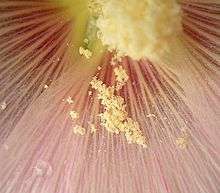
Pollen grains on a flower.
pollen (usually uncountable, plural pollens)
- Fine powder in general, fine flour (16th century usage documented by the OED; no longer common.)
- "...and ther was good wyne of Gascoyne,... as well of pollen, as of other vitailes..." Froissart, Jean, 1338?-1410?; Berners, John Bourchier, Lord
- (Can we find and add a quotation of Bailey to this entry?)
- A fine granular substance produced in flowers. Technically a collective term for pollen grains (microspores) produced in the anthers of flowering plants. (This specific usage dating from mid 18th century.)
- 2013 May-June, Katrina G. Claw, “Rapid Evolution in Eggs and Sperm”, in American Scientist, volume 101, number 3:
- In plants, the ability to recognize self from nonself plays an important role in fertilization, because self-fertilization will result in less diverse offspring than fertilization with pollen from another individual.
-
Derived terms
Derived terms
- pollen analysis
- pollenarious
- pollen basket
- pollen count
- pollen counter
- pollen grain
- polleniferous
- pollenize, pollenise
- pollenlike
- pollen mother cell
- pollen parent
- pollen sac
- pollen tube
- polleny
- pollination
Related terms
Translations
fine granular substance produced in flowers
|
|
See also
Danish
Etymology
Noun
pollen n (singular definite pollenet, plural indefinite pollen)
References
- “pollen” in Den Danske Ordbog
Dutch
Pronunciation
- IPA(key): /pɔlə(n)/
- Hyphenation: pol‧len
Etymology 1
Noun
pollen n (uncountable)
Etymology 2
Verb
pollen
Inflection
| Inflection of pollen (weak) | ||||
|---|---|---|---|---|
| infinitive | pollen | |||
| past singular | pollde | |||
| past participle | gepolld | |||
| infinitive | pollen | |||
| gerund | pollen n | |||
| verbal noun | — | |||
| present tense | past tense | |||
| 1st person singular | poll | pollde | ||
| 2nd person sing. (jij) | pollt | pollde | ||
| 2nd person sing. (u) | pollt | pollde | ||
| 2nd person sing. (gij) | pollt | pollde | ||
| 3rd person singular | pollt | pollde | ||
| plural | pollen | pollden | ||
| subjunctive sing.1 | polle | pollde | ||
| subjunctive plur.1 | pollen | pollden | ||
| imperative sing. | poll | |||
| imperative plur.1 | pollt | |||
| participles | pollend | gepolld | ||
| 1) Archaic. | ||||
Etymology 3
Noun
pollen
- Plural form of pol
French
Pronunciation
- IPA(key): /pɔ.lɛn/
Audio (file)
Noun
pollen m (plural pollens)
See also
- palynologie
- palynologique
- palynologue
- pollinique
- polliniser
- pollinisateur
Further reading
- “pollen” in le Trésor de la langue française informatisé (The Digitized Treasury of the French Language).
German
Verb
pollen (third-person singular simple present pollt, past tense pollte, past participle gepollt, auxiliary haben)
Conjugation
Conjugation of pollen
| infinitive | pollen | ||||
|---|---|---|---|---|---|
| present participle | pollend | ||||
| past participle | gepollt | ||||
| auxiliary | haben | ||||
| indicative | subjunctive | ||||
| present | ich polle | wir pollen | i | ich polle | wir pollen |
| du pollst | ihr pollt | du pollest | ihr pollet | ||
| er pollt | sie pollen | er polle | sie pollen | ||
| preterite | ich pollte | wir pollten | ii | ich pollte | wir pollten |
| du polltest | ihr polltet | du polltest | ihr polltet | ||
| er pollte | sie pollten | er pollte | sie pollten | ||
| imperative | poll (du) polle (du) |
pollt (ihr) | |||
Composed forms of pollen
| perfect | |||||
|---|---|---|---|---|---|
| indicative | ich habe gepollt | wir haben gepollt | subjunctive | ich habe gepollt | wir haben gepollt |
| du hast gepollt | ihr habt gepollt | du habest gepollt | ihr habet gepollt | ||
| er hat gepollt | sie haben gepollt | er habe gepollt | sie haben gepollt | ||
| pluperfect | |||||
| indicative | ich hatte gepollt | wir hatten gepollt | subjunctive | ich hätte gepollt | wir hätten gepollt |
| du hattest gepollt | ihr hattet gepollt | du hättest gepollt | ihr hättet gepollt | ||
| er hatte gepollt | sie hatten gepollt | er hätte gepollt | sie hätten gepollt | ||
| future i | |||||
| infinitive | pollen werden | subjunctive i | ich werde pollen | wir werden pollen | |
| du werdest pollen | ihr werdet pollen | ||||
| er werde pollen | sie werden pollen | ||||
| indicative | ich werde pollen | wir werden pollen | subjunctive ii | ich würde pollen | wir würden pollen |
| du wirst pollen | ihr werdet pollen | du würdest pollen | ihr würdet pollen | ||
| er wird pollen | sie werden pollen | er würde pollen | sie würden pollen | ||
| future ii | |||||
| infinitive | gepollt haben werden | subjunctive i | ich werde gepollt haben | wir werden gepollt haben | |
| du werdest gepollt haben | ihr werdet gepollt haben | ||||
| er werde gepollt haben | sie werden gepollt haben | ||||
| indicative | ich werde gepollt haben | wir werden gepollt haben | subjunctive ii | ich würde gepollt haben | wir würden gepollt haben |
| du wirst gepollt haben | ihr werdet gepollt haben | du würdest gepollt haben | ihr würdet gepollt haben | ||
| er wird gepollt haben | sie werden gepollt haben | er würde gepollt haben | sie würden gepollt haben | ||
Latin
Alternative forms
Etymology
From Proto-Indo-European *pel- (“flour, dust”); compare with pulvis and Ancient Greek πάλη (pálē, “the finest meal”, “any fine dust”).
Pronunciation
- (Classical) IPA(key): /ˈpol.len/, [ˈpɔl.lẽ]
Noun
pollen n (genitive pollinis); third declension
- (literally) flour, especially fine flour, milldust
- (transferred sense) the (very) fine powder or dust of other things
Declension
Third declension neuter.
| Case | Singular | Plural |
|---|---|---|
| nominative | pollen | pollina |
| genitive | pollinis | pollinum |
| dative | pollinī | pollinibus |
| accusative | pollen | pollina |
| ablative | polline | pollinibus |
| vocative | pollen | pollina |
Synonyms
- (transferred sense: fine powder or dust): pulvis
Derived terms
- polenta
- pollināris (Classical)
- pollinārium (New Latin)
- pollinārius (Classical)
- pollinātus (Classical)
- pollinicus (post-Classical)
- pollinium (New Latin)
- pollinivorus (New Latin)
- pollinōdium (New Latin)
- pollinoīdēs (New Latin)
- pollinōsus (New Latin)
References
- pollen in Charlton T. Lewis and Charles Short (1879) A Latin Dictionary, Oxford: Clarendon Press
- pollen in Charlton T. Lewis (1891) An Elementary Latin Dictionary, New York: Harper & Brothers
- pollĕn in Gaffiot, Félix (1934) Dictionnaire Illustré Latin-Français, Hachette, page 1,195/1
Norwegian Bokmål
Etymology
Noun
pollen n (definite singular pollenet)
Related terms
References
- “pollen” in The Bokmål Dictionary.
Norwegian Nynorsk
Etymology
Noun
pollen n (definite singular pollenet)
Related terms
References
- “pollen” in The Nynorsk Dictionary.
Swedish
Noun
pollen n (uncountable)
Declension
| Declension of pollen | ||||
|---|---|---|---|---|
| Uncountable | ||||
| Indefinite | Definite | |||
| Nominative | pollen | pollenet | — | — |
| Genitive | pollens | pollenets | — | — |
This article is issued from
Wiktionary.
The text is licensed under Creative Commons - Attribution - Sharealike.
Additional terms may apply for the media files.