無
| ||||||||
 | ||||||||
Translingual
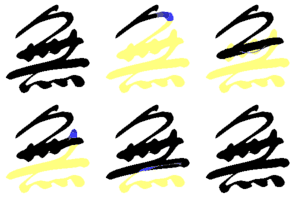
| Stroke order (cursive) | |||
|---|---|---|---|
 | |||

Han character
無 (radical 86, 火+8, 12 strokes, cangjie input 人廿火 (OTF), four-corner 80331, composition ⿱⿳𠂉卌一灬)
Derived characters
References
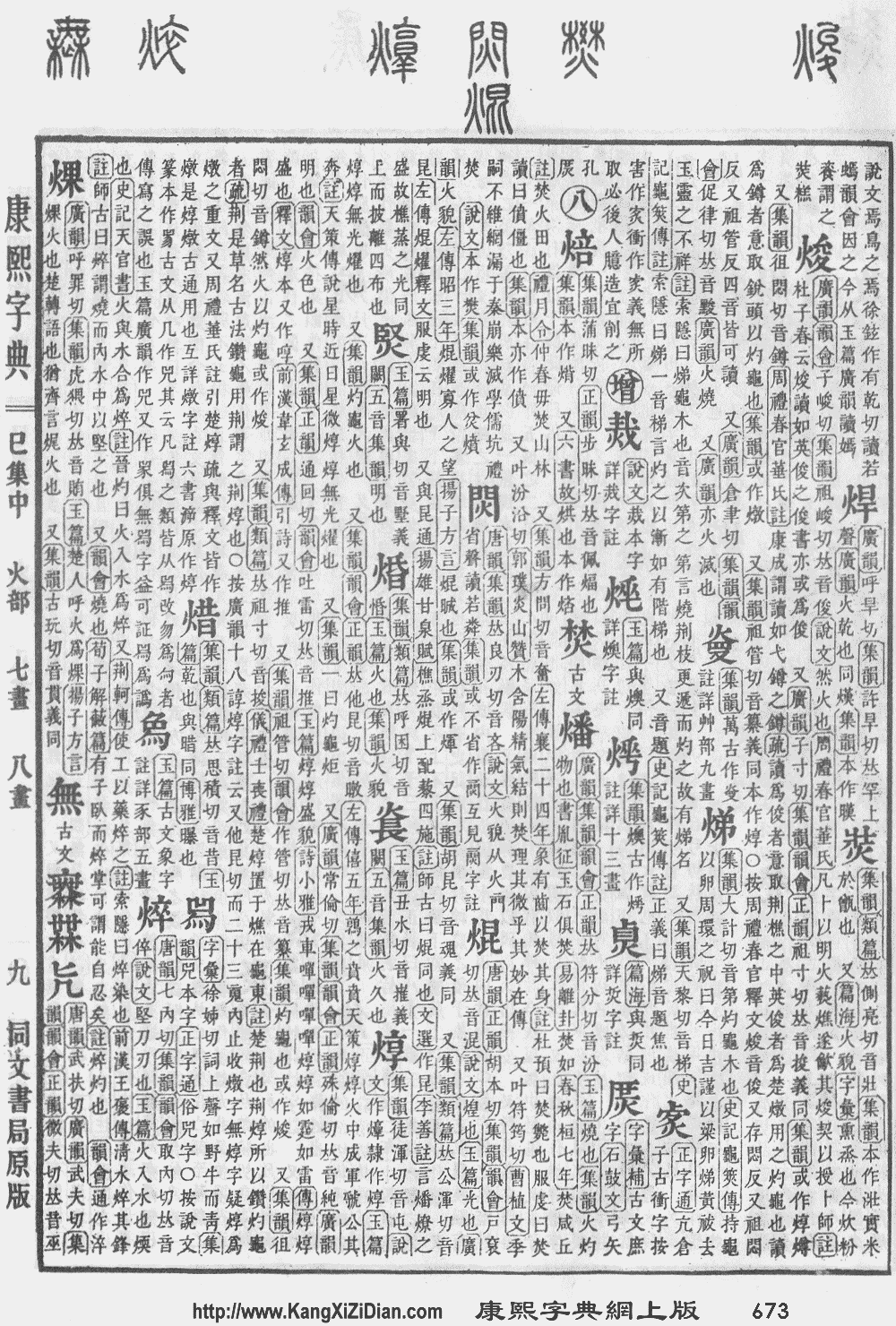
- KangXi: page 673, character 26
- Dai Kanwa Jiten: character 19113
- Dae Jaweon: page 1081, character 24
- Hanyu Da Zidian: volume 3, page 2211, character 15
- Unihan data for U+7121
Chinese
| trad. | 無 | |
|---|---|---|
| simp. | 无 | |
| alt. forms | 橆 | |
Glyph origin
| Historical forms of the character 無 | |||||
|---|---|---|---|---|---|
| Shang | Western Zhou | Warring States | Shuowen Jiezi (compiled in Han) | Liushutong (compiled in Ming) | |
| Oracle bone script | Bronze inscriptions | Chu Slip and silk script | Qin slip script | Small seal script | Transcribed ancient scripts |
 |
 |
 |
 |
 |
 |
| Characters in the same phonetic series (無) (Zhengzhang, 2003) | |
|---|---|
| Old Chinese | |
| 墲 | *m̥ʰaː, *maː, *ma |
| 橅 | *maː |
| 膴 | *hmaː, *ma, *maʔ |
| 幠 | *hmaː |
| 鄦 | *hmaʔ |
| 撫 | *m̥ʰaʔ |
| 無 | *ma |
| 瞴 | *ma, *maʔ |
| 蕪 | *ma |
| 璑 | *ma |
| 鷡 | *ma |
| 譕 | *ma |
| 憮 | *ma, *maʔ |
| 舞 | *maʔ |
| 廡 | *maʔ |
| 嫵 | *maʔ |
| 甒 | *maʔ |
| 潕 | *maʔ |
| 儛 | *maʔ |
Pictogram (象形) . A man with something long held in both hands. Dancing.
This character is borrowed for “have no”, and the character 舞 is used for the original sense.
Etymology 1
Core Sino–Tibetan. From Proto-Sino-Tibetan *ma (“no, not”); cognate with Tibetan མ (ma, “not”) and Burmese မ (ma., “not”).
Cognate with:
- 微 (OC *mɯl, “not, no”)
- 毋 (OC *ma, “do not”)
- 勿 (OC *mɯd, “not, don't”)
- 未 (OC *mɯds, “not yet, haven't”)
- 靡 (OC *mralʔ, “not, no”)
- 亡 (OC *maŋ, “not have; to flee, to disappear, to die”)
- 沒 (OC *mɯːd, “to end, to disappear, to drown”)
- 莫 (OC *maːɡ, “none, nobody, nothing; do not; can not”)
Attested profusely in Classical Chinese, this word is the prototypical negation particle in the *m- series of Chinese negatives. In the oracle bone script, however, 無 is not frequently used, and its homophone (or near-homophone) 毋 (OC *ma) is used instead.
See 不 (OC *pɯ, *pɯʔ, *pɯ', “not”) for more on negative particles in Old Chinese.
Pronunciation
Definitions
無
- (literary, Hakka or Min) to not have something; there is not ...
- (literary, Min) Negation particle preceding verbs and adjectives. not
- (literary, Min) have not
- (literary, Hakka or Min) Interrogative particle.
- (Hakka, Min) if not; otherwise (placed at the start of a sentence)
- † regardless of; no matter whether
- † nothing; nil
- 從無到有 / 从无到有 ― cóng wú dào yǒu ― start from nothing, from scratch
- † Alternative form of 毋 (wú, “do not”).
- without; -less; un-
Synonyms
| Dialectal synonyms of 沒有 (“to not have (+ noun)”) [map] | ||
|---|---|---|
| Variety | Location | Words |
| Classical Chinese | 無 | |
| Formal (Written Standard Chinese) | 沒有 | |
| Mandarin | Beijing | 沒有、沒 |
| Taiwan | 沒有、沒 | |
| Jinan | 沒有、沒 | |
| Xi'an | 沒有 | |
| Wuhan | 冇得 | |
| Chengdu | 沒得 | |
| Yangzhou | 不得、沒得 | |
| Hefei | 沒 | |
| Cantonese | Guangzhou | 冇、冇有 |
| Hong Kong | 冇 | |
| Taishan | 冇 | |
| Gan | Nanchang | 冒有 |
| Hakka | Meixian | 無 |
| Miaoli (N. Sixian) | 無 | |
| Liudui (S. Sixian) | 無 | |
| Hsinchu (Hailu) | 無 | |
| Dongshi (Dabu) | 無 | |
| Zhuolan (Raoping) | 無 | |
| Yunlin (Zhao'an) | 無 | |
| Jin | Taiyuan | 沒、沒啦 |
| Min Dong | Fuzhou | 無 |
| Min Nan | Xiamen | 無 |
| Quanzhou | 無 | |
| Zhangzhou | 無 | |
| Taipei | 無 | |
| Kaohsiung | 無 | |
| Tainan | 無 | |
| Taichung | 無 | |
| Hsinchu | 無 | |
| Lukang | 無 | |
| Sanxia | 無 | |
| Yilan | 無 | |
| Kinmen | 無 | |
| Magong | 無 | |
| Penang | 無 | |
| Singapore | 無 | |
| Philippines (Manila) | 無 | |
| Chaozhou | 無 | |
| Shantou | 無 | |
| Thailand (Bangkok) | 無 | |
| Wu | Shanghai | 嘸沒 |
| Suzhou | 嘸不 | |
| Wenzhou | 冇 | |
| Xiang | Changsha | 冇得、冇 |
| Shuangfeng | 冇得 | |
Compounds
|
|
|
Etymology 2
Pronunciation
Definitions
無
Compounds
Japanese
Kanji
Readings
Compounds
- 無明 (mumyō): unenlightment; ignorance of nirvana
- 神無月 (kannazuki): (archaic) the tenth month of the lunar calendar
- 無形 (mugyō): formlessness, bodylessness; something shapeless and invisible
- 無形 (mukei): intangibility; incorporeality
- 無見 (muken): the belief that everything in this world is completely null and void, with no substance
- 無名 (mumei): nameless, anonymous, unsigned; anonymity
- 無用 (muyō): futility; uselessness
- 無機 (muki): inorganic
- 無双 (musō): matchless, peerless
- 苦無 (kunai): a kunai
- 無月 (mugetsu): when the moon is not visible due to rain or some other reason
- 無精 (bushō): laziness
- 無力 (muryoku): powerless; incompetent
- 無力感 (muryokukan): a feeling of powerlessness
- 無意識 (muishiki): unconscious, unconsciousness
- 無限 (mugen): infinity; limitless; unlimited
- 無人 (bunin): uninhabited, unmanned
| Kanji in this term |
|---|
| 無 |
| む Grade: 4 |
| on’yomi |
Noun
- nothing, nothingness
- (Buddhism): The null set: neither yes nor no (in response to a koan or other question that mistakenly assumes an affirmative or negative answer).
Prefix
Korean
Hanja
無 • (mu) (hangeul 무, revised mu, McCune–Reischauer mu, Yale mu)
- 무 (mu, “nothing”)
- 무 (mu, “no”)
- (Buddhism) 무 (mu, “neither yes nor no”) (in response to a koan or a question that mistakenly assumes an affirmative or negative answer)
Vietnamese
Han character
- This term needs a translation to English. Please help out and add a translation, then remove the text
{{rfdef}}.