言
| ||||||||
Translingual
| Stroke order | |||
|---|---|---|---|
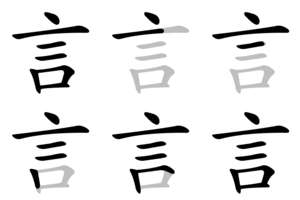 | |||
Alternative forms
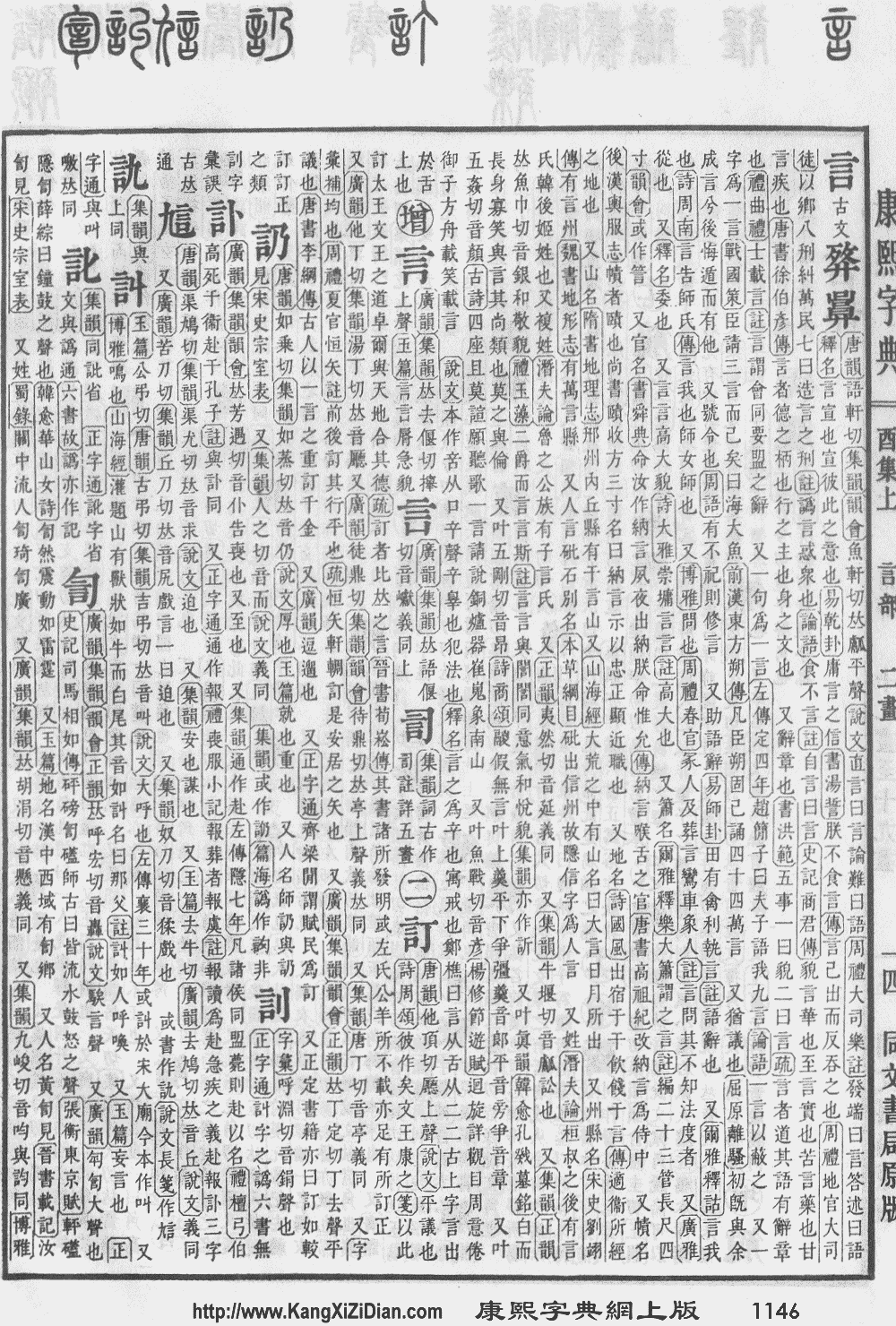
Note that in Japanese and Korean (printed forms), the 亠 component on top is written 二 (as found in the Kangxi dictionary). In traditional/simplified Chinese and Vietnamese, the top component is written 丶. In written Japanese, the top component may be written either 一, 丶 or 丨 (small vertical stroke).
Han character
言 (radical 149 言+0, 7 strokes, cangjie input 卜一一口 (YMMR), four-corner 00601, composition ⿳丶三口(GHTV) or ⿱亖口(JK))
- Kangxi radical #149, ⾔.
Derived characters
See also
References
- KangXi: page 1146, character 1
- Dai Kanwa Jiten: character 35205
- Dae Jaweon: page 1612, character 20
- Hanyu Da Zidian: volume 6, page 3936, character 1
- Unihan data for U+8A00
Chinese
| simp. and trad. |
言 | |
|---|---|---|
Glyph origin
| Historical forms of the character 言 | |||
|---|---|---|---|
| Shang | Western Zhou | Shuowen Jiezi (compiled in Han) | Liushutong (compiled in Ming) |
| Oracle bone script | Bronze inscriptions | Small seal script | Transcribed ancient scripts |
 |
 |
 |
 |
| Characters in the same phonetic series (言) (Zhengzhang, 2003) | |
|---|---|
| Old Chinese | |
| 唁 | *ŋrans |
| 這 | *ŋrans |
| 言 | *ŋan |
| 琂 | *ŋan |
| 圁 | *ŋrɯn |
| 誾 | *ŋrɯn |
| 訔 | *ŋrɯn |
| 狺 | *ŋrɯn, *ŋɯn |
Ideogram (指事) : Representation of words emerging from a mouth (口) or a man (辛) speaking with his mouth (口).
Shuowen: Phono-semantic compound (形聲, OC *ŋan) : phonetic 䇂 + semantic 口 (“mouth”).
Etymology
According to Schuessler (2007: 74) this word is derived from 語 (OC *ŋaʔ, “to speak”) + -n nominal suffix.
Pronunciation
Definitions
言
- to say; to speak; to talk
- to discuss; to comment
- to state; to describe; to explain
- to write down; to record
- to ask; to inquire
- to inform; to tell; to let know
- spoken language; speech
- 洋洋萬言 / 洋洋万言 ― yángyángwànyán ― to be very lengthy (of an article, essay)
- opinion; view; perspective
- words; language appropriate to the occasion
- proposal; idea; plan
- government decree; order
- character; word
- sentence; writing; works
- meaningless sentence-initial mood particle
- A surname.
Synonyms
| Dialectal synonyms of 說 (“to say, to speak”) [map] | ||
|---|---|---|
| Variety | Location | Words |
| Classical Chinese | 言、云、曰 | |
| Formal (Written Standard Chinese) | 說 | |
| Mandarin | Beijing | 說 |
| Taiwan | 說 | |
| Tianjin | 說 | |
| Jinan | 說 | |
| Xi'an | 說 | |
| Wuhan | 說 | |
| Chengdu | 說 | |
| Hefei | 講 | |
| Cantonese | Guangzhou | 講、話 |
| Hong Kong | 講、話 | |
| Yangjiang | 講、話 | |
| Gan | Nanchang | 話 |
| Hakka | Meixian | 講、話 |
| Miaoli (N. Sixian) | 講 | |
| Liudui (S. Sixian) | 講 | |
| Hsinchu (Hailu) | 講 | |
| Dongshi (Dabu) | 講 | |
| Zhuolan (Raoping) | 講 | |
| Yunlin (Zhao'an) | 講 | |
| Jin | Taiyuan | 說 |
| Min Bei | Jian'ou | 話 |
| Min Dong | Fuzhou | 講 |
| Min Nan | Xiamen | 講 |
| Quanzhou | 說 | |
| Zhangzhou | 講 | |
| Taipei | 講 | |
| Chaozhou | 呾 | |
| Wu | Shanghai | 講 |
| Suzhou | 講、說 | |
| Wenzhou | 講 | |
| Xiang | Changsha | 講 |
| Shuangfeng | 曰、講 | |
Compounds
|
|
|
Japanese
Kanji
- to say
- speech
Readings
Compounds
Etymology 1
| Kanji in this term |
|---|
| 言 |
| げん Grade: 2 |
| on’yomi |
From Middle Chinese 言 (ngjon, “speech”).
Pronunciation
Noun
Synonyms
- (parole): パロール (parōru)
Etymology 2
| Kanji in this term |
|---|
| 言 |
| こと Grade: 2 |
| kun’yomi |
Cognate with 事 (koto, “thing”).[3]
Pronunciation
Noun
References
Korean
Hanja
言 • (eon, eun) (hangeul 언, 은, revised eon, eun, McCune–Reischauer ŏn, ŭn, Yale en, un)
Compounds
Vietnamese
Han character
言 (ngôn, ngỏn, ngộn, ngổn, ngồn, ngủn)
- This term needs a translation to English. Please help out and add a translation, then remove the text
{{rfdef}}.