殺
| ||||||||
| ||||||||
| ||||||||
| ||||||||
Translingual
| 殺 | |
| 杀 | |
| 殺 | |
| 殺 |
Alternative forms
- In traditional Chinese, the bottom left component is 朮 in Taiwan/Hong Kong and 朩 in the encoding standard of mainland China.
- In Japanese Kanji, the bottom left component is 木 while in Korean Hanja, the component is 术, which is also the historical form found in the Kangxi dictionary.
- Three unicode z-variants exist for this character. U+F970 corresponds to the historical Kangxi form while U+FA96 corresponds to the Japanese form. U+2F8F5 is similar to the traditional form in Taiwan but has 𣎳 instead of 朮 as its bottom left component.
Han character
殺 (radical 79, 殳+7 in Chinese, 殳+6 in Japanese, 11 strokes in Chinese, 10 strokes in Japanese, cangjie input 大金竹弓水 (KCHNE) or 大木竹弓水 (KDHNE), four-corner 47947, composition ⿰杀殳(G or U+2F8F5) or ⿰⿱㐅朮殳(HT) or ⿰⿱㐅木殳(JV or U+FA96) or ⿰𣏂殳(K or U+F970))
References
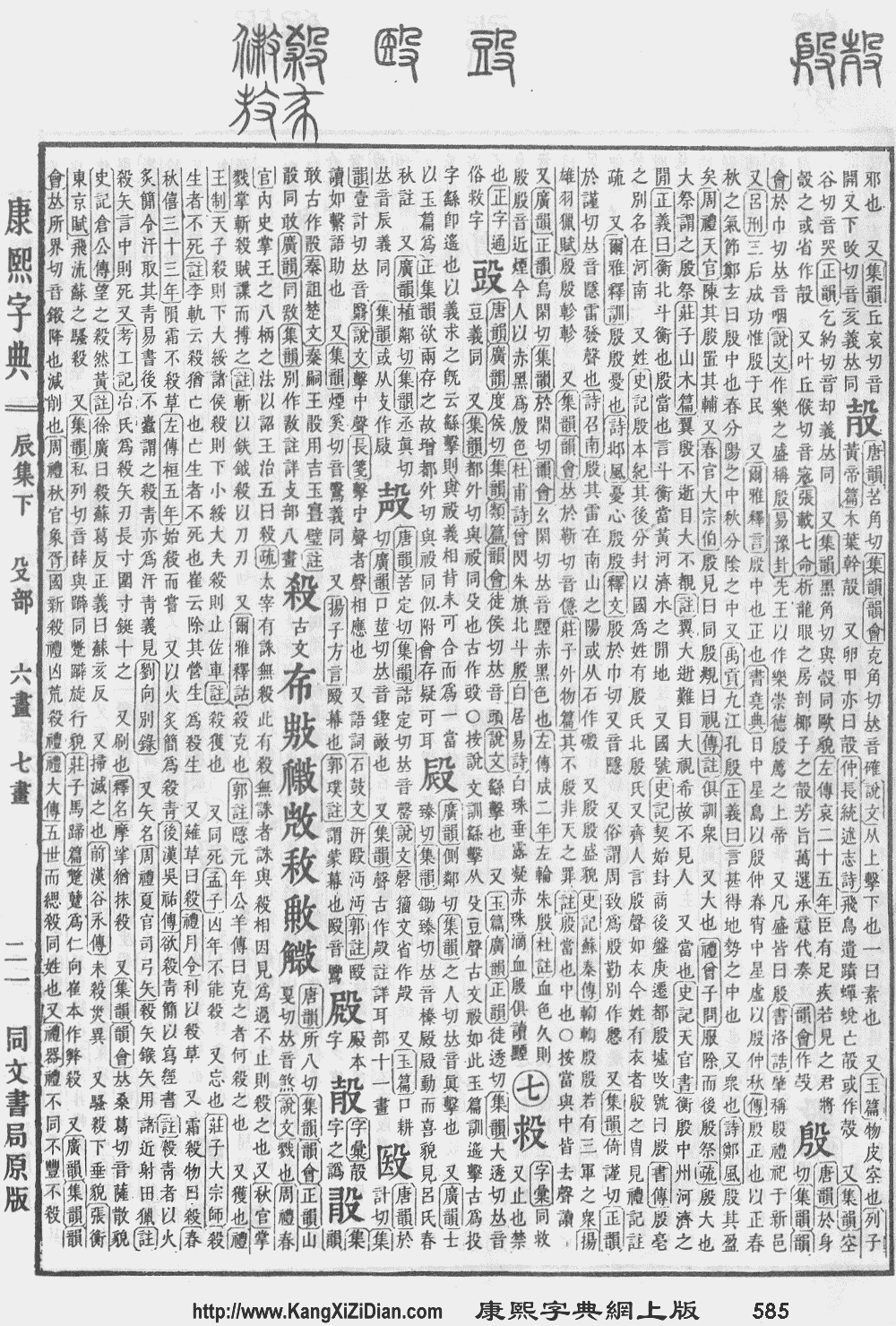
- KangXi: page 585, character 11
- Dai Kanwa Jiten: character 16638
- Dae Jaweon: page 978, character 5
- Hanyu Da Zidian: volume 3, page 2157, character 1
- Unihan data for U+6BBA
- Unihan data for U+F970
- Unihan data for U+FA96
- Unihan data for U+2F8F5
Chinese
| trad. | 殺 | |
|---|---|---|
| simp. | 杀* | |
Glyph origin
| Characters in the same phonetic series (杀) (Zhengzhang, 2003) | |
|---|---|
| Old Chinese | |
| 閷 | *sreːdss |
| 鎩 | *sreːds, *srads, *sreːd |
| 殺 | *sreːds, *sreːd |
| 蔱 | *srads, *sreːd |
| 摋 | *slaːd |
| 煞 | *sreːd |
| 榝 | *sreːd, *sred |
| 刹 | *sʰraːd |
In the oracle bone script, it was an ideogrammic compound (會意) : 戈 (“spear”) + [Term?] (“hair”) – a man impaled in the head.
In the bronze script, 人 (“man”) was added under the hair to accentuate the killing of the man. In some bronze inscriptions, 殳 (“spear”) or 攴 was used in place of 戈.
In the bamboo and silk script, symbol representing the man being killed corrupted into 杀: 乂 (“weapon for killing”) + 𣎳. The seal script inherits this: Phono-semantic compound (形聲, OC *sreːds, *sreːd) : phonetic 𣏂 + semantic 殳 (“spear”).
Etymology 1
From Proto-Sino-Tibetan *g/b-sat.
Pronunciation
Definitions
殺
Synonyms
| Dialectal synonyms of 殺 (“to kill (a person)”) [map] | ||
|---|---|---|
| Variety | Location | Words |
| Classical Chinese | 殺 | |
| Formal (Written Standard Chinese) | 殺 | |
| Mandarin | Beijing | 殺 |
| Taiwan | 殺 | |
| Jinan | 殺 | |
| Xi'an | 殺 | |
| Wuhan | 殺 | |
| Chengdu | 殺 | |
| Yangzhou | 殺 | |
| Hefei | 殺 | |
| Cantonese | Guangzhou | 殺 |
| Hong Kong | 殺 | |
| Yangjiang | 殺 | |
| Gan | Nanchang | 殺 |
| Hakka | Meixian | 殺 |
| Jin | Taiyuan | 殺 |
| Min Bei | Jian'ou | 殺 |
| Min Dong | Fuzhou | 刣 |
| Min Nan | Xiamen | 刣 |
| Quanzhou | 刣 | |
| Zhangzhou | 刣 | |
| Taipei | 刣 | |
| Kaohsiung | 刣 | |
| Penang | 刣 | |
| Chaozhou | 刣 | |
| Wu | Suzhou | 殺 |
| Wenzhou | 殺 | |
| Xiang | Changsha | 殺 |
| Shuangfeng | 殺 | |
| Dialectal synonyms of 宰 (“to slaughter; to butcher”) [map] | ||
|---|---|---|
| Variety | Location | Words |
| Classical Chinese | 宰、屠 | |
| Formal (Written Standard Chinese) | 宰殺、屠宰 | |
| Mandarin | Beijing | 宰、殺、治 fish |
| Taiwan | 宰、殺 | |
| Jinan | 宰、殺、治 | |
| Xi'an | 宰、殺 | |
| Wuhan | 宰、殺、治 fish | |
| Chengdu | 宰、殺 | |
| Yangzhou | 殺、宰、治 fish | |
| Hefei | 殺、治 fish | |
| Cantonese | Guangzhou | 劏、善 chicken |
| Hong Kong | 劏 | |
| Hong Kong (Weitou) | 劏 | |
| Taishan | 劏 | |
| Yangjiang | 劏 | |
| Gan | Nanchang | 殺、治 fish |
| Hakka | Meixian | 治 |
| Miaoli (N. Sixian) | 治 | |
| Liudui (S. Sixian) | 治 | |
| Hsinchu (Hailu) | 治 | |
| Dongshi (Dabu) | 治 | |
| Zhuolan (Raoping) | 治 | |
| Yunlin (Zhao'an) | 治 | |
| Hong Kong | 劏 | |
| Sabah | 劏 | |
| Singkawang | 劏 | |
| Jin | Taiyuan | 宰、殺 |
| Min Bei | Jian'ou | 刣 |
| Min Dong | Fuzhou | 刣、刺 |
| Min Nan | Xiamen | 刣 |
| Quanzhou | 刣 | |
| Zhangzhou | 刣 | |
| Taipei | 刣 | |
| Kaohsiung | 刣 | |
| Penang | 刣 | |
| Chaozhou | 刣 | |
| Wu | Suzhou | 殺 |
| Wenzhou | 㷟、殺 | |
| Xiang | Changsha | 殺、宰 |
| Shuangfeng | 殺 | |
Compounds
|
|
|
Etymology 2
From 衰 (OC *sʰrol, *srul, “to diminish; to decay”) + final *-t (Schuessler, 2007).
Pronunciation
Definitions
殺
Compounds
|
|
|
Etymology 3
Pronunciation
Definitions
殺
- dark
- Alternative form of 𥻦 (“to spread; to exile”).
Etymology 4
Pronunciation
Definitions
殺
- Only used in 蹩殺/蹩杀.
Etymology 5
Pronunciation
Definitions
殺
- Only used in 降殺/降杀.
Etymology 6
| For pronunciation and definitions of 殺 – see 弒 (“to kill a parent or superior”). (This character, 殺, is a variant form of 弒.) |
Japanese
| 殺 | |
| 殺 |
Kanji
- to kill
Readings
Compounds
- 縊殺 (isatsu): strangling to death
- 虐殺 (gyakusatsu)
- 人殺し (hitogoroshi)
- 必殺 (hissatsu)
- 殺人 (satsujin)
- 殺害 (satsugai)
- 殺気 (sakki)
- 殺菌 (sakkin)
- 殺傷 (sasshō)
- 殺身 (sasshin)
- 殺生 (sesshō)
- 殺青 (sassei)
- 殺節 (sassetsu)
- 殺到 (sattō)
- 殺伐 (satsubatsu)
- 殺風景 (sappūkei)
- 殺戮 (satsuriku)
- 殺略 (satsuryaku)
- 殺陣 (satsujin)
- 刺殺 (shisatsu)
- 自殺 (jisatsu): suicide
- 相殺 (sōsai)
- 他殺 (tasatsu)
- 抹殺 (massatsu)
- 黙殺 (mokusatsu)
Korean
Hanja
殺 • (sal, soe) (hangeul 살, 쇠, McCune–Reischauer sal, soe, Yale sal, soy)
- This term needs a translation to English. Please help out and add a translation, then remove the text
{{rfdef}}.
Vietnamese
Han character
殺 (sát, sái, sít, sịt, sướt, sét, sượt)
- This term needs a translation to English. Please help out and add a translation, then remove the text
{{rfdef}}.