tea
English
Etymology 1
Circa 1650, from Dutch thee, from Min Nan 茶 (tê) (Amoy dialect), from Old Chinese, ultimately from Proto-Sino-Tibetan *s-la (“leaf, tea”).
Introduced to English and other Western European languages by the Dutch East India Company, who sourced their tea in Amoy; compare Malay teh along the same trade route. Doublet of chai and cha, from same Proto-Sino-Tibetan root; see discussion of cognates.
The word for “tea” in many languages is of Sinitic origin (due to China being the origin of the plant), and thus there are many cognates; see translations. These are from one of two proximate sources. The word for tea in modern Min Nan is tê and in Mandarin is chá (both written as 茶); this divide dates to Proto-Min/Middle Chinese, though the two terms share the same Proto-Sino-Tibetan root. Different languages borrowed one or the other form (specific language and point in time varied), reflecting trade ties, generally southern Chinese tê if by ocean trade from China, or northern Chinese chá if by overland trade or by ocean trade from India.[1]
Thus Western and Northern European languages borrowed tê (with the exception of Portuguese, which uses chá; despite being by ocean trade, their source was in Macao, not Amoy), while chá borrowings are used over a very large geographical area of Eurasia and Africa: Southern and Eastern Europe, and on through Turkish, Arabic, North and East Africa, Persian, Central Asian, and Indic languages. In Europe the tê/chá line is Italian/Slovene, Hungarian/Romanian, German/Czech, Polish/Ukrainian, Baltics/Russian, Finnish/Karelian, Northern Sami/Inari Sami. tê was also borrowed in European trade stops in Southern India and coastal Africa, though chá borrowings are otherwise more prevalent in these regions, via Arabic or Indic, due to earlier trade. The situation in Southeast Asia is complex due to multiple influences, and some languages borrowed both forms, such as Malay teh and ca.
Pronunciation
- (General American) IPA(key): /ti/
- enPR: tē, IPA(key): /tiː/
Audio (US) (file) Audio (UK) (file) - Rhymes: -iː
- Homophones: T, te, tee, ti
Noun
tea (countable and uncountable, plural teas)
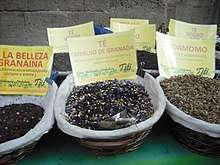
- (uncountable) The dried leaves or buds of the tea plant, Camellia sinensis.
- Synonym: tea leaves
- Go to the supermarket and buy some tea.
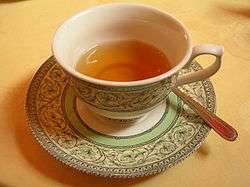
- (uncountable) The drink made by infusing these dried leaves or buds in hot water.
- 1922, Ben Travers, chapter 2, in A Cuckoo in the Nest:
- Mother […] considered that the exclusiveness of Peter's circle was due not to its distinction, but to the fact that it was an inner Babylon of prodigality and whoredom, from which every Kensingtonian held aloof, except on the conventional tip-and-run excursions in pursuit of shopping, tea and theatres.
-
- (countable) A variety of the tea plant.
- Darjeeling is a tea from India.
- (uncountable) By extension, any drink made by infusing parts of various other plants. Also, meat stock served hot as a drink, often as a stimulant or restorative.
- Synonyms: herb tea, herbal tea, infusion, tisane
- camomile tea; mint tea; beef tea
- (countable, Australia, Britain, Canada, New Zealand, northern US) A cup of any one of these drinks, often with a small amount of milk or cream added and sweetened with sugar or honey.
- (countable, Southern US) A glass of iced tea, typically served with ice cubes and sometimes with a slice or wedge of lemon.
- (uncountable, Britain) A light meal eaten mid-afternoon, typically with tea; afternoon tea.
- (uncountable, Commonwealth of Nations) The main evening meal, irrespective of whether tea is drunk with it.
- The family were sitting round the table, having their tea.
- (cricket) The break in play between the second and third sessions.
- Australia were 490 for 7 at tea on the second day.
- 2009, Guardian Media Group, in The Guardian, “What do cricketers eat at tea? When is it safe to flush on the train? What's a plujit?”, in (Please provide the book title or journal name):
- As recently as the mid-80s the players would be given a bottle of beer at lunchtime at some county grounds, and "tea" still meant a cup of tea into the 90s.
- (slang, dated) Marijuana.
- 1940, Raymond Chandler, Farewell, My Lovely, Penguin 2010, page 103:
- So they were evidence. Evidence of what? That a man occasionally smoked a stick of tea, a man who looked as if any touch of the exotic would appeal to him. On the other hand lots of tough guys smoked marijuana […] .
- 1946, Mezz Mezzrow and Bernard Wolfe, Really the Blues, Payback Press 1999, page 74:
- Tea puts a musician in a real masterly sphere, and that's why so many jazzmen have used it.
- 1947, William Burroughs, letter, 11 March 1947:
- Here in Texas possession of tea is a felony calling for 2 years.
- 1940, Raymond Chandler, Farewell, My Lovely, Penguin 2010, page 103:
- (slang, especially African American Vernacular) Information, especially sensitive and/or juicy gossip. (Connected to the idea of sipping tea while listening to such information.)
- 2015, Sonya Shuman, Doors of the Church Are Open: Smoke & Mirrors by Sonya Shuman:
- "What's the tea on you and China? Where she at Alicia? You should know where ya baby at."
- spill the tea on that drama
- 2015, Sonya Shuman, Doors of the Church Are Open: Smoke & Mirrors by Sonya Shuman:
Usage notes
In many places tea is assumed to mean hot tea, while in the southern United States, it is assumed to mean iced tea.
Synonyms
- (a light meal): See Thesaurus:meal
Derived terms
|
Translations
|
|
|
|
|
|
- The translations below need to be checked and inserted above into the appropriate translation tables, removing any numbers. Numbers do not necessarily match those in definitions. See instructions at Wiktionary:Entry layout#Translations.
Verb
tea (third-person singular simple present teas, present participle teaing, simple past and past participle teaed)
- To drink tea.
- To take afternoon tea (the light meal).
- 1877, The Bicycling Times and Tourist's Gazette (page 38)
- The wind was high and the hills ditto, and both being against us we were late in reaching Hitchin (30 from Cambridge), so giving up the idea of reaching Oxford we toiled on through Luton, on to Dunstable (47), where we teaed moderately […]
- 1877, The Bicycling Times and Tourist's Gazette (page 38)
Etymology 2
Noun
tea (plural teas)
- A moment, a historical unit of time from China, about the amount of time needed to quickly drink a traditional cup of tea. It is now found in Chinese-language historical fiction.
Usage notes
This term is found in English translations of Chinese-language historical fiction, where it is used to give the work an ancient Chinese feel.
References
- ↑ The World Atlas of Language Structures Online, “Chapter 138: Tea”, by Östen Dahl
Anagrams
Galician
Etymology 1
13th century (Cantigas de Santa Maria). From Latin tēla. Cognate with Portuguese teia and Spanish tela.
Pronunciation
- IPA(key): /ˈtea̝/
Noun
tea f (plural teas)
- (uncountable) cloth
- (countable) a piece of cloth
- 1326, Antonio López Ferreiro (ed.), Galicia Histórica. Colección diplomática. Santiago: Tipografía Galaica, page 300:
- It. mando que todollos lenços delgados et teas de rens que os tome Garcia perez. et que faça delles fazer uestimentas para o altar de Sta Maria.
- Item, I command that every fine linen and the clothes of Reims to be taken by Garcia Perez, who should make them into clothes for the altar of Saint Mary
- It. mando que todollos lenços delgados et teas de rens que os tome Garcia perez. et que faça delles fazer uestimentas para o altar de Sta Maria.
- 1326, Antonio López Ferreiro (ed.), Galicia Histórica. Colección diplomática. Santiago: Tipografía Galaica, page 300:
- spiderweb
- Synonym: arañeira
- canvas
- Synonym: lenzo
- film (skin)
- Synonym: película
Derived terms
Etymology 2
13th century (Cantigas de Santa Maria). From Latin taeda.
Pronunciation
- IPA(key): /ˈtea̝/
Noun
tea f (plural teas)
References
- “tea” in Dicionario de Dicionarios do galego medieval, SLI - ILGA 2006-2012.
- “tea” in Xavier Varela Barreiro & Xavier Gómez Guinovart: Corpus Xelmírez - Corpus lingüístico da Galicia medieval. SLI / Grupo TALG / ILG, 2006-2016.
- “tea” in Dicionario de Dicionarios da lingua galega, SLI - ILGA 2006-2013.
- “tea” in Santamarina, Antón (coord.): Tesouro informatizado da lingua galega. Santiago de Compostela: Instituto da Lingua Galega.
- “tea” in Álvarez, Rosario (coord.): Tesouro do léxico patrimonial galego e portugués, Santiago de Compostela: Instituto da Lingua Galega.
Hungarian
Etymology
Pronunciation
- IPA(key): [ˈtɛɒ]
- Hyphenation: tea
Noun
tea (plural teák)
Declension
| Inflection (stem in long/high vowel, back harmony) | ||
|---|---|---|
| singular | plural | |
| nominative | tea | teák |
| accusative | teát | teákat |
| dative | teának | teáknak |
| instrumental | teával | teákkal |
| causal-final | teáért | teákért |
| translative | teává | teákká |
| terminative | teáig | teákig |
| essive-formal | teaként | teákként |
| essive-modal | — | — |
| inessive | teában | teákban |
| superessive | teán | teákon |
| adessive | teánál | teáknál |
| illative | teába | teákba |
| sublative | teára | teákra |
| allative | teához | teákhoz |
| elative | teából | teákból |
| delative | teáról | teákról |
| ablative | teától | teáktól |
| Possessive forms of tea | ||
|---|---|---|
| possessor | single possession | multiple possessions |
| 1st person sing. | teám | teáim |
| 2nd person sing. | teád | teáid |
| 3rd person sing. | teája | teái |
| 1st person plural | teánk | teáink |
| 2nd person plural | teátok | teáitok |
| 3rd person plural | teájuk | teáik |
Derived terms
(Compound words):
(Expressions):
Maori
Adjective
tea
Derived terms
Rapa Nui
Noun
tea
Derived terms
Sedang
Noun
tea
Reference
- Kenneth D. Smith, Sedang Dictionary (2012), page 375
Spanish
Etymology
Pronunciation
- IPA(key): /ˈtea/, [ˈt̪ea]
Noun
tea f (plural teas)
- torch
- firelighter
- (figurativelyco) binge