青
| ||||||||
Translingual
| Stroke order | |||
|---|---|---|---|
 | |||
| Japanese stroke order | |||
|---|---|---|---|
 | |||
Han character
青 (radical 174, 靑+0, 8 strokes, cangjie input 手一月 (QMB), four-corner 50227, composition ⿱龶月)
Descendants
See also
References
- KangXi: not present, would follow page 1381, character 19
- Dai Kanwa Jiten: character 42564
- Dae Jaweon: page 1893, character 1
- Hanyu Da Zidian: volume 6, page 4046, character 1
- Unihan data for U+9752
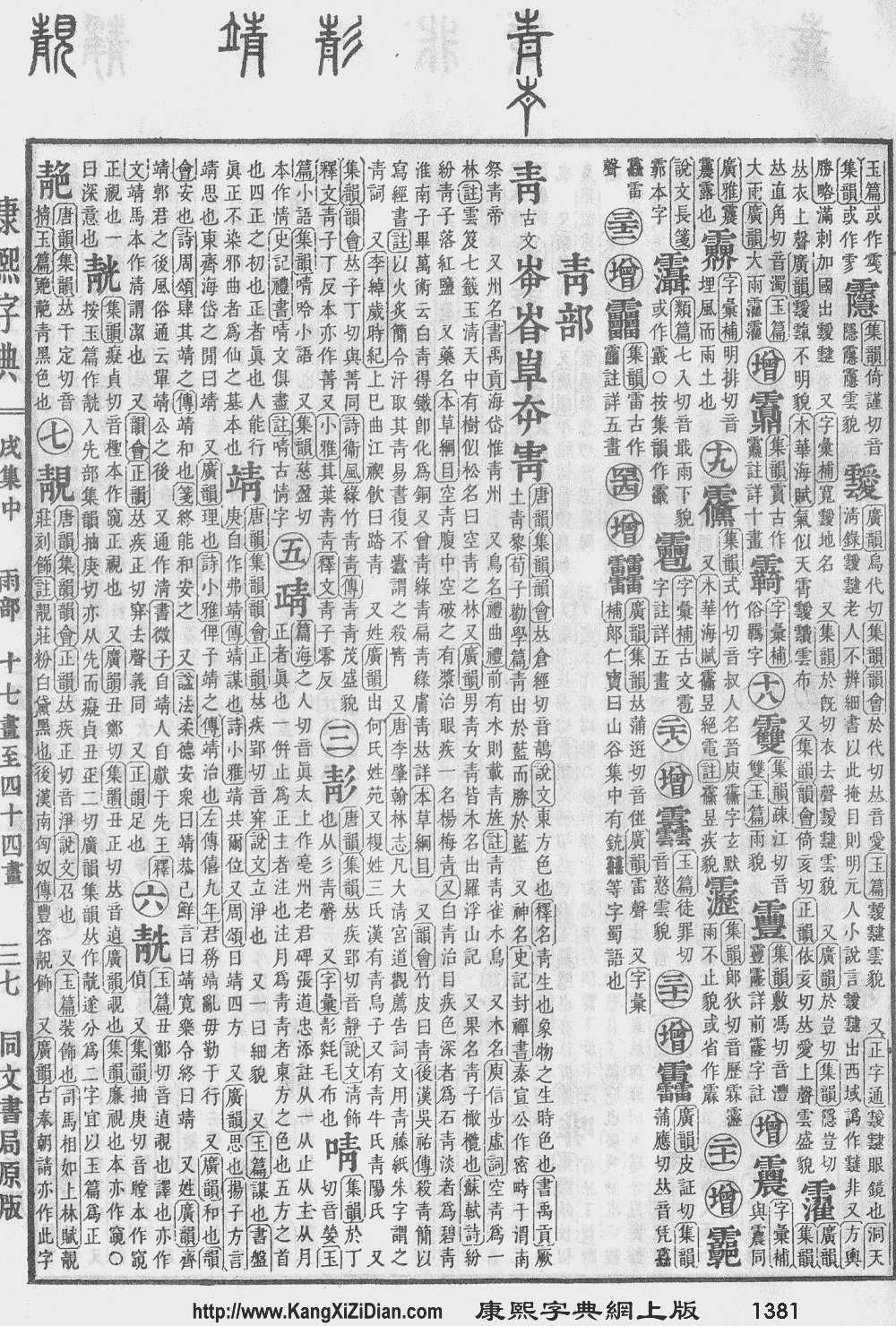
Chinese
| trad. | 青/靑 | |
|---|---|---|
| simp. | 青 | |
| alt. forms | 𤯞 | |
Glyph origin
| Historical forms of the character 青 | ||
|---|---|---|
| Western Zhou | Shuowen Jiezi (compiled in Han) | Liushutong (compiled in Ming) |
| Bronze inscriptions | Small seal script | Transcribed ancient scripts |
 |
 |
 |
| Characters in the same phonetic series (生) (Zhengzhang, 2003) | |
|---|---|
| Old Chinese | |
| 猜 | *sʰlɯː |
| 輤 | *sʰleːns |
| 綪 | *sʰleːns, *ʔsreːŋ |
| 倩 | *sʰleːns, *sʰleŋs |
| 棈 | *sʰleːns |
| 蒨 | *sʰeːns |
| 篟 | *sʰeːns |
| 生 | *sʰleːŋ, *sreŋs |
| 牲 | *sreŋ |
| 笙 | *sreŋ |
| 甥 | *sreŋ |
| 鉎 | *sreŋ, *sleːŋ |
| 珄 | *sreŋ |
| 鼪 | *sreŋ, *sreŋs |
| 猩 | *sreŋ, *seːŋ |
| 狌 | *sreŋ |
| 眚 | *sreŋʔ |
| 貹 | *sreŋs |
| 崝 | *zreːŋ |
| 精 | *ʔsleŋ, *ʔsleŋs |
| 菁 | *ʔsleŋ |
| 鶄 | *ʔsleŋ, *sʰleːŋ |
| 蜻 | *ʔsleŋ, *sʰleːŋ |
| 鼱 | *ʔsleŋ |
| 婧 | *ʔsleŋ, *zleŋs, *zleŋʔ |
| 睛 | *ʔsleŋ, *sʰleŋʔ |
| 箐 | *ʔsleŋ |
| 聙 | *ʔsleŋ |
| 旌 | *ʔsleŋ |
| 清 | *sʰleŋ |
| 圊 | *sʰleŋ |
| 請 | *sʰleŋʔ, *zleŋs, *zleŋ |
| 凊 | *sʰleŋs |
| 䝼 | *zleŋs, *zleŋ |
| 靚 | *zleŋs |
| 情 | *zleŋ |
| 晴 | *zleŋ |
| 夝 | *zleŋ |
| 靜 | *zleŋʔ |
| 靖 | *zleŋʔ |
| 睲 | *seŋʔ, *seːŋs |
| 惺 | *seŋʔ, *seːŋ |
| 性 | *sleŋs |
| 姓 | *sleŋs |
| 靗 | *l̥ʰeŋs |
| 鯖 | *ʔljeŋ, *sʰleːŋ |
| 青 | *sʰleːŋ |
| 靘 | *sʰleːŋ, *sʰleːŋs |
| 掅 | *sʰleːŋs |
| 胜 | *sleːŋ |
| 曐 | *sleːŋ |
| 星 | *sleːŋ |
| 鮏 | *sleːŋ |
| 腥 | *seːŋ, *seːŋs |
| 鯹 | *seːŋ |
| 醒 | *seːŋ, *seːŋʔ, *seːŋs |
| 篂 | *seːŋ |
Ideogrammic compound (會意) : 生 (“growth of plants”) + 丹 (“cinnabar”). Cinnabar was used for dyeing, and by extension, came to imply “color” in general, giving the combined meaning “color of growing plants” → “blue-green”.
Top component is cognate to 生, but bottom component now resembles the unrelated 月 (“moon”).
Pronunciation
Definitions
青
- blue-green; blue (of sky, stone etc.); green (of grass, plants, mountain etc.)
- blue-green-coloured items
- black (of hair, cloth, silk thread etc.)
- luxuriant; lush; exuberant
- young; adolescent
- east
- spring
- green grass
- ripening crops
- Short for 青海 (Qīnghǎi, “Qinghai Province”).
- A surname.
Usage notes
The meaning for “blue” and “black” is more commonly used in Classical Chinese, while in modern Chinese, the meaning for “green” is more common. For example, 青山綠水 (“hill and water green in colour”), 青蘋果 (“green apple”). However, there are still some expressions for the meaning of blue, e.g. 青天 (“blue sky”), 青出於藍 (“blue comes from indigo; someone performing better than their teacher”)
In Cantonese the use of 青 to mean “black” is still used in circumstances where to use 黑 (hak1) would be inauspicious, as it is a near-homophone of 乞 (hat1, “beggar”). For example, 黑衣 (hak1 ji1) used to describe clothing would be a near-homophone of both beggar and a beggar's garment.
See also
Compounds
|
|
|
Japanese
Kanji
Readings
Compounds
- 青海原 (aounabara)
- 青馬 (aouma)
- 青黴 (aokabi)
- 青桐 (aogiri)
- 青草 (aokusa)
- 青臭い (aokusai)
- 青写真 (aojashin)
- 青筋 (aosuji)
- 青空 (aozora)
- 青田 (aota)
- 青大将 (aodaishō)
- 青菜に塩 (aona ni shio)
- 青二才 (aonisai)
- 青虫 (aomushi)
- 青物 (aomono)
- 青果 (seika): produce, fruits and vegetables
- 青雲の志 (seiun no kokorozashi)
- 青眼 (seigan)
- 青酸 (seisan): hydrocyanic acid
- 青酸塩 (seisan'en): cyanide
- 青山 (seizan)
- 青磁 (seiji)
- 青春 (seishun)
- 青天 (seiten)
- 青天の霹靂 (seiten no hekireki)
- 青天白日 (seitenhakujitsu)
- 青銅 (seidō)
- 青年 (seinen)
- 青嵐 (seiran)
- 青竜刀 (seiryūtō)
- 刺青 (irezumi): a tattoo, tattooing
Etymology 1
/sawo/ (uncertain, may be compound as opposed to root) → /awo/ → /ao/
From Old Japanese.
Appears as the latter part in older compounds with an -s- infix or prefix. It is unclear if this leading /s/ is indicative of an earlier form (sawo), or if this was an addition for euphony to avoid vowel clusters, or for other reasons. This /s/ is also seen in 雨 (ame, becoming same in old compounds) and 稲 (ine, becoming shine in old compounds).
Given that this /s/ only ever appears interstitially, and given the semantics, this /s/ may be cognate with Korean interfix -ᄉ- (-s-) used to mark possession, much like English 's.
Pronunciation
Noun
青 (hiragana あお, rōmaji ao, historical hiragana あを)
- the black, bluish color of a horse's hair; also, such a horse
- 1603–1604, Nippo Jisho (page 39)[2]
- Auo. アヲ (青) 馬の毛色で, 全体に黒くて青みがあり, 両耳の内側に多少白いところのあるもの. この部分の毛も他の部分と同じようにすっかり黒い時には, Curo(黒)と呼ばれる.
- 1603–1604, Nippo Jisho (page 39)[2]
- green (traffic-light green is referred to as ao, as are plant leaves.)
Derived terms
See also
| Colors in Japanese · 色 (iro) (layout · text) | |||||
|---|---|---|---|---|---|
| 白 (shiro) | 灰色 (haiiro), 鼠色 (nezumiiro) (dated) |
黒 (kuro) | 茶色 (chairo), 褐色 (kasshoku) | ||
| ピンク (pinku), 桃色 (momoiro) |
赤 (aka) ; 深紅 (shinku), クリムゾン (kurimuzon), 紅色 (beniiro), 紅色 (kurenaiiro) |
オレンジ (orenji), 橙色 (daidaiiro) |
黄色 (kiiro) ; クリーム色 (kurīmuiro) | ||
| 黄緑 (kimidori) | 緑 (midori), 青 (ao) (dated) |
シアン (shian) ; 鴨の羽色 (kamo no hane iro) | |||
| 水色 (mizuiro) | 青 (ao) | 菫色 (sumireiro) ; 藍色 (aiiro), インジゴ (injigo) |
マゼンタ (mazenta) ; 紫 (murasaki) | ||
Etymology 2
Unknown. The reading might be an obscure term from Old Japanese or dialect. The use of the character 青 arises from its 宋音 (sōon, “Song-dynasty pronunciation”).[3]
Pronunciation
Noun
- (rare, archaic, mythology) a beast that looks like a weasel, and is said to have lived in present-day Fukuoka and Yamaguchi prefectures
- (rare, archaic, mythology) a beast that looks like a wolf, and is said to have appeared around Mount Yoshino
References
- ↑ 2006, 大辞林 (Daijirin), Third Edition (in Japanese), Tōkyō: Sanseidō, →ISBN
- ↑ Doi, Tadao (1603–1604) Hōyaku Nippo Jisho (in Japanese), Tōkyō: Iwanami Shoten, published 1980, →ISBN.
- ↑ 1988, 国語大辞典(新装版) (Kokugo Dai Jiten, Revised Edition) (in Japanese), Tōkyō: Shogakukan
Korean
Hanja
青 (eumhun 푸를 청 (pureul cheong))
Vietnamese
Han character
- green
- blue