前
| ||||||||
Translingual
| Stroke order | |||
|---|---|---|---|
 | |||
Han character
前 (radical 18, 刀+7, 9 strokes, cangjie input 廿月中弓 (TBLN), four-corner 80221, composition ⿱䒑刖)
Derived characters
References
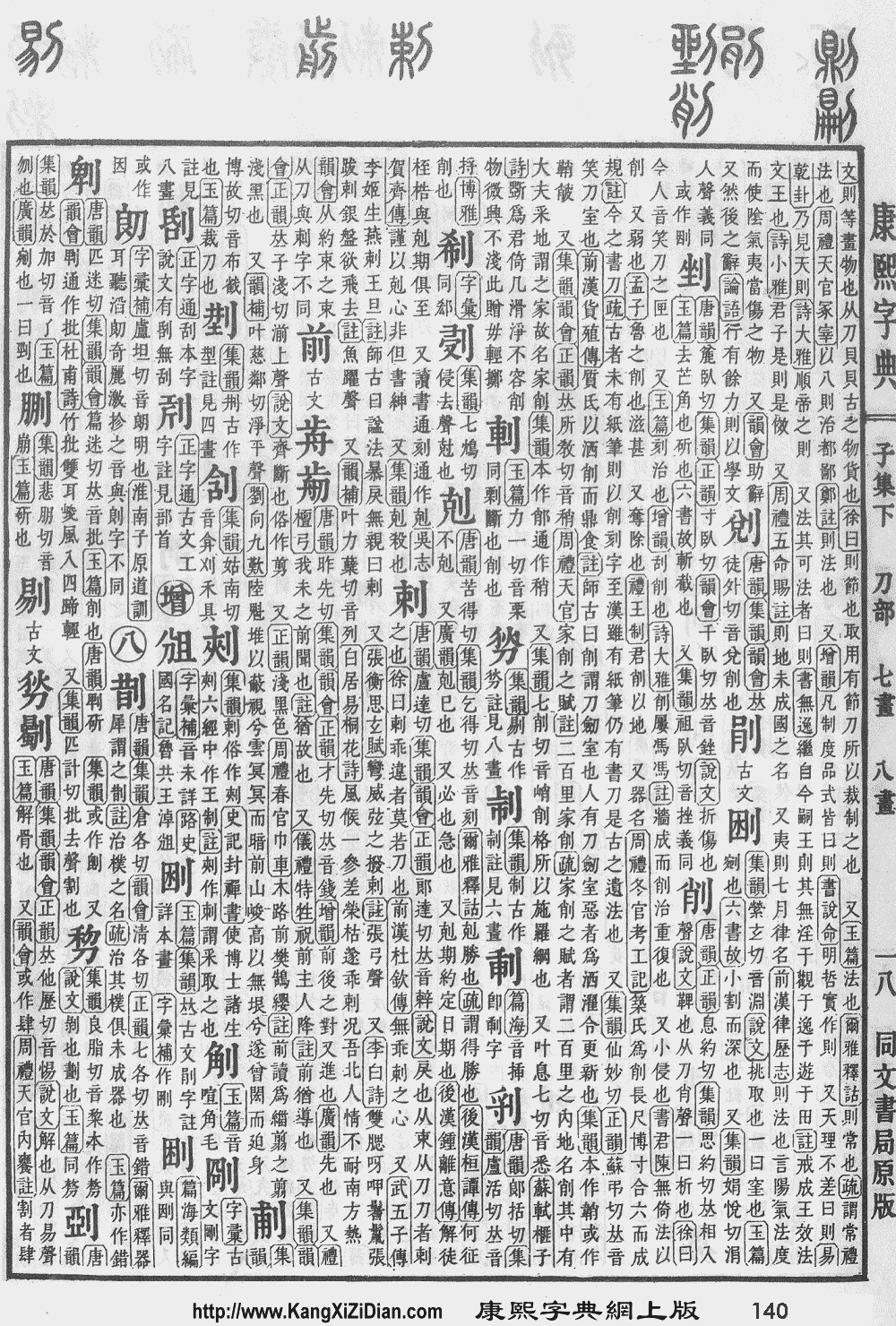
- KangXi: page 140, character 15
- Dai Kanwa Jiten: character 2011
- Dae Jaweon: page 318, character 6
- Hanyu Da Zidian: volume 1, page 248, character 4
- Unihan data for U+524D
Chinese
| simp. and trad. |
前 | |
|---|---|---|
| alt. forms | 歬 | |
Glyph origin
| Historical forms of the character 前 | ||||
|---|---|---|---|---|
| Western Zhou | Warring States | Shuowen Jiezi (compiled in Han) | Liushutong (compiled in Ming) | |
| Bronze inscriptions | Chu Slip and silk script | Qin slip script | Small seal script | Transcribed ancient scripts |
 |
 |
 |
 |
 |
| Characters in the same phonetic series (前) (Zhengzhang, 2003) | |
|---|---|
| Old Chinese | |
| 媊 | *ʔslel, *ʔslenʔ |
| 煎 | *ʔslen, *ʔslens |
| 湔 | *ʔslen, *ʔslens, *ʔsleːn, *zleːn |
| 鬋 | *ʔslen, *ʔslenʔ, *ʔslens |
| 剪 | *ʔslenʔ |
| 翦 | *ʔslenʔ |
| 譾 | *ʔslenʔ |
| 揃 | *ʔslenʔ |
| 箭 | *ʔslens |
| 葥 | *ʔslens |
| 前 | *zleːn |
| 騚 | *zleːn |
| 歬 | *zleːn |
Originally 歬, an ideogrammic compound (會意) : 止 (“foot”) + 舟 (“boat”) – a foot on a boat moving forward. Alternatively, 舟 represents a shoe (cf. Shuowen 履: 舟象履形) — a foot with a shoe on to walk forward. In the current form, 止 is simplified to 䒑 and 舟 to 月. The current form with an additional 刀 (“knife”) is the original form of 剪 (OC *ʔslenʔ, “to cut”).
Etymology 1
Pronunciation
Definitions
前
Compounds
|
|
|
Etymology 2
| For pronunciation and definitions of 前 – see 剪 (“to cut”). (This character, 前, is an ancient form of 剪.) |
Japanese
Kanji
Readings
Etymology 1
| Kanji in this term |
|---|
| 前 |
| まえ Grade: 2 |
| kun’yomi |
From Old Japanese as a compound of 目 (ma, “eye”) + 方 (he, “direction, -wards”).[1][2]
/mape/ > /maɸe/ > /mawe/ > /mae/
Pronunciation
Noun
Suffix
前 (hiragana まえ, rōmaji -mae)
Etymology 2
| Kanji in this term |
|---|
| 前 |
| さき Grade: 2 |
| kun’yomi |
From Old Japanese. Cognate with 崎 (saki, “a (geographical) point, where the land sticks out into the water”).[1]
Pronunciation
Noun
- Alternative spelling of 先 the tip of something; ahead, in front; before, earlier, the past; afterwards, the future; the destination of a motion or action
Usage notes
This sense is much more commonly spelled 先. See that entry for more details.
Etymology 3
From Middle Chinese 前 (dzen). Compare modern Mandarin 前 (qián).
Pronunciation
Counter
前 (hiragana ぜん, rōmaji -zen)
Prefix
Etymology 4
| Kanji in this term |
|---|
| 前 |
| ぜ Grade: 2 |
| kan’yōon |
Contraction of 御前 (goze), itself a contraction of 御前 (gozen), an honorific form of address.[1][2]
Pronunciation
- Kan’yōyomi
- IPA(key): [d͡ze̞]
Suffix
前 (hiragana ぜ, rōmaji -ze)
References
- 1 2 3 1988, 国語大辞典(新装版) (Kokugo Dai Jiten, Revised Edition) (in Japanese), Tōkyō: Shogakukan
- 1 2 3 4 5 2006, 大辞林 (Daijirin), Third Edition (in Japanese), Tōkyō: Sanseidō, →ISBN
- 1 2 3 1998, NHK日本語発音アクセント辞典 (NHK Japanese Pronunciation Accent Dictionary) (in Japanese), Tōkyō: NHK, →ISBN
- ↑ 1997, 新明解国語辞典 (Shin Meikai Kokugo Jiten), Fifth Edition (in Japanese), Tōkyō: Sanseidō, →ISBN
Korean
Hanja
前 • (jeon) (hangeul 전, revised jeon, McCune–Reischauer chŏn)
Vietnamese
Han character
- This term needs a translation to English. Please help out and add a translation, then remove the text
{{rfdef}}.