哈
| ||||||||
Translingual
Han character
哈 (radical 30, 口+6, 9 strokes, cangjie input 口人一口 (ROMR), four-corner 68061, composition ⿰口合)
References
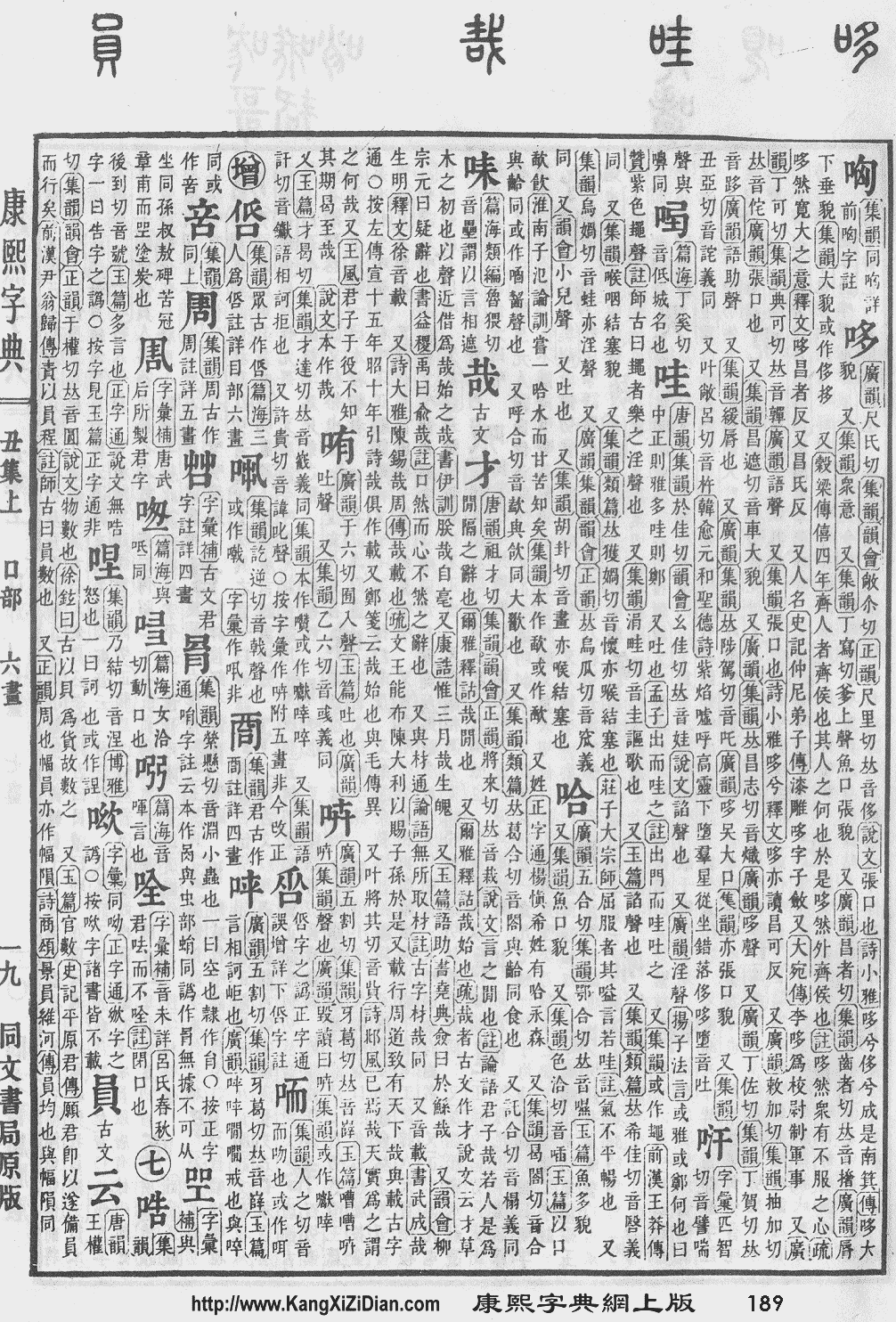
- KangXi: page 189, character 6
- Dai Kanwa Jiten: character 3594
- Dae Jaweon: page 408, character 12
- Hanyu Da Zidian: volume 1, page 619, character 5
- Unihan data for U+54C8
Chinese
Glyph origin
| Characters in the same phonetic series (合) (Zhengzhang, 2003) | |
|---|---|
| Old Chinese | |
| 龕 | *kʰuːm |
| 媕 | *quːm, *qromʔ, *qɯːm, *qramʔ, *qɯːb |
| 頜 | *ɡuːmʔ, *kuːb |
| 答 | *tkuːb |
| 畣 | *tkuːb |
| 荅 | *tkuːb |
| 嗒 | *tuːb, *tʰoːb |
| 褡 | *tuːb, *toːb |
| 撘 | *tuːb |
| 搭 | *tuːb, *tʰoːb |
| 榙 | *tkuːb, *ɡuːb |
| 佮 | *tkʰuːb, *kuːb, *quːb, *quːb |
| 蛤 | *kuːb |
| 鴿 | *kuːb |
| 合 | *kuːb, *ɡuːb |
| 郃 | *kuːb, *ɡuːb |
| 匌 | *kuːb, *kʰuːb |
| 鉿 | *kuːb |
| 閤 | *kuːb |
| 鞈 | *kuːb, *kruːb |
| 韐 | *kuːb, *kruːb |
| 鮯 | *kuːb |
| 哈 | *ŋɡuːb |
| 姶 | *quːb, *quːb |
| 欱 | *qʰuːb, *qʰruːb |
| 盒 | *ɡuːb |
| 耠 | *ɡuːb |
| 詥 | *ɡuːb |
| 塔 | *tʰuːb |
| 鞳 | *tʰoːb |
| 劄 | *rtuːb |
| 跲 | *kruːb, *kob, *ɡob |
| 袷 | *kruːb, *ŋkob |
| 餄 | *kruːb |
| 恰 | *kʰruːb |
| 帢 | *kʰruːb |
| 洽 | *ɡruːb |
| 祫 | *ɡruːb |
| 珨 | *ɡruːb |
| 烚 | *ɡruːb |
| 歙 | *qʰjob, *qʰrub |
| 湁 | *tkʰub |
| 拾 | *ɡjub |
| 給 | *krub |
| 翕 | *qʰrub |
| 噏 | *qʰrub |
| 潝 | *qʰrub |
| 熻 | *qʰrub |
| 嬆 | *qʰrub |
| 翖 | *qʰrub |
| 闟 | *qʰrub |
Phono-semantic compound (形聲, OC *ŋɡuːb) : semantic 口 (“mouth”) + phonetic 合 (OC *kuːb, *ɡuːb).
Etymology 1
| simp. and trad. |
哈 | |
|---|---|---|
Pronunciation
Definitions
哈
- ‡ (of fish) many; plenteous
- ‡ (of a fish's mouth) opening; moving
- † mouthful; sip
- 臾兒、易牙,淄、澠之水合者,嘗一哈水而甘苦知矣。 [Classical Chinese, trad.]
- From: Huainanzi, 2nd century BCE
- Yú'ér, Yìyá, Zī, Miǎn zhī shuǐ hé zhě, cháng yī hā shuǐ ér gān kǔ zhī yǐ. [Pinyin]
- After mixing the water from the Zi and Mian Rivers, Yu'er and Yiya can take a sip of the water and distinguish [the water's source] by sweetness and bitterness.
臾儿、易牙,淄、渑之水合者,尝一哈水而甘苦知矣。 [Classical Chinese, simp.]
Etymology 2
| simp. and trad. |
哈 | |
|---|---|---|
Pronunciation
Definitions
哈
- (onomatopoeia) sound of laughter: ha
- exclamation of triumph, etc.: ha!
- to breathe out
- (Taiwanese Min Nan) to drink (hot tea)
- Short for 哈薩克斯坦/哈萨克斯坦 (Hāsàkèsītǎn, “Kazakhstan”).
- Short for 哈爾濱/哈尔滨 (Hā'ěrbīn, “Harbin”).
Compounds
Etymology 3
| simp. and trad. |
哈 | |
|---|---|---|
| alt. forms | 𨉣 | |
Pronunciation
Definitions
哈
Compounds
Etymology 4
| simp. and trad. |
哈 | |
|---|---|---|
Pronunciation
Definitions
哈
Etymology 5
| simp. and trad. |
哈 | |
|---|---|---|
Pronunciation
Definitions
哈
Compounds
Etymology 6
| simp. and trad. |
哈 | |
|---|---|---|
Pronunciation
Definitions
哈
- A surname.
Etymology 7
| simp. and trad. |
哈 | |
|---|---|---|
Pronunciation
Definitions
哈
- Used in the words below.
Compounds
Etymology 8
| simp. and trad. |
哈 | |
|---|---|---|
Pronunciation
Definitions
哈
- Only used in 哈喇 (hāla, “a kind of top-quality woollen goods produced in Russia”).
Compounds
|
|
Etymology 9
| simp. and trad. |
哈 | |
|---|---|---|
Pronunciation
Definitions
哈
Synonyms
| Dialectal synonyms of 傻 (“stupid”) [map] | ||
|---|---|---|
| Variety | Location | Words |
| Formal (Written Standard Chinese) | 傻 | |
| Mandarin | Beijing | 傻 |
| Taiwan | 傻 | |
| Tianjin | 傻 | |
| Xi'an | 瓜 | |
| Wuhan | 苕、哈、嘎 | |
| Chengdu | 哈、瓜 | |
| Yangzhou | 呆、木足、瓜 | |
| Hefei | 呆、傻 | |
| Cantonese | Guangzhou | 戇、傻 |
| Hong Kong | 傻、戇 | |
| Dongguan | 戇、傻、吽 | |
| Yangjiang | 傻、戇 | |
| Gan | Nanchang | 蟬 |
| Hakka | Meixian | 傻、戇 |
| Miaoli (N. Sixian) | 戇 | |
| Liudui (S. Sixian) | 戇 | |
| Hsinchu (Hailu) | 戇 | |
| Dongshi (Dabu) | 戇 | |
| Zhuolan (Raoping) | 戇 | |
| Yunlin (Zhao'an) | 戇 | |
| Jin | Taiyuan | 傻、二不楞 |
| Min Bei | Jian'ou | 賴、戇 |
| Min Dong | Fuzhou | 戇 |
| Matsu | 戇 | |
| Min Nan | Xiamen | 戇 |
| Quanzhou | 戇 | |
| Zhangzhou | 戇 | |
| Taipei | 戇 | |
| Kaohsiung | 戇 | |
| Penang | 戇 | |
| Chaozhou | 㦙、白仁 | |
| Wu | Shanghai | 戇 |
| Suzhou | 戇 | |
| Wenzhou | 呆、憨 | |
| Xiang | Changsha | 寶、醒 |
| Shuangfeng | 哈 | |
Compounds
|
|
Etymology 10
| simp. and trad. |
哈 | |
|---|---|---|
Pronunciation
Definitions
哈
Etymology 11
| simp. and trad. |
哈 | |
|---|---|---|
Pronunciation
Definitions
哈
- Only used in 哈士蟆 (hàshimá).
Etymology 12
| simp. and trad. |
哈 | |
|---|---|---|
Pronunciation
Definitions
哈
- Only used in 哈巴 (hàba, “knee bending when walking”).
Etymology 13
| simp. and trad. |
哈 | |
|---|---|---|
Pronunciation
Definitions
哈
Etymology 14
| simp. and trad. |
哈 | |
|---|---|---|
Pronunciation
Definitions
哈
- Used in placenames.
Compounds
|
Etymology 15
| For pronunciation and definitions of 哈 – see 歃 (“smear one's mouth with blood of a victim when taking an oath”). (This character, 哈, is a variant form of 歃.) |
Etymology 16
| For pronunciation and definitions of 哈 – see 𪘁. (This character, 哈, is a variant form of 𪘁.) |
References
Japanese
Kanji
哈
- This term needs a translation to English. Please help out and add a translation, then remove the text
{{rfdef}}.
Readings
- Goon: か (ka); こう (kō)←こふ (kofu, historical); ごう (gō)←ごふ (gofu, historical); しょう (shō)←せふ (sefu, historical); とう (tō)←とふ (tofu, historical)
- Kan’on: か (ka); こう (kō)←かふ (kafu, historical); ごう (gō)←がふ (gafu, historical); そう (sō)←さふ (safu, historical); とう (tō)←たふ (tafu, historical)
- Tōon: は (ha)
- Kun: くう (kuu, 哈う); すする (susuru, 哈る); のむ (nomu, 哈む)
References
- “哈” in: 諸橋轍次 (Morohashi Tetsuji), chief ed. 大漢和辞典 (Dai Kan-Wa Jiten, “Comprehensive Chinese–Japanese Dictionary”). 13 vols. 1955–1960. Revised and enlarged ed. 1984–1986. Tokyo: Taishukan.
Korean
Hanja
哈 • (hap) (hangeul 합, revised hap, McCune–Reischauer hap)
- This term needs a translation to English. Please help out and add a translation, then remove the text
{{rfdef}}.
Vietnamese
Han character
哈 (cáp, hóp, hộp, ngáp, họp, hớp, ngớp)
- This term needs a translation to English. Please help out and add a translation, then remove the text
{{rfdef}}.
This article is issued from
Wiktionary.
The text is licensed under Creative Commons - Attribution - Sharealike.
Additional terms may apply for the media files.