合
See also: 閤
| ||||||||
Translingual
| Stroke order | |||
|---|---|---|---|
 | |||
Han character
合 (radical 30, 口+3, 6 strokes, cangjie input 人一口 (OMR), four-corner 80601, composition ⿱亼口)
Derived characters
References
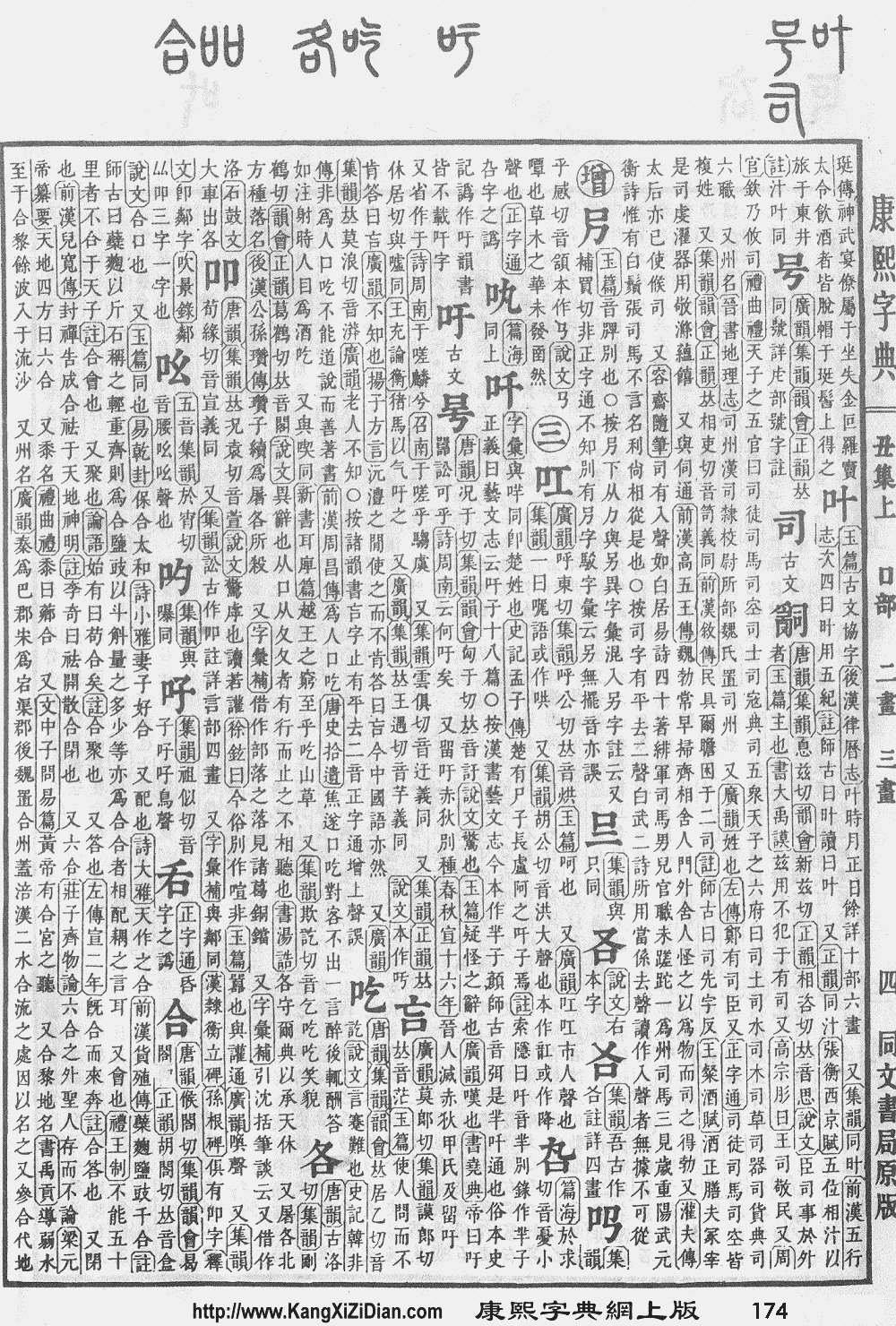
- KangXi: page 174, character 24
- Dai Kanwa Jiten: character 3287
- Dae Jaweon: page 387, character 17
- Hanyu Da Zidian: volume 1, page 581, character 1
- Unihan data for U+5408
Chinese
| simp. and trad. |
合 | |
|---|---|---|
Glyph origin
| Historical forms of the character 合 | |||||
|---|---|---|---|---|---|
| Shang | Western Zhou | Warring States | Shuowen Jiezi (compiled in Han) | Liushutong (compiled in Ming) | |
| Oracle bone script | Bronze inscriptions | Bronze inscriptions | Chu Slip and silk script | Small seal script | Transcribed ancient scripts |
 |
 |
 |
 |
 |
 |
| Characters in the same phonetic series (合) (Zhengzhang, 2003) | |
|---|---|
| Old Chinese | |
| 龕 | *kʰuːm |
| 媕 | *quːm, *qromʔ, *qɯːm, *qramʔ, *qɯːb |
| 頜 | *ɡuːmʔ, *kuːb |
| 答 | *tkuːb |
| 畣 | *tkuːb |
| 荅 | *tkuːb |
| 嗒 | *tuːb, *tʰoːb |
| 褡 | *tuːb, *toːb |
| 撘 | *tuːb |
| 搭 | *tuːb, *tʰoːb |
| 榙 | *tkuːb, *ɡuːb |
| 佮 | *tkʰuːb, *kuːb, *quːb, *quːb |
| 蛤 | *kuːb |
| 鴿 | *kuːb |
| 合 | *kuːb, *ɡuːb |
| 郃 | *kuːb, *ɡuːb |
| 匌 | *kuːb, *kʰuːb |
| 鉿 | *kuːb |
| 閤 | *kuːb |
| 鞈 | *kuːb, *kruːb |
| 韐 | *kuːb, *kruːb |
| 鮯 | *kuːb |
| 哈 | *ŋɡuːb |
| 姶 | *quːb, *quːb |
| 欱 | *qʰuːb, *qʰruːb |
| 盒 | *ɡuːb |
| 耠 | *ɡuːb |
| 詥 | *ɡuːb |
| 塔 | *tʰuːb |
| 鞳 | *tʰoːb |
| 劄 | *rtuːb |
| 跲 | *kruːb, *kob, *ɡob |
| 袷 | *kruːb, *ŋkob |
| 餄 | *kruːb |
| 恰 | *kʰruːb |
| 帢 | *kʰruːb |
| 洽 | *ɡruːb |
| 祫 | *ɡruːb |
| 珨 | *ɡruːb |
| 烚 | *ɡruːb |
| 歙 | *qʰjob, *qʰrub |
| 湁 | *tkʰub |
| 拾 | *ɡjub |
| 給 | *krub |
| 翕 | *qʰrub |
| 噏 | *qʰrub |
| 潝 | *qʰrub |
| 熻 | *qʰrub |
| 嬆 | *qʰrub |
| 翖 | *qʰrub |
| 闟 | *qʰrub |
Ideogrammic compound (會意) : 亼 + 口 (“mouth”) : Two mouths speaking together.
Etymology 1
Pronunciation
Definitions
合
- to close; to shut
- 合上 ― héshàng ― close
- to join; to combine; to unite; to bring together
- to suit; to fit
- to have sexual intercourse
- to fight, to have a confrontation with
- to be equivalent to, to add up
- spouse
- whole; entire
- together
- † Alternative form of 盒 (hé, “box”).
- (games, battle) round
- (astronomy) conjunction
- † Classifier for the number of fights.
- A surname.
Etymology 2
Pronunciation
Definitions
合
Etymology 3
Pronunciation
Definitions
合
- (music) Gongche notation of low sol (5̣).
Etymology 4
| For pronunciation and definitions of 合 – see 閤 (“side door; etc.”). (This character, 合, is the simplified form of 閤.) |
Notes:
|
Etymology 5
| For pronunciation and definitions of 合 – see 盒 (“box; case; small box or case; etc.”). (This character, 合, is the second-round simplified form of 盒.) |
Notes:
|
Compounds
Derived terms from 合
|
|
|
Japanese
Kanji
合
Readings
- Goon: ごう (gō, Jōyō)←がふ (gafu, historical)
- Kan’on: こう (kō)←こふ (kofu, historical)
- Kan’yōon: かっ (ka', Jōyō, uncommon); がっ (ga', Jōyō)
- Kun: あい (ai, 合い)←あひ (afi, historical); あう (au, 合う, Jōyō)←あふ (afu, historical); あわせる (awaseru, 合わせる, Jōyō)←あはせる (afaseru, historical); あわす (awasu, 合わす, Jōyō)←あはす (afasu, historical)
- Nanori: かい (kai); はる (haru); よし (yoshi)
Compounds
- 合憎 (ainiku, “unfortunately”)
- 連合 (rengō, “union, alliance, combination”)
- 総合 (sōgō, “synthesis, consolidation”)
Counter
合 (hiragana ごう, rōmaji -gō, historical hiragana ごふ)
- covered containers
- battles
Noun
See also
Korean
Hanja
合 • (hap, gap) (hangeul 합, 갑, revised hap, gap, McCune–Reischauer hap, kap)
Noun
Vietnamese
Han character
合 (hợp, hiệp, cáp, cóp, góp, gộp, họp, hạp)
- This term needs a translation to English. Please help out and add a translation, then remove the text
{{rfdef}}.
This article is issued from
Wiktionary.
The text is licensed under Creative Commons - Attribution - Sharealike.
Additional terms may apply for the media files.