ear
English
Pronunciation
Etymology 1
From Middle English ere, eare, from Old English ēare (“ear”), from the voiced Verner alternant of Proto-Germanic *ausô (“ear”) (compare Scots ear, West Frisian ear, Dutch oor, German Ohr, Swedish öra, Danish øre), from Proto-Indo-European *h₂ṓws (compare Old Irish áu, Latin auris, Lithuanian ausìs, Russian у́хо (úxo), Albanian vesh, Ancient Greek οὖς (oûs), Old Armenian ունկն (unkn), and Persian گوش (guš)).
Noun
ear (plural ears)
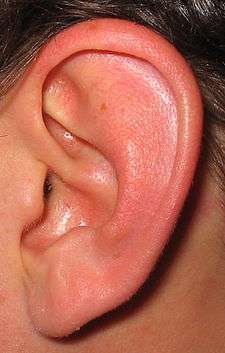
- (countable) The organ of hearing, consisting of the pinna, auditory canal, eardrum, malleus, incus, stapes and cochlea.
- (countable) The external part of the organ of hearing, the auricle.
- 1898, Winston Churchill, chapter 4, in The Celebrity:
- Judge Short had gone to town, and Farrar was off for a three days' cruise up the lake. I was bitterly regretting I had not gone with him when the distant notes of a coach horn reached my ear, and I descried a four-in-hand winding its way up the inn road from the direction of Mohair.
-
- (countable, slang) A police informant.
- 1976, Stirling Silliphant, Dean Riesner, Gail Morgan Hickman, The Enforcer.
- No I'm not kidding, and if you don't give it to me I'll let it out that you’re an ear.
- 1976, Stirling Silliphant, Dean Riesner, Gail Morgan Hickman, The Enforcer.
- The sense of hearing; the perception of sounds; skill or good taste in listening to music.
- Tennyson
- songs […] not all ungrateful to thine ear
- a good ear for music
- Tennyson
- The privilege of being kindly heard; favour; attention.
- Francis Bacon
- Dionysius […] would give no ear to his suit.
- William Shakespeare
- Friends, Romans, countrymen, lend me your ears.
- Francis Bacon
- That which resembles in shape or position the ear of an animal; a prominence or projection on an object, usually for support or attachment; a lug; a handle.
- the ears of a tub, skillet, or dish; The ears of a boat are outside kneepieces near the bow.
- (architecture) An acroterium.
- (architecture) A crossette.
Alternative forms
Derived terms
Translations
|
|


- The translations below need to be checked and inserted above into the appropriate translation tables, removing any numbers. Numbers do not necessarily match those in definitions. See instructions at Wiktionary:Entry layout#Translations.
Verb
ear (third-person singular simple present ears, present participle earing, simple past and past participle eared)
See also

Etymology 2
From Middle English eere, er, from Old English ēar (Northumbrian dialect æhher), from Proto-Germanic *ahaz (compare West Frisian ier, Dutch aar, German Ähre), from Proto-Indo-European *h₂eḱ- (“sharp”) (compare Latin acus (“needle; husk”), Tocharian B āk (“ear, awn”), Old Church Slavonic ость (ostĭ, “wheat spike, sharp point”). More at edge.
Noun
ear (plural ears)
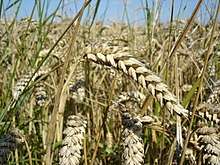
- (countable) The fruiting body of a grain plant.
- He is in the fields, harvesting ears of corn.
Synonyms
Derived terms
Translations
|
|
Verb
ear (third-person singular simple present ears, present participle earing, simple past and past participle eared)
- (intransitive) To put forth ears in growing; to form ears, as grain does.
- This corn ears well.
Etymology 3
From Old English erian, from Proto-Germanic *arjaną, from Proto-Indo-European *h₂erh₃- (“to plough”).
Verb
ear (third-person singular simple present ears, present participle earing, simple past and past participle eared)
- (archaic) To plough.
- 1595, William Shakespeare, Richard II:
- That power I have, discharge; and let them go
- To ear the land that hath some hope to grow,
- For I have none.
- 1611, Bible (King James Version), Deuteronomy 21:4:
- And the elders of that city shall bring down the heifer unto a rough valley, which is neither eared nor sown, and shall strike off the heifer's neck there in the valley
- 1595, William Shakespeare, Richard II:
Translations
Anagrams
Latin
Verb
ear
- first-person singular present passive subjunctive of eō
Middle English
Noun
ear
- Alternative form of eere (“ear of grain”)
Old English
Pronunciation
- IPA(key): /æːɑ̯r/, [æːɑ̯rˠ]
Etymology 1
Noun
ēar m
Etymology 2
From Proto-Germanic *ahaz, from Proto-Indo-European *h₂eḱ- (“pointed”).
Noun
ēar n
- ear (of corn)
Descendants
Scottish Gaelic
Noun
ear f
Antonyms
Derived terms
West Frisian
Etymology
From Old Frisian āre, from the voiced Verner alternant of Proto-Germanic *ausô, from Proto-Indo-European *h₂ṓws. Compare English ear, Dutch oor, German Ohr, Danish øre.
Noun
ear n (plural earen, diminutive earke)