ab
English
Pronunciation
- IPA(key): /æb/
- Rhymes: -æb
Etymology 1
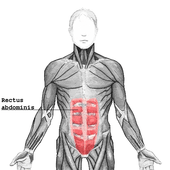
Abbreviation of abdominal muscles.
Noun
ab (plural abs)
- (informal) abdominal muscle. [Mid 20th century.][1]
- 2006, H. Peter Steeves, The Things Themselves (page 75)
- The bikinied models in most of the ESPN2 shows have abs. Many of the malnourished bikinied models in the commercials have visible rib cages. How did the two get conflated into a shared vision of beauty?
- 2010, Bill Geiger, "6-pack Abs in 9 Weeks", Reps! 17:106
- When possible, do your ab workout on a day when you're not training a major muscle group […] .
- 2006, H. Peter Steeves, The Things Themselves (page 75)
Usage notes
Most often used attributively. Substantive use is more common in the plural form abs.
Translations
Etymology 2
Abbreviation of abscess.
Noun
ab (plural abs)
Translations
Etymology 3
Abbreviations, see definitions.
Verb
ab
- Abbreviation of abort.
Noun
ab
- Abbreviation of abortion.
Preposition
ab
- Abbreviation of about.
Adverb
ab
- Abbreviation of about.
Etymology 4
From the spelling books and the fact that it was the first of the letter combinations.[2]
Noun
ab (plural abs)
- (US) The early stages of; the beginning process; the start.
References
- “ab” in The American Heritage Dictionary of the English Language, 4th edition, Boston, Mass.: Houghton Mifflin, 2000, →ISBN.
- "ab" in Merriam-Webster's Medical Dictionary, Merriam-Webster, 2002.
- “ab” in Dictionary.com Unabridged, Dictionary.com, LLC, 1995–present.
Anagrams
Aynu
Etymology
Pronunciation
- IPA(key): /ɑb/
Noun
ab
References
- Otto Ladstätter, Andreas Tietze, Die Abdal (Äynu) in Xinjiang (1994)
Blagar
Noun
ab
References
- A. Schapper (citing Steinhauer), Elevation in the spatial deictic systems of Alor-Pantar languages, in The Alor-Pantar languages: History and Typology, edited by Marian Klamer
- ASJP, citing L. C. Robinson and G. Holton, Internal classification of the Alor-Pantar language family using computational methods applied to the lexicon (2012)
Catalan
Pronunciation
- IPA(key): /ap/
- (Before a voiced consonant or a vowel) IPA(key): /ab/
- (Before a voiced consonant or a vowel in betacist dialects) IPA(key): /aβ/
Preposition
ab
- (archaic) Alternative form of amb
Danish
Etymology 1
Pronunciation
- IPA(key): /ab/, [ɑb̥]
Preposition
ab
Etymology 2
See abe (“to ape, mimic”).
Pronunciation
- IPA(key): /aːb/, [æːˀb̥]
Verb
ab
- imperative of abe
Further reading
- “ab” in Den Danske Ordbog
East Central German
Particle
ab
- (Strehlen and Schömberg, Silesia) negative particle, do not
East Yugur
Etymology
From Proto-Mongolic *ab-, compare Mongolian авах (avah).
Pronunciation
- IPA(key): /abqʰə/, [aβqʰə]
Verb
ab
- to take
- Ci ghudal kelese bu cini arasini xuulj' abqu.
- If you tell a lie I will skin you [take your skin].
-
German
Pronunciation
- (Germany) IPA(key): /ap/, /ɑp/
- (Switzerland, Austro-Bavarian) IPA(key): /ɑb̥/
- Rhymes: -ap
Etymology 1
From Old High German ab, from Proto-Germanic *ab.
Preposition
ab
- Beginning at that time or location; from.
- Ab heute verfügbar.
- Available from today.
- Ab heute verfügbar.
Derived terms
Etymology 2
From adverbial use of the preposition in verbs such as abschlagen, abgehen etc.
Adjective
ab
- (colloquial, predicative) off; not attached to anything anymore
- Der Arm ist ab.
- The arm is (hewn) off.
- Der Arm ist ab.
- (nonstandard, attributive) off; not attached to anything anymore
- Der abbe Arm ist verschwunden.
- The (hewn) off arm has disappeared.
- Der abbe Arm ist verschwunden.
Usage notes
- The predicative use is common in colloquial German throughout the country.
- The attributive forms are mostly used in Western and Northern Germany and are considerably less common than the predicative use. They used to be used mostly jocularly, but become gradually more frequent since they are much shorter than the appropriate full verb forms such as abgetrennt (“disconnected, severed”).
- The inflected attributive forms retain the devoiced consonant. Hence, sometimes they are spelled with p, rather than b: Appes Bein.
Related terms
Interlingua
Preposition
ab
Irish
Etymology 1
From Latin abbas (“father”), from Ancient Greek ἀββᾶς (abbâs), from Aramaic אַבָּא (’abbā, “father”).
Pronunciation
- IPA(key): /abˠ/
Noun
ab m (genitive singular aba, nominative plural abaí)
Declension
Coordinate terms
Derived terms
|
|
|
Etymology 2
Contraction of the relative particle a and the prevocalic variant of the past/conditional copula particle b’.
Pronunciation
- IPA(key): /əbˠ/
Particle
ab
- Alternative form of ba (used in relative clauses before a vowel sound).
- Fear maith ab ea é.
- He was a good man.
- buachaill ab áirde ná mo dheartháir ― a boy (who was) taller than my brother
-
- Alternative form of an
Related terms
Simple copular forms
|
Compound copular forms
| |||||||||||||||||||||||||||||||||||||||||||||||||||||||||||||||||||||||||||||||||||||||||||||||||||||
| v Used before vowel sounds | ||||||||||||||||||||||||||||||||||||||||||||||||||||||||||||||||||||||||||||||||||||||||||||||||||||||
Mutation
| Irish mutation | |||
|---|---|---|---|
| Radical | Eclipsis | with h-prothesis | with t-prothesis |
| ab | n-ab | hab | t-ab |
| Note: Some of these forms may be hypothetical. Not every possible mutated form of every word actually occurs. | |||
Further reading
- "ab" in Foclóir Gaeilge-Béarla, An Gúm, 1977, by Niall Ó Dónaill.
- Entries containing “ab” in English-Irish Dictionary, An Gúm, 1959, by Tomás de Bhaldraithe.
- Entries containing “ab” in New English-Irish Dictionary by Foras na Gaeilge.
Kein
Noun
ab
Further reading
- Johannes A. Z'Graggen, The Madang-Adelbert Range Sub-Phylum (1975) (as ʌb)
- Bemal Organized Phonology Data (as ab)
Latin
Alternative forms
Etymology
From Proto-Indo-European *h₂epo (“off, away”) (English off, of and after). See also po-.
Pronunciation
- (Classical) IPA(key): /ab/
- (Ecclesiastical) IPA(key): /ab/
-
Audio (Classical) (file) -
Audio (Ecclesiastical) (file)
Preposition
ab (+ ablative)
Usage notes
- Used in conjunction with passive verbs to mark the agent, e.g. Liber ā discipulō aperītur ("the book is opened by the student").
References
- ab in Charlton T. Lewis and Charles Short (1879) A Latin Dictionary, Oxford: Clarendon Press
- ab in Gaffiot, Félix (1934) Dictionnaire Illustré Latin-Français, Hachette
- Carl Meissner; Henry William Auden (1894) Latin Phrase-Book, London: Macmillan and Co.
- a gentle ascent: collis leniter ab infimo acclivis (opp. leniter a summo declivis)
- the east winds are blowing: venti ab ortu solis flant
- the Rhone[TR2] is the frontier between the Helvetii and the Sequani: Rhodanus Sequanos ab Helvetiis dividit
- to be far from town: longe, procul abesse ab urbe
- to devote every spare moment to...; to work without intermission at a thing: nullum tempus intermittere, quin (also ab opere, or ad opus)
- in the fifth year from the founding of the city: anno ab urbe condita quinto
- to be always at a person's side: ab alicuius latere non discedere
- to turn one's gaze away from an object: oculos deicere, removere ab aliqua re
- to trace one's descent from some one: originem ab aliquo trahere, ducere
- a native of England: ortus ab Anglis or oriundus ex Anglis
- from one's entry into civil life: ab ineunte (prima) aetate (De Or. 1. 21. 97)
- to begin with a thing: initium capere; incipere ab aliqua re
- to start from small beginnings: ab exiguis initiis proficisci
- the motive, cause, is to be found in..: causa repetenda est ab aliqua re (not quaerenda)
- to originate in, arise from: ab aliqua re proficisci
- to rescue from destruction: ab exitio, ab interitu aliquem vindicare
- to gain a person's esteem, friendship: gratiam inire ab aliquoor apud aliquem
- to look favourably upon; to support: propenso animo, studio esse or propensa voluntate esse in aliquem (opp. averso animo esse ab aliquo)
- to gain one's point with any one: aliquid ab aliquo impetrare
- to win golden opinions from every one: maximam ab omnibus laudem adipisci
- to have a good or bad reputation, be spoken well, ill of: bene, male audire (ab aliquo)
- to use up, make full use of one's spare time: otio abūti or otium ad suum usum transferre
- to draw away some one's attention from a thing: alicuius animum ab aliqua re abducere
- to hold the same views: idem sentire (opp. dissentire ab aliquo)
- to apply to a person for advice: consilium petere ab aliquo
- to rescue from oblivion: aliquid ab oblivione vindicare
- to be quite uncivilised: ab omni cultu et humanitate longe abesse (B. G. 1. 1. 3)
- to be educated by some one: litteras discere ab aliquo
- to receive instruction from some one: institui or erudiri ab aliquo
- to derive an argument from a thing: argumentum ducere, sumere ex aliqua re or petere ab aliqua re
- to disagree with a person: dissentire, dissidere ab or cum aliquo
- to go back to the remote ages: repetere ab ultima (extrema, prisca) antiquitate (vetustate), ab heroicis temporibus
- to have no taste for the fine arts: abhorrere ab artibus (opp. delectari artibus)
- to go a long way back (in narrative): longe, alte (longius, altius) repetere (either absolute or ab aliqua re)
- no sound passed his lips: nulla vox est ab eo audita
- to extract an answer from some one: responsum ab aliquo ferre, auferre
- to translate from Plato: ab or de (not ex) Platone vertere, convertere, transferre
- to form, derive a word from... (used of the man who first creates the word): vocabulum, verbum, nomen ducere ab, ex...
- the word amicitia comes from amare: nomen amicitiae (or simply amicitia) dicitur ab amando
- to be separated by a deadly hatred: capitali odio dissidere ab aliquo (De Am. 1. 2)
- to prevent some one from growing angry, appease his anger: animum alicuius ab iracundia revocare
- to revenge oneself on some one: ulcisci aliquem, poenas expetere ab aliquo
- to revenge oneself on another for a thing or on some one's behalf: poenas alicuius or alicuius rei repetere ab aliquo
- to protect any one from wrong: ab iniuria aliquem defendere
- to neglect one's duty: ab officio discedere
- to neglect one's duty: de, ab officio decedere
- to let oneself be perverted from one's duty: ab officio abduci, avocari
- to have an inclination for a thing: propensum, proclivem esse ad aliquid (opp. alienum, aversum esse, abhorrere ab aliqua re)
- the principles which I have followed since I came to man's estate: meae vitae rationes ab ineunte aetate susceptae (Imp. Pomp. 1. 1.)
- to summon some one from the dead: aliquem ab inferis or a mortuis evocare, excitare (passive ab inferis exsistere)
- to ask for an oracular response: oraculum petere (ab aliquo)
- from beginning to end: ab ovo usque ad mala (proverb.)
- the conversation began with..: sermo ortus est ab aliqua re
- something has been left as a legacy by some one: hereditate aliquid relictum est ab aliquo
- I have received a legacy from a person: hereditas ad me or mihi venit ab aliquo (Verr. 2. 1. 10)
- to lend, borrow money at interest: pecuniam fenori (fenore) alicui dare, accipere ab aliquo
- to borrow money from some one: pecuniam mutuari or sumere mutuam ab aliquo
- to demand an account, an audit of a matter: rationem alicuius rei reposcere aliquem or ab aliquo
- to demand an account, an audit of a matter: rationem ab aliquo reptere de aliqua re (Cluent. 37. 104)
- to gain some one's favour: gratiam inire apud aliquem, ab aliquo (cf. sect. V. 12)
- to be on a person's side (not ab alicuius partibus): ab (cum) aliquo stare (Brut. 79. 273)
- to hold different views in politics: ab aliquo in re publica dissentire
- to deliver some one from slavery: ab aliquo servitutem or servitutis iugum depellere
- to exact a penalty from some one: poenam petere, repetere ab aliquo
- to exact a penalty from some one: poenas expetere ab aliquo
- to lay down arms: ab armis discedere (Phil. 11. 33)
- to demand satisfaction, restitution: res repetere (ab aliquo) (Off. 1. 11. 36)
- to gain a victory over the enemy: victoriam reportare ab hoste
- putting aside, except: cum discessi, -eris, -eritis ab
- a gentle ascent: collis leniter ab infimo acclivis (opp. leniter a summo declivis)
- Latin Dictionary, Lewis and Short, 1879.
- Lingua Latina, Hans H. Ørberg, 2005.
Livonian
Pronunciation
- IPA(key): /ɑb/
Noun
a'b
- (anatomy) shoulder
- Tiit-Rein Viitso, Valts Ernštreits (2012–2013), Līvõkīel-ēstikīel-lețkīel sõnārōntõz, Tartu, Rīga: TÜ, LVA
Usage notes
LĒL also features a partitive plural form with -īdi as in the example abīdi nustõ "to shrug."
Declension
Middle Irish
Alternative forms
Etymology
From Old Irish aub, from Proto-Celtic *abū.
Noun
ab f (genitive aba)
Descendants
Mutation
| Middle Irish mutation | ||
|---|---|---|
| Radical | Lenition | Nasalization |
| ab | unchanged | n-ab |
| Note: Some of these forms may be hypothetical. Not every possible mutated form of every word actually occurs. | ||
Occitan
Alternative forms
Pronunciation
- IPA(key): [ˈab]
Preposition
ab
Old French
Etymology
Preposition
ab
- (10th century) with
Synonyms
- avoec (used throughout Old French into the Middle and modern French periods)
Old High German
Etymology
From Proto-Germanic *ab.
Preposition
ab
Old Occitan
Etymology
Preposition
ab
- with
- circa 1000, unknown, Lo Poèma de Boecis:
- Non comprarias ab mil liuras d’argent.
-
Descendants
Pennsylvania German
Etymology
Preposition
ab
Pumpokol
Noun
ab
Romani
Noun
ab m (plural ab)
Scottish Gaelic
Noun
ab m (genitive singular aba, plural abachan)
- Alternative form of aba
Turkish
Etymology 1
From Ottoman Turkish آب (āb, “water”), from Persian آب (āb).
Noun
ab (definite accusative abı, plural ablar)
- (obsolete, poetic) water
Etymology 2
From Ottoman Turkish عاب (ˁāb), from Arabic عَاب (ʿāb).
Noun
ab (definite accusative abı, plural ablar)
- (obsolete) defect, flaw, imperfection
Declension
| Inflection | ||
|---|---|---|
| Nominative | ab | |
| Definite accusative | abı | |
| Singular | Plural | |
| Nominative | ab | ablar |
| Definite accusative | abı | abları |
| Dative | aba | ablara |
| Locative | abda | ablarda |
| Ablative | abdan | ablardan |
| Genitive | abın | abların |
Volapük
Etymology
Conjunction
ab
Wolof
Article
ab
Usage notes
Precedes the noun.