零
| ||||||||
| ||||||||
Translingual
| Stroke order | |||
|---|---|---|---|
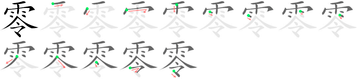 | |||
| Stroke order | |||
|---|---|---|---|
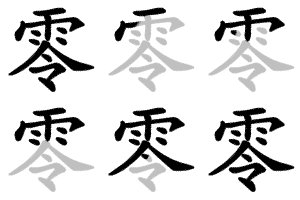 | |||
Alternative forms
In Japan and Korea, the bottom component 令 is written 亼 + ㄗ, similar to its Kangxi dictionary form. In traditional Chinese script, 令 is written 亼 + マ. In simplified Chinese and Vietnamese (Chữ Nôm) script, the component 令 is written 亽 + マ.
Han character
零 (radical 173 雨+5, 13 strokes, cangjie input 一月人戈戈 (MBOII), four-corner 10307, composition ⿱⻗令)
References
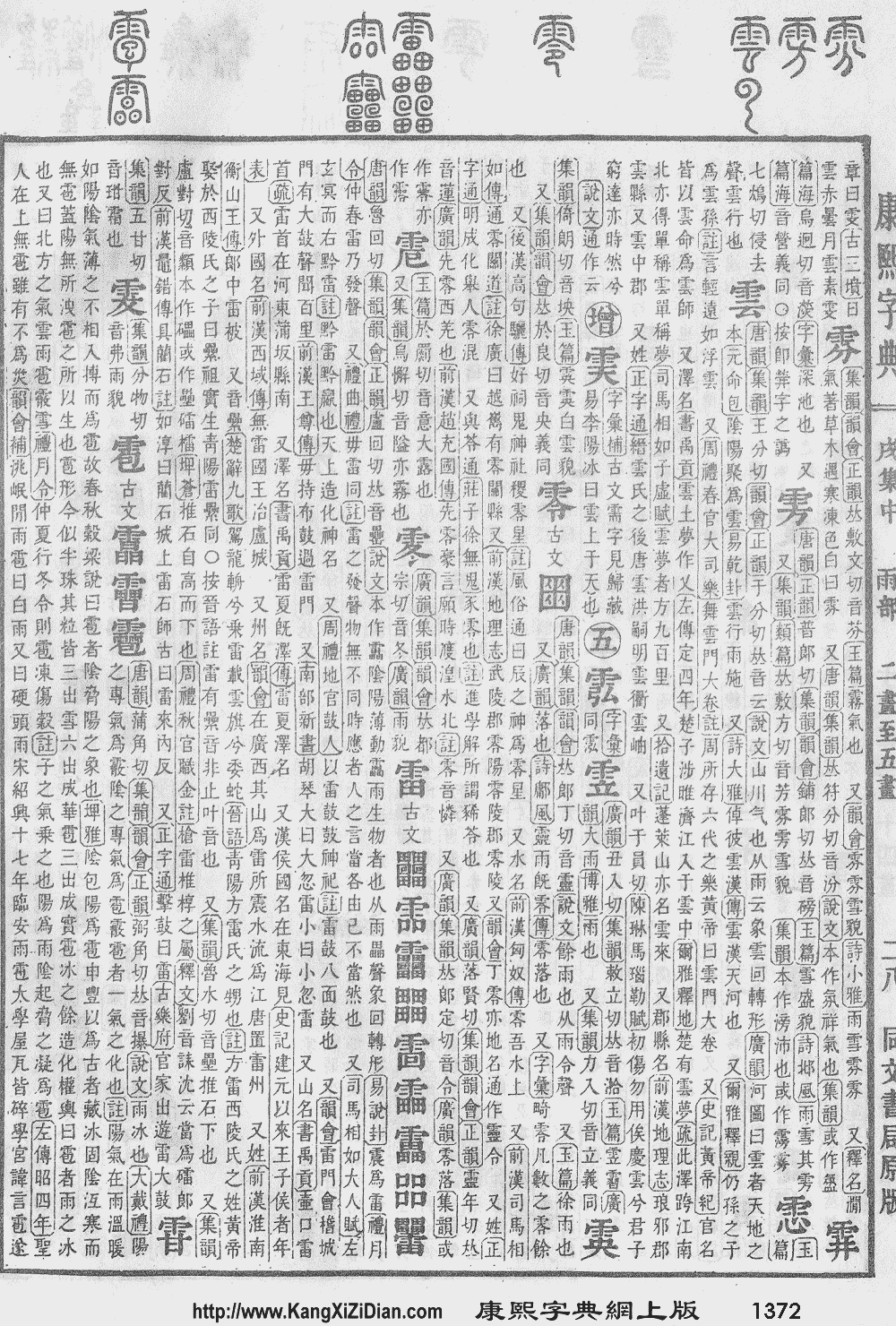
- KangXi: page 1372, character 10
- Dai Kanwa Jiten: character 42242
- Dae Jaweon: page 1880, character 5
- Hanyu Da Zidian: volume 6, page 4061, character 1
- Unihan data for U+96F6
Chinese
| simp. and trad. |
零 | |
|---|---|---|
| alt. forms | 〇 zero | |
Glyph origin
| Historical forms of the character 零 | |
|---|---|
| Shuowen Jiezi (compiled in Han) | Liushutong (compiled in Ming) |
| Small seal script | Transcribed ancient scripts |
 |
 |
| Characters in the same phonetic series (令) (Zhengzhang, 2003) | |
|---|---|
| Old Chinese | |
| 令 | *ren, *reŋ, *reŋs, *reːŋ, *reːŋs |
| 怜 | *riːn, *reːŋ |
| 零 | *riːŋ, *reːŋ, *reːŋs |
| 魿 | *ɡriŋ, *reːŋ |
| 命 | *mreŋs |
| 冷 | *raːŋʔ, *reːŋ, *reːŋʔ |
| 跉 | *reŋ, *reːŋ |
| 嶺 | *reŋʔ |
| 領 | *reŋʔ |
| 阾 | *reŋʔ, *reːŋ |
| 柃 | *reŋʔ, *reːŋ |
| 袊 | *reŋʔ |
| 詅 | *reŋs, *reːŋ |
| 旍 | *ʔsleŋ |
| 舲 | *reːŋ |
| 齡 | *reːŋ |
| 囹 | *reːŋ |
| 鴒 | *reːŋ |
| 蛉 | *reːŋ |
| 鈴 | *reːŋ |
| 苓 | *reːŋ |
| 伶 | *reːŋ |
| 泠 | *reːŋ |
| 瓴 | *reːŋ |
| 拎 | *reːŋ |
| 刢 | *reːŋ |
| 玲 | *reːŋ |
| 聆 | *reːŋ |
| 竛 | *reːŋ |
| 軨 | *reːŋ |
| 笭 | *reːŋ, *reːŋʔ |
| 翎 | *reːŋ |
| 閝 | *reːŋ |
| 鹷 | *reːŋ |
| 昤 | *reːŋ |
| 駖 | *reːŋ |
| 彾 | *reːŋ |
| 呤 | *reːŋ |
| 狑 | *reːŋ |
| 秢 | *reːŋ |
| 岭 | *reːŋ |
| 紷 | *reːŋ |
| 砱 | *reːŋ |
| 羚 | *reːŋ |
| 姈 | *reːŋ |
| 蕶 | *reːŋ |
| 澪 | *reːŋ |
Phono-semantic compound (形聲, OC *riːŋ, *reːŋ, *reːŋs) : semantic 雨 (“rain”) + phonetic 令 (OC *ren, *reŋ, *reŋs, *reːŋ, *reːŋs).
Pronunciation
Definitions
零
- (of precipitation or tear) to fall
-
- 零雨其濛。 [Classical Chinese, trad.]
- From: Classic of Poetry
- Líng yǔ qí méng. [Pinyin]
- Falls the rain, drizzly one.
零雨其蒙。 [Classical Chinese, simp.] -
- 涕零如雨。 [Classical Chinese, trad. and simp.]
- From: Classic of Poetry
- Tì líng rú yǔ. [Pinyin]
- Tears fall like raining.
- (of plants or flowers) to wither and fall
- fragment; fraction
- zero
- alt. forms: 〇
- (LGBT, slang) bottom
- alt. forms: 0
Compounds
|
|
|
See also
| Chinese numbers | ||||||||||||||||
|---|---|---|---|---|---|---|---|---|---|---|---|---|---|---|---|---|
| 0 | 1 | 2 | 3 | 4 | 5 | 6 | 7 | 8 | 9 | 10 | 102 | 103 | 104 | 108 | 1012 | |
| Normal (小寫/小写) |
〇 | 一 | 二 | 三 | 四 | 五 | 六 | 七 | 八 | 九 | 十 | 百 | 千 | 萬/万 | 億/亿 | 兆 (Taiwan) 萬億/万亿 (Mainland China) |
| Financial (大寫/大写) |
零 | 壹 | 貳/贰 | 參/叁 | 肆 | 伍 | 陸/陆 | 柒 | 捌 | 玖 | 拾 | 佰 | 仟 | |||
Japanese
| 0 | 1 > | |
|---|---|---|
| Cardinal : 零 | ||
Kanji
Readings
Etymology 1
| Kanji in this term |
|---|
| 零 |
| れい Grade: S |
| on’yomi |
From Middle Chinese 零 (leng) with an original meaning of a small rainfall. The character was later repurposed in 1248 by mathematician Li Ye to mean zero, extending from its a little bit (of rain) meaning to indicate a bit more remaining. In Li Ye's notation, a number like 302 would be represented as 三百零二, literally three hundred and remaining two, with the 零 character used as a means of skipping the tens place, by indicating zero tens.[1]
Pronunciation
Alternative forms
Noun
Numeral
Usage notes
The 〇 spelling is more common in numeric notation.
Proper noun
- A male given name
Etymology 2
| Kanji in this term |
|---|
| 零 |
| こぼし Grade: S |
| kun’yomi |
The 連用形 (ren'yōkei, “continuative or stem form”) of verb 零す, 溢す (kobosu, “to spill something”).[3][2]
Pronunciation
Noun
零 (hiragana こぼし, rōmaji koboshi)
Usage notes
More commonly spelled with the okurigana, as 零し. See that entry for more detail.
Etymology 3
| Kanji in this term |
|---|
| 零 |
| こぼれ Grade: S |
| kun’yomi |
The 連用形 (ren'yōkei, “continuative or stem form”) of verb 翻れる, 零れる (koboreru, “to spill, to be left over”).[3][2]
Pronunciation
Noun
零 (hiragana こぼれ, rōmaji kobore)
Usage notes
More commonly spelled with the okurigana, as 零れ. See that entry for more detail.
Etymology 4
| Kanji in this term |
|---|
| 零 |
| ぜろ Grade: S |
| kun’yomi |
From English zero,[3][2] or French zéro.[3] The kanji spelling is ateji.
Pronunciation
Alternative forms
Noun
零 (hiragana ぜろ, rōmaji zero)
Numeral
零 (hiragana ぜろ, rōmaji zero)
Usage notes
The 〇 spelling is more common in numeric notation. The katakana spelling ゼロ is more common in general contexts.
References
- ↑ 1999, 「算木」を超えた男: もう一つの近代数学の誕生と関孝和 ("Sangi" o Koeta Otoko: Mō Hitotsu no Kindai Sūgaku no Tanjō to Seki Takakazu, “The Man Who Went Beyond 'Counting Sticks': The Birth of Another Modern Mathematics, and Seki Takakazu”) (in Japanese), Wang Qing-xiang, Tōkyō: Toyo Shoten, →ISBN
- 1 2 3 4 5 6 7 2006, 大辞林 (Daijirin), Third Edition (in Japanese), Tōkyō: Sanseidō, →ISBN
- 1 2 3 4 1988, 国語大辞典(新装版) (Kokugo Dai Jiten, Revised Edition) (in Japanese), Tōkyō: Shogakukan
| Numbers in Japanese | |||||||||
|---|---|---|---|---|---|---|---|---|---|
| 0 | 1 | 2 | 3 | 4 | 5 | 6 | 7 | 8 | 9 |
| 零 (rei) ゼロ (zero) | 一 (ichi) | 二 (ni) | 三 (san) | 四 (yon) 四 (shi) | 五 (go) | 六 (roku) | 七 (nana) 七 (shichi) | 八 (hachi) | 九 (kyū) 九 (ku) |
| 10 | 11 | 12 | 13 | 14 | 15 | 16 | 17 | 18 | 19 |
| 十 (jū) | 十一 (jūichi) | 十二 (jūni) | 十三 (jūsan) | 十四 (jūyon) 十四 (jūshi) | 十五 (jūgo) | 十六 (jūroku) | 十七 (jūnana) 十七 (jūshichi) | 十八 (jūhachi) | 十九 (jūkyū) 十九 (jūku) |
Korean
Hanja
零 • (ryeong→yeong, ryeon→yeon) (hangeul 령→영, 련→연, revised ryeong→yeong, ryeon→yeon, McCune–Reischauer ryŏng→yŏng, ryŏn→yŏn, Yale lyeng→yeng, lyen→yen)
- This term needs a translation to English. Please help out and add a translation, then remove the text
{{rfdef}}.
Vietnamese
Han character
- This term needs a translation to English. Please help out and add a translation, then remove the text
{{rfdef}}.