雷
| ||||||||
Translingual
Han character
雷 (radical 173, 雨+5, 13 strokes, cangjie input 一月田 (MBW), four-corner 10603, composition ⿱⻗田)
Derived characters
References
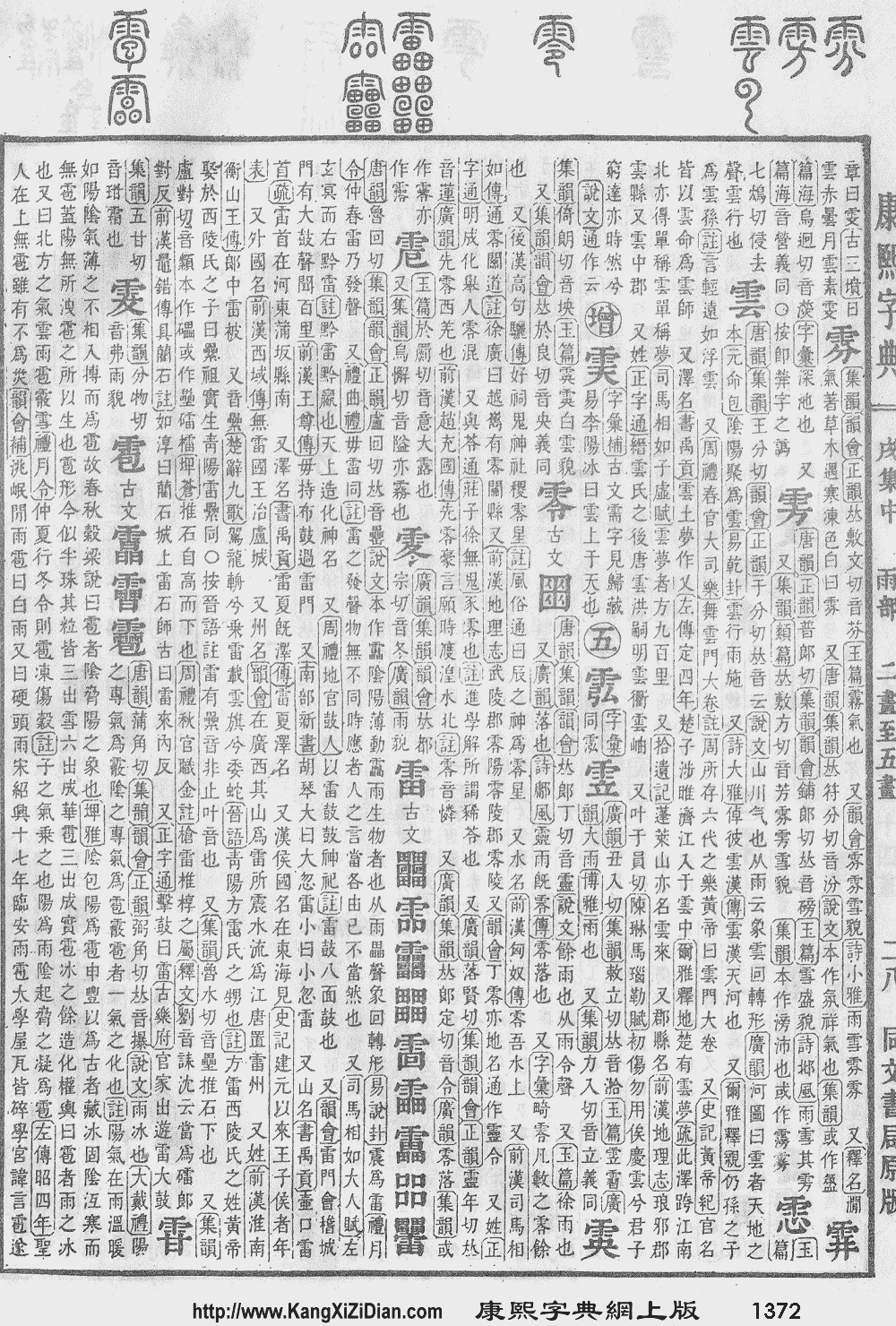
- KangXi: page 1372, character 14
- Dai Kanwa Jiten: character 42245
- Dae Jaweon: page 1881, character 3
- Hanyu Da Zidian: volume 6, page 4060, character 2
- Unihan data for U+96F7
Chinese
| simp. and trad. |
雷 | |
|---|---|---|
| alt. forms | ||
Glyph origin
| Characters in the same phonetic series (畾) (Zhengzhang, 2003) | |
|---|---|
| Old Chinese | |
| 摞 | *roːl, *roːls |
| 騾 | *roːl |
| 螺 | *roːl |
| 蔂 | *roːl, *rul |
| 虆 | *roːl, *rul |
| 瘰 | *roːlʔ |
| 礌 | *ruːl, *ruːls |
| 雷 | *ruːl |
| 擂 | *ruːl, *ruːls |
| 攂 | *ruːl, *ruːls |
| 礧 | *ruːll, *ruːlʔ, *ruːls |
| 儡 | *ruːl, *ruːlʔ, *ruːls |
| 瓃 | *ruːl, *rul, *ruls |
| 櫑 | *ruːl, *ruːlʔ |
| 鑘 | *ruːl, *ruːlʔ |
| 鐳 | *ruːl |
| 畾 | *ruːl |
| 轠 | *ruːl, *rulʔ |
| 罍 | *ruːl |
| 蕾 | *ruːlʔ |
| 癗 | *ruːlʔ |
| 磥 | *ruːlʔ |
| 累 | *ruːls, *rolʔ, *rols |
| 儽 | *ruːls, *rul |
| 樏 | *rolʔ, *rul |
| 鸓 | *rul, *rulʔ |
| 嫘 | *rul |
| 纍 | *rul, *ruls |
| 欙 | *rul |
| 纝 | *rul |
| 壘 | *rulʔ |
| 櫐 | *rulʔ |
| 蘽 | *rulʔ |
| 藟 | *rulʔ |
| 讄 | *rulʔ |
Ancient simplification of 靁, which was a phono-semantic compound (形聲, OC *ruːl) : semantic 雨 (“rain”) + phonetic 畾 (OC *ruːl).
Pronunciation
Definitions
雷
Compounds
|
|
|
Japanese
Kanji
Readings
Compounds
- 避雷針 (hiraishin): lightning rod
- 雷鳥 (raichō): a rock ptarmigan, a snow grouse
- 雷神鳥 (raijinchō): a thunderbird
- 雷獣 (raijū): a thunder beast
Etymology 1
| Kanji in this term |
|---|
| 雷 |
| かみなり Grade: S |
| kun’yomi |
Compound of 神 (kami, “god, spirit”) + 鳴り (nari, “the 連用形 (ren'yōkei, “continuative or stem form”) of verb 鳴る naru, “to cry out, to call””).[1][2]
Pronunciation
Noun
雷 (hiragana かみなり, rōmaji kaminari)
- thunder (the sound)
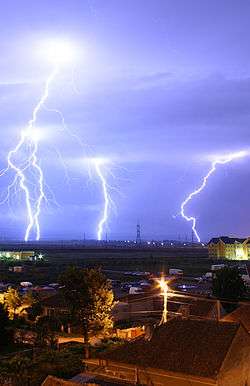
- lightning, a thunderbolt
- 1999 February 4, “サンダー・キッズ [Thunder Kid]”, in Vol.1 (in Japanese), Konami:
- 雷をからだの中に蓄電させている。泣かせたときは危険。
- Kaminari o karada no naka ni chikuden saseteiru. Nakaseta toki wa kiken.
- He stores lightning inside his body. He’s very dangerous when he cries.
- 雷をからだの中に蓄電させている。泣かせたときは危険。
- 1999 March 1, “エレキッズ [Elekid]”, in BOOSTER 1 (in Japanese), Konami:
- 雷攻撃は意外と強い。甘く見ると感電するぞ。
- Kaminarikōgeki wa igai to tsuyoi. Amaku miru to kanden suru zo.
- It has a surprisingly powerful lightning attack. However, its electrocution tends to be underestimated.
- 雷攻撃は意外と強い。甘く見ると感電するぞ。
-
Usage notes
This kaminari reading is the most common reading when used as a standalone noun.
Synonyms
Idioms
Etymology 2
| Kanji in this term |
|---|
| 雷 |
| かんなり Grade: S |
| kun’yomi |
/kaminari/ → /kannari/
Shift in pronunciation from kaminari above.[1][2]
Pronunciation
Alternative forms
- 雷鳴り, 雷鳴
Noun
雷 (hiragana かんなり, rōmaji kannari)
- (rare, archaic) thunder (the sound)
- (rare, archaic) lightning, a thunderbolt
Proper noun
雷 (hiragana かんなり, rōmaji Kannari)
Etymology 3
| Kanji in this term |
|---|
| 雷 |
| いかずち Grade: S |
| kun’yomi |
/ika t͡su t͡ɕi/ → /ikad͡ʑut͡ɕi/ → /ikazut͡ɕi/
From Old Japanese. Originally a compound of 厳 (ika, “sternness, terribleness, imposingness”) + つ (tsu, Old Japanese possessive particle) + 霊 (chi, “spirit, force, essence”).[1][2]
Pronunciation
Noun
雷 (hiragana いかずち, rōmaji ikazuchi, historical hiragana いかづち)
Etymology 4
| Kanji in this term |
|---|
| 雷 |
| なるかみ Grade: S |
| kun’yomi |
Compound of 鳴る (naru, “to cry out, to call”) + 神 (kami, “god, spirit”).[1][2]
Pronunciation
Alternative forms
- 鳴る神, 鳴神
Noun
雷 (hiragana なるかみ, rōmaji narukami)
- (rare) thunder (the sound)
- (rare) lightning, a thunderbolt
Proper noun
雷 (hiragana なるかみ, rōmaji Narukami)
- one of the eighteen styles of kabuki
- This sense is more commonly spelled as 鳴神.
Etymology 5
| Kanji in this term |
|---|
| 雷 |
| らい Grade: S |
| on’yomi |
From Middle Chinese 雷 (luəi, “thunder”). Compare modern Mandarin reading léi, Cantonese leoi4.
Pronunciation
Noun
- (rare) thunder (the sound)
- (rare) lightning, a thunderbolt
Usage notes
Used more in compounds than on its own. As a standalone noun, the kaminari reading is the most common.
References
Korean
Hanja
雷 • (roe>noe) (hangeul 뢰>뇌, revised roe>noe, McCune–Reischauer roe>noe, Yale loy>noy)
- This term needs a translation to English. Please help out and add a translation, then remove the text
{{rfdef}}.
Vietnamese
Han character
雷 (lôi)
- This term needs a translation to English. Please help out and add a translation, then remove the text
{{rfdef}}.