蓮
| ||||||||
Translingual
Han character
蓮 (radical 140 艸+11, 14 strokes, cangjie input 廿卜十十 (TYJJ), four-corner 44304, composition ⿱艹連)
References
- KangXi: page 1052, character 16
- Dai Kanwa Jiten: character 31722
- Dae Jaweon: page 1514, character 27
- Hanyu Da Zidian: volume 5, page 3261, character 10
- Unihan data for U+84EE

Chinese
| trad. | 蓮 | |
|---|---|---|
| simp. | 莲 | |
Glyph origin
| Characters in the same phonetic series (連) (Zhengzhang, 2003) | |
|---|---|
| Old Chinese | |
| 連 | *ren |
| 漣 | *ren |
| 鰱 | *ren |
| 翴 | *ren |
| 鏈 | *ren, *rens, *r̥ʰen |
| 璉 | *renʔ |
| 僆 | *renʔ, *reːns |
| 摙 | *renʔ, *rens |
| 蓮 | *renʔ, *reːn |
| 嗹 | *reːn |
| 縺 | *reːn |
Phono-semantic compound (形聲, OC *renʔ, *reːn) : semantic 艹 + phonetic 連 (OC *ren).
Pronunciation 1
Definitions
蓮
Compounds
Pronunciation 2
Definitions
蓮
- Only used in 蓮勺/莲勺.
Japanese
Kanji
(“Jinmeiyō” kanji used for names)
Readings
Etymology 1
| Kanji in this term |
|---|
| 蓮 |
| はちす Jinmeiyō |
| kun’yomi |
Originally a compound of 蜂 (hachi, “bee”) + 巣 (su, “nest, hive”), literally “beehive, honeycomb”, from the way the lotus seed resembles a honeycomb.[1][2]
Pronunciation
Noun
蓮 (hiragana はちす, rōmaji hachisu)
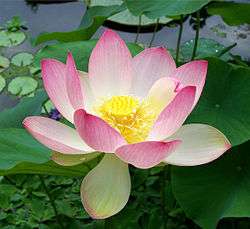
- older name for hasu below: a lotus plant or flower, Nelumbo nucifera
- (Buddhism, particularly Pure Land Buddhism) a lotus bloom in the realm of Sukhāvatī (“Land of Ultimate Bliss”), as an expression of reincarnation
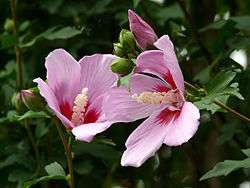
- alternate name for 木槿 (mukuge), Hibiscus syriacus: the rose of Sharon, rose mallow, or St. Joseph's rod
Related terms
Proper noun
蓮 (hiragana はちす, rōmaji Hachisu)
- the name of various places in Japan
- a surname
Etymology 2
| Kanji in this term |
|---|
| 蓮 |
| はす Jinmeiyō |
| kun’yomi |
/hat͡ɕisu/ → */hassu/ → /hasu/
Appears to be a contraction of hachisu above.
Pronunciation
Noun
Usage notes
The reading hasu appears to be more common for the lotus meaning in modern Japanese.
Derived terms
Proper noun
蓮 (hiragana はす, rōmaji Hasu)
- a female given name
- a surname
Etymology 3
| Kanji in this term |
|---|
| 蓮 |
| れん Jinmeiyō |
| on’yomi |
From Middle Chinese 蓮 (len, “lotus fruit”). Compare modern Mandarin reading lián.
Pronunciation
Noun
Usage notes
The ren reading is seldom used on its own. It is most often used in compounds.
Derived terms
Proper noun
- a female given name
- a surname
References
Korean
Hanja
蓮 • (ryeon>yeon) (hangeul 련>연, revised ryeon>yeon, McCune–Reischauer ryŏn>yŏn, Yale lyen>yen)
- This term needs a translation to English. Please help out and add a translation, then remove the text
{{rfdef}}.
Vietnamese
Han character
蓮 (liên)
- This term needs a translation to English. Please help out and add a translation, then remove the text
{{rfdef}}.