event
See also: évent
English
Etymology 1
From Middle French event, from Latin ēventus (“an event, occurrence”), from ēveniō (“to happen, to fall out, to come out”), from ē (“out of, from”), short form of ex + veniō (“come”); related to venture, advent, convent, invent, convene, evene, etc.
Pronunciation
- IPA(key): /ɪˈvɛnt/
Audio (US) (file) - Rhymes: -ɛnt
Noun
event (plural events)
- An occurrence; something that happens.
- Macaulay
- the events of his early years
- Macaulay
- One of several contests that combine to make up a competition.
- An end result; an outcome (now chiefly in phrases).
- 1621, Democritus Junior [pseudonym; Robert Burton], The Anatomy of Melancholy, Oxford: Printed by Iohn Lichfield and Iames Short, for Henry Cripps, OCLC 216894069; The Anatomy of Melancholy: […], 2nd corrected and augmented edition, Oxford: Printed by John Lichfield and James Short, for Henry Cripps, 1624, OCLC 54573970, partition 2, section 3, member 3:
- hard beginnings have many times prosperous events […].
- 1707, Semele, by Eccles and Congrieve; scene 8
- Of my ill boding Dream / Behold the dire Event.
- Young
- dark doubts between the promise and event
- In the event, he turned out to have what I needed anyway.
-
- (physics) A point in spacetime having three spatial coordinates and one temporal coordinate.
- (computing) A possible action that the user can perform that is monitored by an application or the operating system (event listener). When an event occurs an event handler is called which performs a specific task.
- (probability theory) A set of some of the possible outcomes; a subset of the sample space.
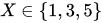
- If is a random variable representing the toss of a six-sided die, then its sample space could be denoted as {1,2,3,4,5,6}. Examples of events could be: , , and .
- (obsolete) An affair in hand; business; enterprise.
- Shakespeare
- Leave we him to his events.
- Shakespeare
- (medicine) An episode of severe health conditions.



Hyponyms
Hyponyms of "event"
- episodic events
- K-T extinction event
- media event
- quick time event
- risk event
- sentinel event
- social event
- speciation event
Derived terms
Derived terms
|
Related terms
Terms related to "event"
Translations
occurrence
|
|
one of several contests that combine to make up a sports competition
point in spacetime (physics)
computing: action which triggers an event handler
probability theory: a set of some of the possible outcomes
(medicine) An episode of severe health conditions
- The translations below need to be checked and inserted above into the appropriate translation tables, removing any numbers. Numbers do not necessarily match those in definitions. See instructions at Wiktionary:Entry layout#Translations.
Further reading
Verb
event (third-person singular simple present events, present participle eventing, simple past and past participle evented)
- (obsolete) To occur, take place.
- 1590, Robert Greene, Greene’s Never Too Late, in The Life and Complete Works in Prose and Verse of Robert Greene, Volume 8, Huff Library, 1881, p. 33,
- […] I will first rehearse you an English Historie acted and evented in my Countrey of England […]
- 1590, Robert Greene, Greene’s Never Too Late, in The Life and Complete Works in Prose and Verse of Robert Greene, Volume 8, Huff Library, 1881, p. 33,
Etymology 2
Verb
event (third-person singular simple present events, present participle eventing, simple past and past participle evented)
- (obsolete, intransitive) To be emitted or breathed out; to evaporate.
- c. 1597, Ben Jonson, The Case is Altered, Act V, Scene 8, in C. H. Herford and Percy Simpson (editors), Ben Jonson, Volume 3, Oxford: Clarendon Press, 1927, p. 178,
- ô that thou sawst my heart, or didst behold
- The place from whence that scalding sigh evented.
- 1615, William Barclay, Callirhoe; commonly called The Well of Spa or The Nymph of Aberdene, Aberdeen, 1799, p. 12,
- This is the reason why this water hath no such force when it is carried, as it hath at the spring it self: because the vertue of it consisteth in a spiritual and occulte qualitie, which eventeth and vanisheth by the carriage.
- c. 1597, Ben Jonson, The Case is Altered, Act V, Scene 8, in C. H. Herford and Percy Simpson (editors), Ben Jonson, Volume 3, Oxford: Clarendon Press, 1927, p. 178,
- (obsolete, transitive) To expose to the air, ventilate.
- 1559, attributed to William Baldwin, “How the Lorde Clyfford for his straunge and abhominable cruelty came to as straunge and sodayne a death” in The Mirror for Magistrates, Part III, edited by Joseph Haslewood, London: Lackington, Allen & Co., 1815, Volume 2, p. 198,
- For as I would my gorget have undon
- To event the heat that had mee nigh undone,
- An headles arrow strake mee through the throte,
- Where through my soule forsooke his fylthy cote.
- 1598, George Chapman, The Third Sestiad, Hero and Leander (completion of the poem begun by Christopher Marlowe),
- […] as Phœbus throws
- His beams abroad, though he in clouds be clos’d,
- Still glancing by them till he find oppos’d
- A loose and rorid vapour that is fit
- T’ event his searching beams, and useth it
- To form a tender twenty-colour’d eye,
- Cast in a circle round about the sky […]
- 1559, attributed to William Baldwin, “How the Lorde Clyfford for his straunge and abhominable cruelty came to as straunge and sodayne a death” in The Mirror for Magistrates, Part III, edited by Joseph Haslewood, London: Lackington, Allen & Co., 1815, Volume 2, p. 198,
This article is issued from
Wiktionary.
The text is licensed under Creative Commons - Attribution - Sharealike.
Additional terms may apply for the media files.