grave
English
Pronunciation
- enPR: grāv, IPA(key): /ɡɹeɪv/
Audio (US) (file) - Rhymes: -eɪv
Etymology 1
From Middle English grave, grafe, from Old English græf (“cave, grave, trench”), from Proto-Germanic *grabą, *grabō (“grave, trench, ditch”), from Proto-Indo-European *gʰrābʰ- (“to dig, scratch, scrape”). Cognate with West Frisian grêf (“grave”), Dutch graf (“grave”), Low German Graf (“a grave”), Graff, German Grab (“grave”), Danish, Swedish and Norwegian grav (“grave”), Icelandic gröf (“grave”). Related to groove.
Noun
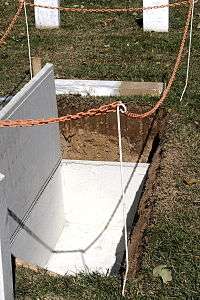
grave (plural graves)
- An excavation in the earth as a place of burial
- (Can we date this quote?), John 11:17:
- He had lain in the grave four days.
- 1856, Eleanor Marx-Aveling (translator), Gustave Flaubert (author), Madame Bovary, Part III, Chapter X:
- They reached the cemetery. The men went right down to a place in the grass where a grave was dug. They ranged themselves all round; and while the priest spoke, the red soil thrown up at the sides kept noiselessly slipping down at the corners.
- (Can we date this quote?), John 11:17:
- Any place of interment; a tomb; a sepulcher.
- (by extension) Death, destruction.
Derived terms
Related terms
Translations
|
|
See also

Etymology 2
From Middle English graven, from Old English grafan (“to dig, dig up, grave, engrave, carve, chisel”), from Proto-Germanic *grabaną (“to dig”), from Proto-Indo-European *gʰrebʰ- (“to dig, scratch, scrape”). Cognate with Dutch graven (“to dig”), German graben (“to dig”), Swedish gräva (“to dig”).
Verb
grave (third-person singular simple present graves, present participle graving, simple past graved or grove, past participle graved or graven)
- (transitive, obsolete) To dig.
- (Can we date this quote?) Book of Prayer, Psalms 7:16:
- He hath graven and digged up a pit.
- (Can we date this quote?) Book of Prayer, Psalms 7:16:
- (transitive, obsolete) To carve or cut, as letters or figures, on some hard substance; to engrave.
- Exodus 28:9:
- Thou shalt take two onyx stones, and grave on them the names of the children of Israel.
- 1872, James De Mille, The Cryptogram, HTML edition, The Gutenberg Project, published 2009:
- Deep lines were graven on her pale forehead, and on her wan, thin cheeks.
- (Can we date this quote?) Robert Louis Stevenson, Requiem:
- This be the verse you grave for me / "Here he lies where he longs to be"
- Exodus 28:9:
- (transitive, obsolete) To carve out or give shape to, by cutting with a chisel; to sculpture
- to grave an image
- (Can we date this quote?) Geoffrey Chaucer:
- With gold men may the hearte grave.
- (transitive, obsolete) To impress deeply (on the mind); to fix indelibly.
- (Can we date this quote?) Matthew Prior:
- O! may they graven in thy heart remain.
- (Can we date this quote?) Matthew Prior:
- (transitive, obsolete) To entomb; to bury.
- (Can we date this quote?), William Shakespeare:
- Lie full low, graved in the hollow ground.
- (Can we date this quote?), William Shakespeare:
- (transitive, obsolete, nautical) To clean, as a vessel's bottom, of barnacles, grass, etc., and pay it over with pitch — so called because graves or greaves was formerly used for this purpose.
- (intransitive, obsolete) To write or delineate on hard substances, by means of incised lines; to practice engraving.
Related terms
Translations
|
Etymology 3
From French grave, from Latin gravis (“heavy, important”). Doublet of grief.
Adjective
grave (comparative graver, superlative gravest)
- (obsolete) Influential, important; authoritative. [16th-18th c.]
- 1621, Democritus Junior [pseudonym; Robert Burton], The Anatomy of Melancholy, Oxford: Printed by Iohn Lichfield and Iames Short, for Henry Cripps, OCLC 216894069; The Anatomy of Melancholy: […], 2nd corrected and augmented edition, Oxford: Printed by John Lichfield and James Short, for Henry Cripps, 1624, OCLC 54573970, (please specify |partition=1, 2, or 3):, II.3.7:
- An illiterate fool sits in a mans seat; and the common people hold him learned, grave, and wise.
-
- Characterised by a dignified sense of seriousness; not cheerful, sombre. [from 16th c.]
- Low in pitch, tone etc. [from 17th c.]
- (Can we date this quote?) Moore, Encyclopedia of Music:
- The thicker the cord or string, the more grave is the note or tone.
- (Can we date this quote?) Moore, Encyclopedia of Music:
- Serious, in a negative sense; important, formidable. [from 19th c.]
Synonyms
- The terms below need to be checked and allocated to the definitions (senses) of the headword above. Each term should appear in the sense for which it is appropriate. Use the templates
{{syn|en|...}}or{{ant|en|...}}to add them to the appropriate sense(s).
Translations
Noun
grave (plural graves)
- A written accent used in French, Italian, and other languages. è is an e with a grave accent.
Translations
Anagrams
Danish
Pronunciation
- IPA(key): /ɡraːvə/, [ˈɡ̊ʁɑːvə]
Etymology 1
From Italian grave, from Latin gravis (“heavy, grave”).
Adverb
grave
- (music) grave (low in pitch, tone etc.)
- accent grave – accent grave, grave accent
Etymology 2
From Old Norse grafa (“to dig, bury”), from Proto-Germanic *grabaną, from Proto-Indo-European *gʰrābʰ- (“to dig, scratch, scrape”).
Verb
grave (imperative grav, infinitive at grave, present tense graver, past tense gravede, perfect tense har gravet)
- dig (to move hard-packed earth out of the way)
Derived terms
Etymology 3
See grav (“grave, tomb, pit”).
Noun
grave c
- plural indefinite of grav
Dutch
Pronunciation
Audio (file)
Verb
grave
- (archaic) singular present subjunctive of graven
Anagrams
Esperanto
Adverb
grave
French
Etymology
Pronunciation
- IPA(key): /ɡʁav/
audio (file)
Adjective
grave (plural graves)
- serious
- solemn
- low-pitched
- Antonym: aigu
Adverb
grave
Related terms
Verb
grave
Further reading
- “grave” in le Trésor de la langue française informatisé (The Digitized Treasury of the French Language).
Anagrams
Italian
Etymology
Adjective
grave (masculine and feminine plural gravi)
Synonyms
Antonyms
Related terms
Anagrams
Latin
Adjective
grave
References
- grave in Charlton T. Lewis (1891) An Elementary Latin Dictionary, New York: Harper & Brothers
- grave in Charles du Fresne du Cange’s Glossarium Mediæ et Infimæ Latinitatis (augmented edition, 1883–1887)
- grave in The Perseus Project (1999) Perseus Encyclopedia
Middle English
Alternative forms
Etymology 1
From Old English græf, from Proto-Germanic *grabą.
Pronunciation
- IPA(key): /ɡraːv/, /ɡrav/
Noun
grave (plural graves)
Derived terms
Descendants
References
- “grāve (n.(1))” in MED Online, Ann Arbor, Mich.: University of Michigan, 2007, retrieved 2018-04-09.
Etymology 2
From Old French gravé.
Pronunciation
- IPA(key): /ˈɡraːvɛi̯/, /ˈɡraːveː/
Noun
grave (plural graves)
- Alternative form of gravey
Middle French
Alternative forms
Etymology
From Old French grave.
Noun
grave f (plural graves)
Descendants
- French: grève
References
- Godefroy, Frédéric, Dictionnaire de l'ancienne langue française et de tous ses dialectes du IXe au XVe siècle (1881) (grave)
Middle High German
Etymology
From Old High German grāfo, grāvo, grāfio, grāvio (“count, local judge”).
Pronunciation
- IPA(key): /ɡraːvə/
Noun
grâve m
Declension
| Case \ Number | singular | plural |
|---|---|---|
| nominative | grâve | grâven |
| accusative | grâven | grâven |
| genitive | grâven | grâven |
| dative | grâven | grâven |
Derived terms
Descendants
- German: Graf
References
- “grâve” Benecke, Georg Friedrich, Wilhelm Müller, and Friedrich Zarncke. Mittelhochdeutsches Wörterbuch: mit benutzung des Nachlasses von Benecke. Vol. 1. S. Hirzel, 1863.
Norwegian Bokmål
Etymology
From Old Norse grafa, from Proto-Germanic *grabaną, from Proto-Indo-European *gʰrābʰ- (“to dig, scratch, scrape”).
Verb
grave (imperative grav, present tense graver, passive graves, simple past gravde or grov, past participle gravd, present participle gravende)
Derived terms
References
- “grave” in The Bokmål Dictionary.
Norwegian Nynorsk
Verb
grave (present tense grev, past tense grov, past participle grave, passive infinitive gravast, present participle gravande, imperative grav)
- Alternative form of grava
Derived terms
Old French
Alternative forms
Etymology
Probably via Gaulish from Celtic, related to Cornish grow (“gravel”), Breton grouan, and Welsh gro (“gravel”); ultimately from Proto-Indo-European *gʰr-eu-d-.
Noun
grave f (oblique plural graves, nominative singular grave, nominative plural graves)
Descendants
- French: grève
References
- Godefroy, Frédéric, Dictionnaire de l'ancienne langue française et de tous ses dialectes du IXe au XVe siècle (1881) (grave)
Portuguese
Pronunciation
- (Portugal) IPA(key): /ˈɡɾa.vɨ/
- (Brazil) IPA(key): /ˈɡɾa.vi/
- (South Brazil) IPA(key): /ˈɡɾa.ve/
- Rhymes: -avi
Etymology 1
From Old Portuguese grave, from Latin gravis (“heavy; grave”), from Proto-Indo-European *gʷréh₂us.
Adjective
grave m, f (plural graves, comparable)
- serious; grave (having possible severe negative consequences)
- Sofria de uma doença grave.
- He suffered from a serious disease.
- (of sound) low-pitched; grave (low in pitch or tone)
- O som da tuba é mais grave do que o do trombone.
- The sound of the tuba has a lower pitch than that of the trombone.
- grave; serious; sombre; austere; solemn (characterised by a dignified sense of seriousness)
- O programa tinha um tom grave.
- The program had a serious tone.
- (archaic, physics) that falls down; that doesn’t float
- O balão não é um corpo grave.
- Balloons are not a falling body.
Inflection
Synonyms
Antonyms
- (low-pitched): agudo
Noun
grave f (plural graves)
- (music) a low-pitched note
Etymology 2
Verb
grave
- first-person singular (eu) present subjunctive of gravar
- third-person singular (ele and ela, also used with você and others) present subjunctive of gravar
- third-person singular (você) affirmative imperative of gravar
- third-person singular (você) negative imperative of gravar
Spanish
Pronunciation
- IPA(key): /ˈɡɾabe/, [ˈɡɾaβe]
- Homophone: grabe
Etymology 1
Adjective
grave (plural graves) (superlative gravísimo)
- serious, grave
- bass (sound)
- solemn
- (grammar) stressed in the penultimate syllable; paroxytone
Coordinate terms
Related terms
Etymology 2
See etymology on the main entry.
Verb
grave
Anagrams
Further reading
- “grave” in Diccionario de la lengua española, Vigésima tercera edición, Real Academia Española, 2014.
Swedish
Adjective
grave
- absolute definite natural masculine form of grav.