倭
| ||||||||
Translingual
Han character
倭 (radical 9 人+8, 10 strokes, cangjie input 人竹木女 (OHDV), four-corner 22244, composition ⿰亻委)
References
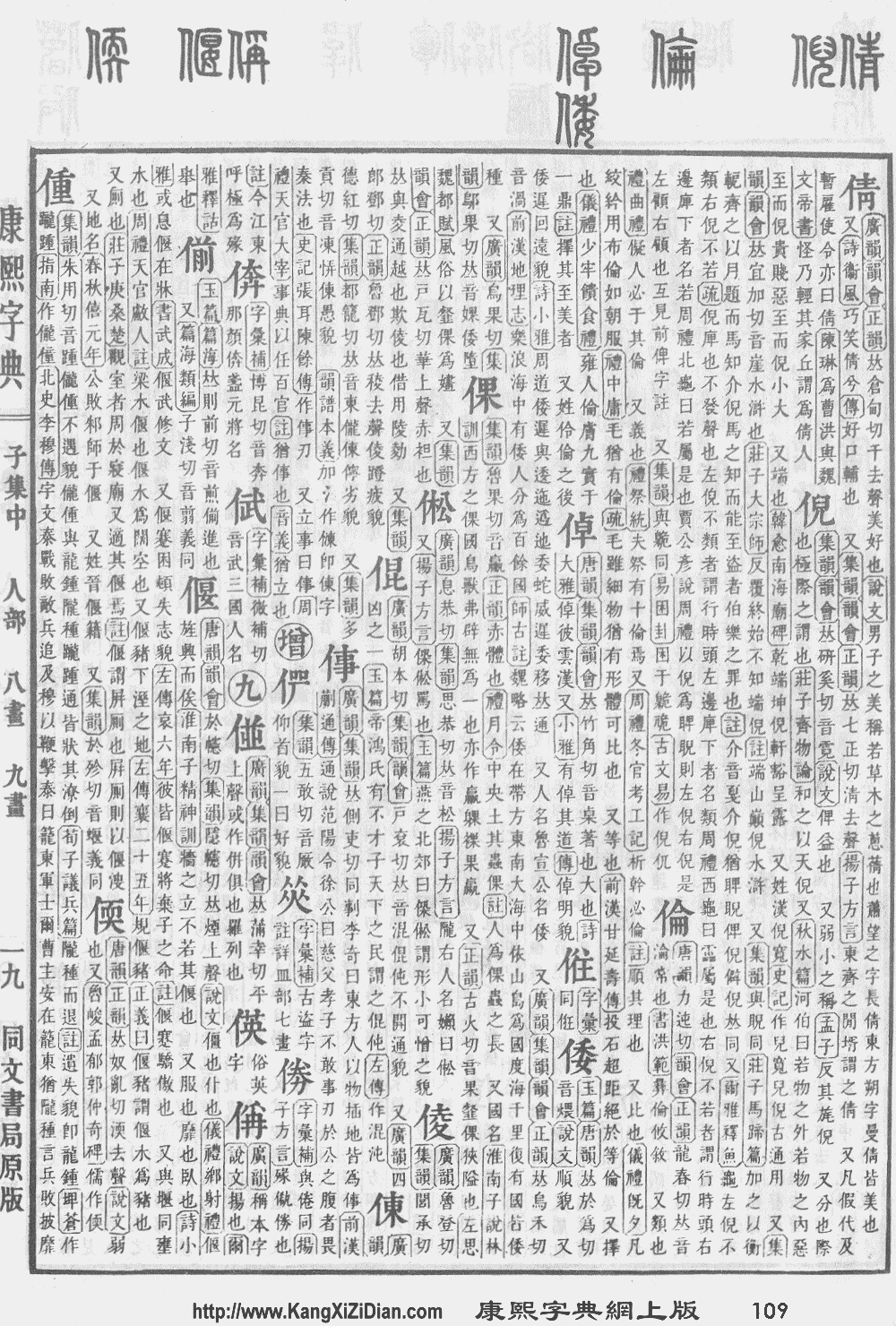
- KangXi: page 109, character 6
- Dai Kanwa Jiten: character 796
- Dae Jaweon: page 232, character 4
- Hanyu Da Zidian: volume 1, page 179, character 8
- Unihan data for U+502D
- Shuowen Jiezi: volume 15, page 46, character 18. http://kanji.zinbun.kyoto-u.ac.jp/db-machine/toho/html/A0200003.html
Chinese
| simp. and trad. |
倭 | |
|---|---|---|
Glyph origin
| Historical forms of the character 倭 | ||
|---|---|---|
| ||
|
References: Mostly from Richard Sears' Chinese Etymology site (authorisation),
|


| Characters in the same phonetic series (委) (Zhengzhang, 2003) | |
|---|---|
| Old Chinese | |
| 矮 | *qraːlʔ |
| 躷 | *qraːlʔ |
| 捼 | *noːl, *nuːl, *njul |
| 倭 | *qoːl, *qoːlʔ, *qrol |
| 涹 | *qoːl |
| 踒 | *qoːl |
| 餧 | *nuːlʔ, *qrols |
| 諉 | *nols, *qrolʔ |
| 痿 | *njol, *qrol |
| 萎 | *qrol, *qrols |
| 逶 | *qrol |
| 覣 | *qrol |
| 蜲 | *qrol, *qrolʔ |
| 委 | *qrol, *qrolʔ |
| 緌 | *njul |
Pronunciation 1
Definitions
倭
- dwarf
- (historical, now pejorative) Japan; Yamato
- (historical, now pejorative) Japanese
- dwarfish, short
See also
Compounds
|
|
|
Pronunciation 2
Definitions
倭
- (Can we verify(+) this sense?) (archaic) obedient
- Only used in 倭遲/倭迟, alternative form of 逶迤 (wēiyí, “winding; meandering”).
Pronunciation 3
Definitions
倭
- Only used in 倭墮髻/倭堕髻 (wōduòjì, “a hairstyle for women that was popular during the Han Dynasty in which the hair was gathered up in a lopsided bun”).
Japanese
Kanji
倭
(“Jinmeiyō” kanji used for names)
Readings
Alternative forms
Pronunciation
Proper noun
倭 (hiragana やまと, rōmaji Yamato)
Korean
Hanja
倭 • (wi, wae)
References
- ↑ 新字海, 民衆書林, 서울, 1967, p. 27.
Vietnamese
Han character
- This term needs a translation to English. Please help out and add a translation, then remove the text
{{rfdef}}.
This article is issued from
Wiktionary.
The text is licensed under Creative Commons - Attribution - Sharealike.
Additional terms may apply for the media files.