wolf
English
Etymology
From Middle English wolf, from Old English wulf, ƿulf, from Proto-Germanic *wulfaz (compare Saterland Frisian Wulf, West Frisian and Dutch wolf, German Wolf, Norwegian and Danish ulv), from Proto-Indo-European *wĺ̥kʷos; akin to Sanskrit वृक (vṛka), Persian گرگ (gorg), Lithuanian vilkas, Russian волк (volk), Albanian ujk, Latin lupus, Greek λύκος (lýkos), Tocharian B walkwe.
Pronunciation
Noun
wolf (plural wolves)
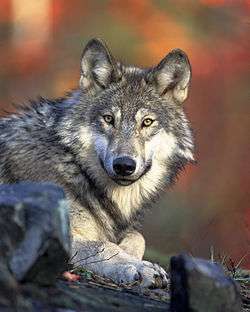
- The gray wolf, specifically all subspecies of the gray wolf (Canis lupus) that are not dingoes or dogs.
- A man who makes amorous advances on many women.
- (music) A wolf tone or wolf note.
- One of the destructive, and usually hairy, larvae of several species of beetles and grain moths.
- the bee wolf
- (figuratively) Any very ravenous, rapacious, or destructive person or thing; especially, want; starvation.
- 1918, W. B. Maxwell, chapter 7, in The Mirror and the Lamp:
- “ […] Churchill, my dear fellow, we have such greedy sharks, and wolves in lamb's clothing. Oh, dear, there's so much to tell you, so many warnings to give you, but all that must be postponed for the moment.”
- They toiled hard to keep the wolf from the door.
-
- A white worm, or maggot, which infests granaries.
- (obsolete) An eating ulcer or sore. See lupus.
- (Can we date this quote?), Jeremy Taylor, (Please provide the book title or journal name):
- If God should send a cancer upon thy face, or a wolf into thy side.
-
- A willying machine.
- (Can we find and add a quotation of Knight to this entry?)
Part or all of this entry has been imported from the 1913 edition of Webster’s Dictionary, which is now free of copyright and hence in the public domain. The imported definitions may be significantly out of date, and any more recent senses may be completely missing.
(See the entry for wolf in Webster’s Revised Unabridged Dictionary, G. & C. Merriam, 1913.)
Hypernyms
- (large wild canid): Canis lupus, canid
Hyponyms
- (large wild canid): she-wolf
Coordinate terms
Derived terms
Translations
|
|
Verb
wolf (third-person singular simple present wolfs, present participle wolfing, simple past and past participle wolfed)
- (transitive) To devour; to gobble; to eat (something) voraciously.
- 1987, James Ellroy, The Black Dahlia:
- After a wolfed burger dinner, I called the night number at Administrative Vice and inquired about known lesbian gathering places.
- 2013, Neil Martin, Collected Stories of the Sea:
- Vicars seated himself and began wolfing a sandwich.
-
- (intransitive, slang) To make amorous advances to many women; to hit on women; to cruise for sex.
- 1949, Nelson Algren, The Man with the Golden Arm:
- [1940s Chicago punk:] ‘I’ve seen a thing or two in my time,’ he still liked to boast, ‘that was how I found out the best place for wolfin’ ain’t the taverns. It ain’t in dance halls ’r on North Clark on Saturday night. It’s in the front row in Sunday school on Sunday mornin’. Oh yeh, I know a thing or two, I been around.’
-
Synonyms
Translations
|
Further reading

Anagrams
Afrikaans
Etymology
From Dutch wolf, from Middle Dutch wolf, from Old Dutch *wulf, *wolf, from Proto-Germanic *wulfaz, from Proto-Indo-European *wĺ̥kʷos.
Noun
wolf (plural wolwe)
Alemannic German
Noun
wolf
References
- Umberto Patuzzi, ed., (2013) Ünsarne Börtar [Our Words]. Luserna: Comitato unitario delle linguistiche storiche germaniche in Italia / Einheitskomitee der historischen deutschen Sprachinseln in Italien.
Dutch
Etymology
From Middle Dutch wolf, from Old Dutch *wulf, *wolf, from Proto-Germanic *wulfaz, from Proto-Indo-European *wĺ̥kʷos.
Pronunciation
audio (file) - IPA(key): /ʋɔlf/
Noun
wolf m (plural wolven, diminutive wolfje n, feminine wolvin)
Derived terms
Related terms
Middle Dutch
Etymology
From Old Dutch *wulf, *wolf, from Proto-Germanic *wulfaz, from Proto-Indo-European *wĺ̥kʷos.
Noun
wolf m
Inflection
This noun needs an inflection-table template.
Descendants
- Dutch: wolf
- Limburgish: wólf
Further reading
- “wolf (I)”, in Vroegmiddelnederlands Woordenboek, 2000
- “wolf (I)”, in Middelnederlandsch Woordenboek, 1929
Middle English
Alternative forms
Etymology
From Old English wulf, from Proto-Germanic *wulfaz, from Proto-Indo-European *wĺ̥kʷos.
Pronunciation
- IPA(key): /wulf/
Noun
wolf (plural wolves, diminutive wolfy, wolfie)
Descendants
- English: wolf
Middle High German
Etymology
From Old High German wolf, from Proto-Germanic *wulfaz, from Proto-Indo-European *wĺ̥kʷos.
Noun
wolf m
Descendants
- German: Wolf
Old High German
Etymology
From Proto-Germanic *wulfaz.
Noun
wolf m (plural wolfa)
Declension
Derived terms
Descendants
West Frisian
Etymology
From Old Frisian wolf, from Proto-Germanic *wulfaz, from Proto-Indo-European *wĺ̥kʷos. Compare Dutch and English wolf, German Wolf, Danish ulv.
Noun
wolf c (plural wolven)