海
| ||||||||
| ||||||||
| ||||||||
Translingual
| Japanese | 海 |
|---|---|
| Simplified | 海 |
| Traditional | 海 |
| Stroke order | |||
|---|---|---|---|
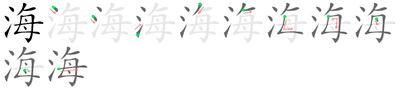 | |||
Alternative forms
In Chinese, the bottom right component is 母 with 2 dots, yielding 海. In Japanese shinjitai, this component is simplified to 毋 (1 cross stroke), yielding 海 (氵+毎). Both forms are encoded under the same Unicode codepoint – see Han unification.
Han character
海 (radical 85, 水+7 in Chinese, 水+6 in Japanese, 10 strokes in Chinese, 9 strokes in Japanese, cangjie input 水人田卜 (EOWY), four-corner 38157, composition ⿰氵每(GHTKV or U+FA45) or ⿰氵毎(J or U+2F901))
Derived characters
References
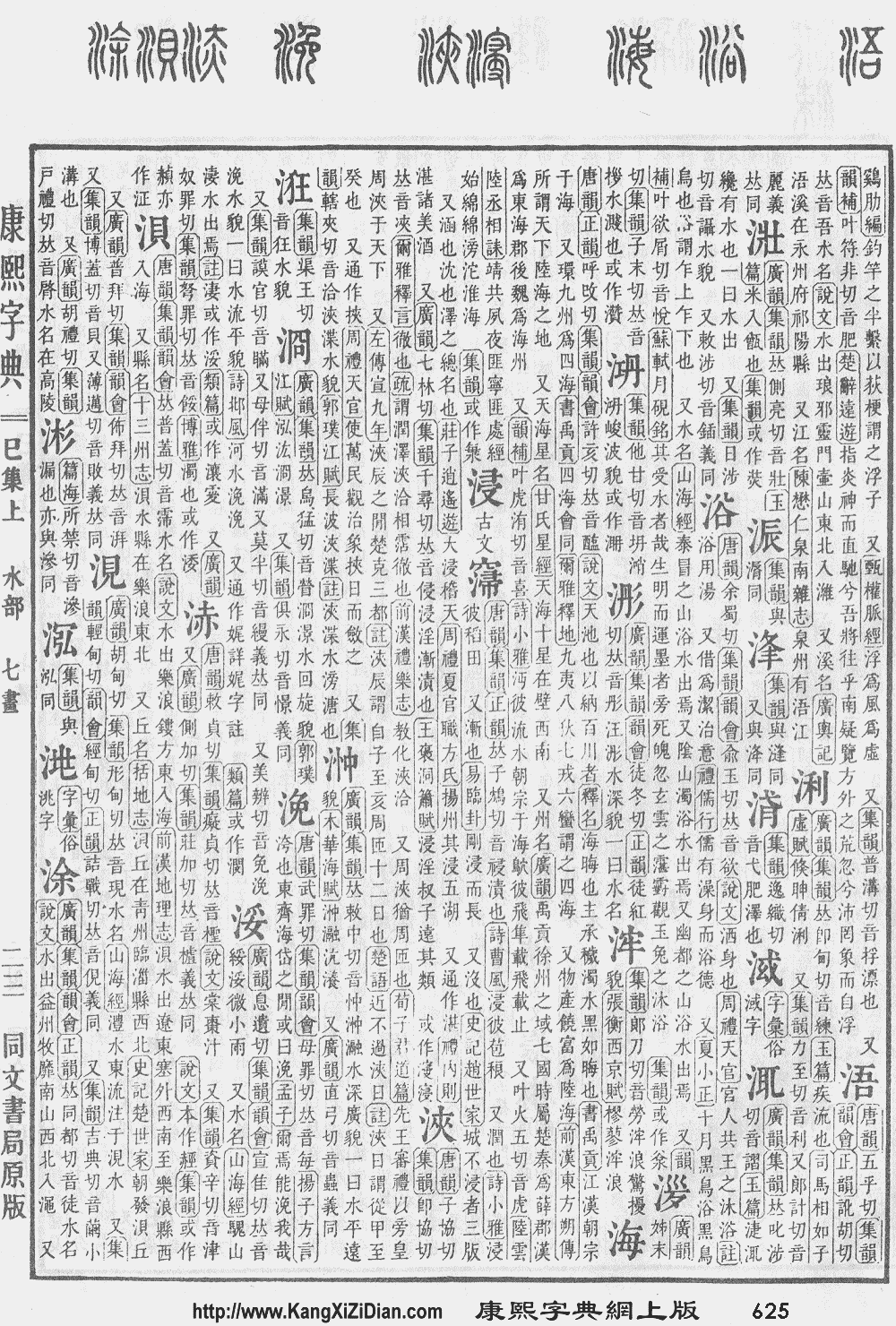
- KangXi: page 625, character 14
- Dai Kanwa Jiten: character 17450
- Dae Jaweon: page 1023, character 11
- Hanyu Da Zidian: volume 3, page 1627, character 1
- Unihan data for U+6D77
Chinese
| simp. and trad. |
海 | |
|---|---|---|
Glyph origin
| Historical forms of the character 海 | ||
|---|---|---|
| Western Zhou | Shuowen Jiezi (compiled in Han) | Liushutong (compiled in Ming) |
| Bronze inscriptions | Small seal script | Transcribed ancient scripts |
 |
 |
 |
| Characters in the same phonetic series (母) (Zhengzhang, 2003) | |
|---|---|
| Old Chinese | |
| 脢 | *mɯːs, *mɯː, *mɯːs |
| 挴 | *mlɯːʔ, *mɯːʔ |
| 海 | *hmlɯːʔ |
| 毐 | *ʔmɯː, *ʔmɯːʔ |
| 呣 | *mɯ |
| 拇 | *mɯʔ |
| 母 | *mɯʔ |
| 胟 | *mɯʔ |
| 姆 | *mɯʔ, *mɯs, *maːʔ |
| 畮 | *mɯʔ |
| 踇 | *mɯʔ |
| 苺 | *mɯs, *mɯːʔ, *mɯːs |
| 莓 | *mɯs, *mɯː, *mɯːs |
| 敏 | *mrɯʔ, *mrɯŋʔ |
| 鰵 | *mrɯŋʔ |
| 慜 | *mrɯŋʔ |
| 毋 | *ma |
| 梅 | *mɯː |
| 酶 | *mɯː |
| 鋂 | *mɯː |
| 每 | *mɯːʔ |
| 毎 | *mɯːs |
| 痗 | *mɯːs, *hmɯːs |
| 晦 | *hmɯːs |
| 誨 | *hmɯːs |
| 悔 | *hmɯːʔ, *hmɯːs |
| 霉 | *mrɯl |
Phono-semantic compound (形聲, OC *hmlɯːʔ) : semantic 氵 (“water”) + phonetic 每 (OC *mɯːʔ).
Etymology
Probably related to 晦 (OC *hmɯːs, “dark”); in numerous Zhou texts 海 is described as 晦 (Schuessler, 2007).
Compare the parallelism in Chinese: 溟 (OC *meːŋ, *meːŋʔ, “ocean”) < 冥 (OC *meːŋ, “dark”).
Pronunciation
Definitions
海
Compounds
|
|
|
Japanese
| 海 | |
| 海 |
Kanji
Readings
Compounds
- 海運 (kaiun, “marine transportation”)
- 海外 (kaigai, “abroad, foreign country”)
- 海岸 (kaigan, “coast, seashore, seacoast”)
- 海峡 (kaikyō, “strait”)
- 海軍 (kaigun, “navy”)
- 海獣 (kaijū, “marine animal”)
- 海嘯 (kaishō, “tidal wave”)
- 海上 (kaijō, “on the sea, marine, maritime”)
- 海王星 (Kaiōsei, “Neptune”)
- 海神 (kaijin, “sea god/spirit”)
- 海図 (kaizu, “sea chart, water map”)
- 海水 (kaisui, “seawater”)
- 海鮮 (kaisen, “seafood”)
- 海戦 (kaisen, “naval battle”)
- 海草 (kaisō, “seagrass”)
- 海藻 (kaisō, “seaweed”)
- 海賊 (kaizoku, “pirate”)
- 海中 (kaichū)
- 海底 (kaitei, “seabed”)
- 海藤 (kaidō)
- 海難 (kainan, “marine”)
- 海馬 (kaiba, “sea lion”)
- 海抜 (kaibatsu, “above sea level”)
- 海錨 (kaibyō, “sea anchor”)
- 海辺 (kaihen, “seaside”)
- 海洋 (kaiyō, “marine”)
- 海流 (kairyū, “sea current, ocean trend”)
- 海豹 (azarashi)
- 海驢 (ashika)
- 熱海 (Atami)
- 海人, 海士, 海女 (ama, “diver”)
- 海参, 煎海鼠 (iriko)
- 海豚 (iruka, “dolphin”)
- 海胆 (uni)
- 海老 (ebi, “shrimp, prawn, lobster”)
- 淡海 (ōmi)
- 海髪 (ogo), 海髪 (ogonori)
- 海月 (kurage, “jellyfish”)
- 海鼠腸 (konowata)
- 海象, 海馬 (seiuchi)
- 海鼠 (namako)
- 海苔 (nori, “nori”)
- 海底 (haitei), 海底摸月 (haitei raoyue)
- 海星, 海盤車 (hitode, “starfish”)
- 海蘿 (funori)
- 海鞘 (hoya, “sea squirt”)
- 海松 (miru)
- 海雲, 海蘊 (mozuku)
- 海人草, 海仁草 (makuri)
- 天空海闊 (tenkū kaikatsu)
Etymology 1
| Kanji in this term |
|---|
| 海 |
| うみ Grade: 2 |
| kun’yomi |
⟨umi1⟩ → */umij/ → /umi/
From Old Japanese.
Appears to be derived from a compound; there are two leading theories regarding the ultimate derivation:
- Shift from 大 (ō-, “big, great”) + 水 (mi, “water”, combining form).[1] This is problematic phonetically because there is no known term having a related shift from /opo/ → /oː/ → /o/ → /u/, and semantically as there already exists a compound 大水 (ōmizu, “flood”).
- From う (u-, stem indicating “ocean”) + 水 (mi, “water”, combining form). The u- stem is evident in 魚 (uo, “fish”) and 潮 (ushio, “salt water; tide”)
The second derivation appears to be likely.
Pronunciation
Noun
- a sea, an ocean
- a lake
- Synonym: 湖 (mizuumi)
- (figuratively) an object covering over a large area, as in 血の海 (chi no umi, “pool of blood”) or 火の海 (hi no umi, “sea of fire”)
- (planetology) a mare (dark surface of a celestial body, thought to appear like a sea)
- (calligraphy) in a 硯 (suzuri, “inkstone”), a reservoir where water is stored
- Synonym: 池 (ike)
Usage notes
This is the most common general term in modern Japanese for sea or ocean.
Derived terms
- 海上 (unakami), 海上 (unagami)
- 海境, 海界, 海坂 (unasaka)
- 海路 (unaji)
- 海底 (unazoko)
- 海原 (unabara, “wide ocean”)
- 海牛 (umiushi, “sea slug”)
- 海風 (umikaze, “sea breeze”)
- 海亀 (umigame, “sea turtle”)
- 海草 (umigusa, “seaweed”)
- 海幸 (umisachi), 海の幸 (umi no sachi, “seafood”)
- 海沿い (umizoi, “coastlands”)
- 海狸 (umidanuki, “beaver”)
- 海鳥 (umidori, “sea bird”)
- 海鳴り (uminari, “rumbling of the sea”)
- 海の日 (Umi no Hi)
- 海辺 (umibe, “beach, seashore”)
- 海山 (umiyama, “sea and mountains”)
- 海綿 (umiwata, “sea sponge”)
- 荒海 (araumi, “rough sea”)
- 淡海 (awaumi)
- 入海 (iriumi, “bay, inlet, gulf, creek”)
- 大海 (ōumi, “ocean, large sea”)
- 外海 (sotoumi, “open seas”)
- 血の海 (chi no umi, “pool of blood”)
- 泥海 (doroumi, “muddy sea”)
- 鳰の海 (Nio-no-umi)
Idioms
- 海を渡る (umi o wataru, “cross over the ocean → go to a foreign country”)
Proper noun
海 (hiragana うみ, rōmaji Umi)
- a female given name.
Etymology 2
| Kanji in this term |
|---|
| 海 |
| わた Grade: 2 |
| kun’yomi |
From Old Japanese.
May be related to Goguryeo 波旦 (padan). Possibly cognate with Korean 바다 (bada, “ocean, sea”).
Pronunciation
Noun
Derived terms
Etymology 3
| Kanji in this term |
|---|
| 海 |
| み Grade: 2 |
| kun’yomi |
Either cognate with 水 (mi, “water”), or an abbreviation of umi above.
Pronunciation
Noun
Derived terms
- 温海 (Atsumi)
References
- ↑ 1984, 日本大百科全書:ニッポニカ (Nippon Dai Hyakka Zensho: Nipponica, “Encyclopedia Nipponica”) (in Japanese), Tōkyō: Shogakukan, relevant text online here.
- ↑ 2006, 大辞林 (Daijirin), Third Edition (in Japanese), Tōkyō: Sanseidō, →ISBN
- ↑ 1998, NHK日本語発音アクセント辞典 (NHK Japanese Pronunciation Accent Dictionary) (in Japanese), Tōkyō: NHK, →ISBN
- 1988, 国語大辞典(新装版) (Kokugo Dai Jiten, Revised Edition) (in Japanese), Tōkyō: Shogakukan
Korean
Hanja
Compounds
- 海軍 (해군,haegun) : navy
- 海圖 (해도,haedo)
- 海拔 (해발,haebal)
- 海溢 (해일,haeil) : tsunami
- 海底 (해저,haejeo) : seabed
- 海外 (해외,haeoe) : oversea
Mulam
Noun
海 (hai3)
Vietnamese
Han character
海 (hải)