梅
| ||||||||
| ||||||||
| ||||||||
Translingual
| Japanese | 梅 |
|---|---|
| Simplified | 梅 |
| Traditional | 梅 |
Alternative forms
In Chinese, Korean and Vietnamese scripts, the right side component is written 每 (contains 母 with 2 dots). In Japanese shinjitai, the component is simplified to 毎 (contains 毋 with a single middle stroke). Due to Han unification, both characters (梅/梅) are encoded under the same Unicode codepoint. A CJK compatibility ideograph (U+FA44) exists for the kyūjitai form of 梅.
Han character
梅 (radical 75, 木+7 in Chinese, 木+6 in Japanese, 11 strokes in Chinese, 10 strokes in Japanese, cangjie input 木人田卜 (DOWY), four-corner 48957, composition ⿰木每(GHTKV) or ⿰木毎(J))
References
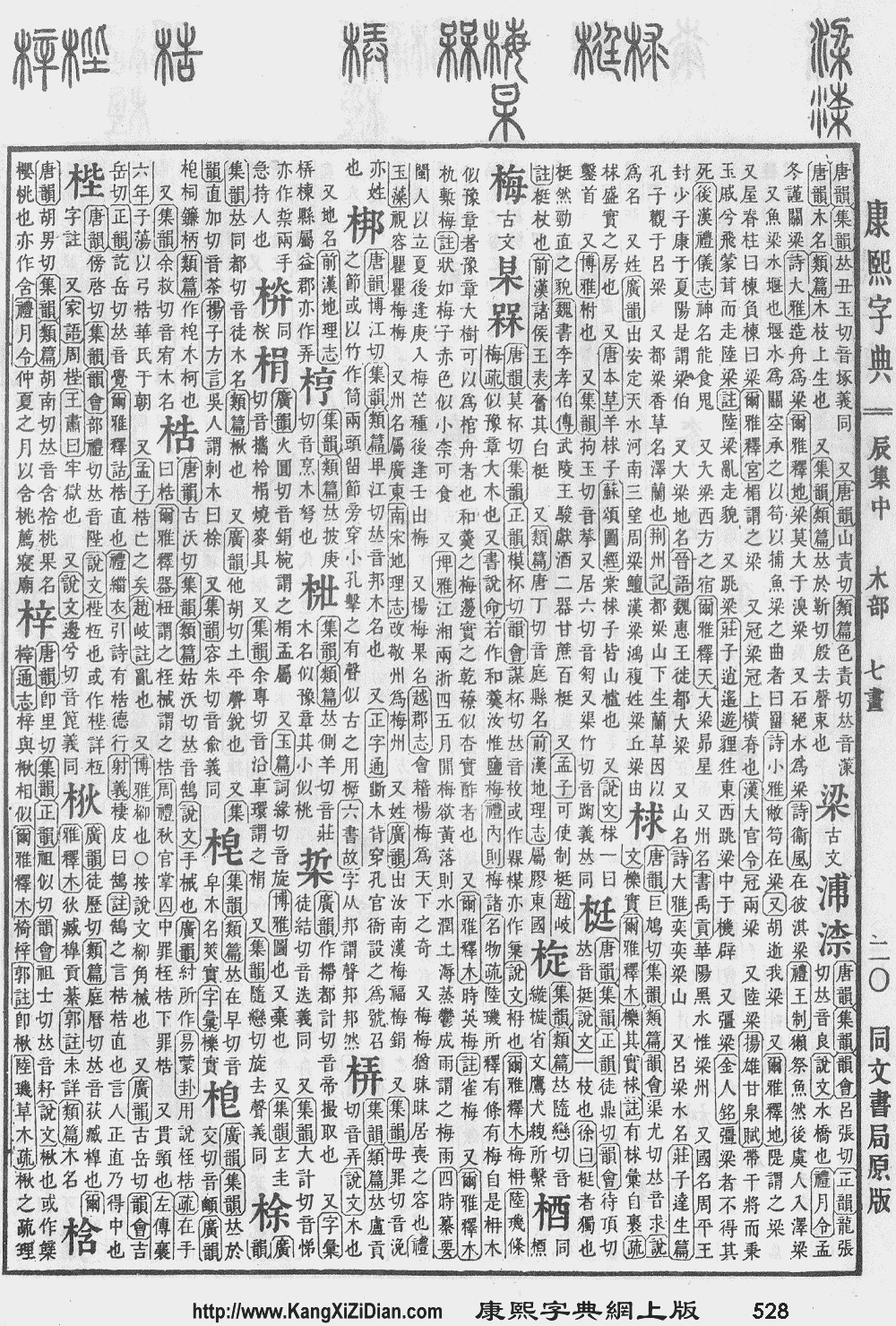
- KangXi: page 528, character 8
- Dai Kanwa Jiten: character 14795
- Dae Jaweon: page 916, character 23
- Hanyu Da Zidian: volume 2, page 1215, character 13
- Unihan data for U+6885
Chinese
| simp. and trad. |
梅 | |
|---|---|---|
| alt. forms | 楳 槑 | |
Glyph origin
| Characters in the same phonetic series (母) (Zhengzhang, 2003) | |
|---|---|
| Old Chinese | |
| 脢 | *mɯːs, *mɯː, *mɯːs |
| 挴 | *mlɯːʔ, *mɯːʔ |
| 海 | *hmlɯːʔ |
| 毐 | *ʔmɯː, *ʔmɯːʔ |
| 呣 | *mɯ |
| 拇 | *mɯʔ |
| 母 | *mɯʔ |
| 胟 | *mɯʔ |
| 姆 | *mɯʔ, *mɯs, *maːʔ |
| 畮 | *mɯʔ |
| 踇 | *mɯʔ |
| 苺 | *mɯs, *mɯːʔ, *mɯːs |
| 莓 | *mɯs, *mɯː, *mɯːs |
| 敏 | *mrɯʔ, *mrɯŋʔ |
| 鰵 | *mrɯŋʔ |
| 慜 | *mrɯŋʔ |
| 毋 | *ma |
| 梅 | *mɯː |
| 酶 | *mɯː |
| 鋂 | *mɯː |
| 每 | *mɯːʔ |
| 毎 | *mɯːs |
| 痗 | *mɯːs, *hmɯːs |
| 晦 | *hmɯːs |
| 誨 | *hmɯːs |
| 悔 | *hmɯːʔ, *hmɯːs |
| 霉 | *mrɯl |
Phono-semantic compound (形聲, OC *mɯː) : semantic 木 (“tree”) + phonetic 每 (OC *mɯːʔ).
Pronunciation
Definitions
梅
- Chinese plum
- Alternative name for 楠 (nán, “Machilus nanmu”).
- 終南何有?有條有梅。 [Classical Chinese, trad.]
- From: The Classic of Poetry, circa 11th – 7th centuries BCE, translated based on James Legge's version
- Zhōngnán hé yǒu? Yǒu tiáo yǒu méi. [Pinyin]
- (please add an English translation of this example)
终南何有?有条有梅。 [Classical Chinese, simp.]
- Short for 楊梅/杨梅 (yángméi).
- Short for 梅雨 (méiyǔ).
- Short for 梅州 (Méizhōu).
- A surname.
Compounds
|
Japanese
| 梅 | |
 |
Kanji
(grade 4 “Kyōiku” kanji, shinjitai kanji, kyūjitai form 梅)
Readings
Compounds
- 梅雨 (baiu)
- 梅園 (baien)
- 梅花 (baika, “plum or apricot blossom flower”)
- 梅果 (baika, “plum or apricot (fruit)”)
- 梅蕙草 (baikeisō)
- 梅子 (baishi)
- 梅天 (baiten)
- 梅毒 (baidoku)
- 梅肉 (bainiku)
- 梅林 (bairin)
- 梅霖 (bairin)
- 梅瓶 (meipin)
- 塩梅 (anbai)
- 烏梅 (ubai)
- 塩梅 (enbai)
- 鶯宿梅 (ōshukubai)
- 黄梅 (ōbai, “Jasminum nudiflorum”)
- 臥竜梅 (garyōbai)
- 寒梅 (kanbai)
- 観梅 (kanbai, “plum blossom viewing”)
- 甘露梅 (kanrobai)
- 金糸梅 (kinshibai)
- 金梅 (kinbai)
- 金瓶梅 (Kinpeibai)
- 金露梅 (kinrōbai)
- 駆梅 (kubai)
- 検梅 (kenbai)
- 紅梅 (kōbai)
- 黄梅 (kōbai)
- 車輪梅 (sharinbai)
- 松竹梅 (shōchikubai)
- 早梅 (sōbai)
- 探梅 (tanbai)
- 茶梅 (chabai, Chinese name for "camellia")
- 入梅 (nyūbai)
- 白梅 (hakubai)
- 盆梅 (bonbai, “plum bonsai”)
- 野梅 (yabai)
- 楊梅 (yōbai)
- 落梅 (rakubai)
- 利休梅 (Rikyū-bai, “Exochorda racemosa”)
- 老梅 (rōbai)
- 﨟梅, 蠟梅, 臘梅 (rōbai)
- 梅雨 (tsuyu)
- 入梅 (tsuiri), 入梅 (tsuyuiri)
Etymology 1
| Kanji in this term |
|---|
| 梅 |
| うめ Grade: 4 |
| kun’yomi |
/muəi/ → ⟨me2⟩ → */mme/ → ⟨mume2⟩ → ⟨ume2⟩ → /ume/
From Old Japanese.[1][2][3] Found already in the Man'yōshū with the ume reading, completed some time after 759 CE.[4]
Probably ultimately from Middle Chinese 梅 (MC muʌi),[2][3] with the borrowed /me/ reading gaining a pronounced kind of initial /m/ sound, perhaps realized as /mme/. The phonetic spelling was often rendered as むめ (/mme/ or /mume/) from the Heian period,[1][3] with mme / mume and ume apparently existing in free variation. The reading eventually settled on うめ (/ume/). Compare the similar pattern of phonetic shift for 馬 (ma → *mma → muma → uma, “horse”), from Middle Chinese 馬 (MC mˠaX).
Pronunciation
Alternative forms
- 楳 (rare)
Noun
梅 (hiragana うめ, katakana ウメ, rōmaji ume)
- a Japanese plum or Japanese apricot, Prunus mume
- c. 759, Man'yōshū (book 5, poem 840), text here
- c. 1005, Shūi Wakashū (book 1, poem 15)
- the lowest of a three-level rank system
- a style of 家紋 (kamon, “family crest”), in the form of plum blossoms
- short for 梅襲 (ume-gasane)
Usage notes
As with many terms that name organisms, this term is often spelled in katakana, especially in biological contexts, as ウメ.
Derived terms
- 梅枝, 梅が枝 (umegae)
- 梅返し (umegaeshi)
- 梅笠草 (umegasasō)
- 梅襲 (ume-gasane)
- 梅暦 (ume-goyomi)
- 梅児誉美 (Ume-goyomi)
- 梅崎 (Umezaki)
- 梅沢 (Umezawa, a place in Kanagawa Prefecture; a surname)
- 梅酒 (umeshu, “plum wine”)
- 梅醬油 (ume shōyu)
- 梅酢 (umezu)
- 梅助 (umesuke)
- 梅染め (umezome)
- 梅園 (umezono)
- 梅田 (Umeda)
- 梅津 (Umezu)
- 梅つ五月 (ume tsu satsuki)
- 梅辻 (Umetsuji)
- 梅壺 (umetsubo)
- 梅根 (Umene)
- 梅鉢 (umebachi)
- 梅春 (umeharu)
- 梅醬 (ume-bishio)
- 梅干, 梅干し (umeboshi)
- 梅見 (umemi)
- 梅結び (ume-musubi)
- 梅擬 (umemodoki)
- 梅谷渋 (umeyashibu)
- 梅羊羹 (ume yōkan)
- 梅割, 梅割り (umewari)
- 青梅 (aōme)
- 杏子梅 (anzu ume)
- 庵梅, 庵の梅 (Iori no ume)
- 岩梅 (iwaume)
- 裏梅 (uraume)
- 箙の梅 (Ebira no Ume)
- 青梅 (Ōme)
- 唐梅 (karaume)
- 甲州梅 (kōshū ume)
- 小梅 (koume)
- 氷梅 (kōriume)
- 零れ梅 (kobore ume)
- 枝垂れ梅 (shidare ume)
- 白梅 (shiraume)
- 袖の梅 (Sode-no-ume)
- 漬梅, 漬け梅 (tsukeume)
- 天梅 (ten-no-ume)
- 飛び梅 (tobiume)
- 冬至梅 (tōji ume)
- 夏梅 (natsuume)
- 煮梅 (niume)
- 捩じ梅 (nejiume)
- 熨梅 (noshiume)
- 一重梅 (hitoe ume)
- 燻べ梅 (fusube ume)
- 豊後梅 (Bungo ume)
- 干し梅 (hoshi ume)
- 実梅 (miume)
Proverbs
- 桜切る馬鹿梅切らぬ馬鹿 (sakura kiru baka ume kiranu baka)
Coordinate terms
See also
- 李, 酸桃 (sumomo, “Prunus salicina”)
Proper noun
- a female given name
Etymology 2
| Kanji in this term |
|---|
| 梅 |
| むめ Grade: 4 |
| kun’yomi |
/muəi/ → ⟨me2⟩ → */mme/ → ⟨mume2⟩ → /mume/
From Old Japanese.[1][2][3] This reading becomes common during the Heian period,[1][3] later falling into disuse. Superseded by the ume reading above.
Pronunciation
Noun
梅 (hiragana むめ, rōmaji mume)
- (archaic, possibly obsolete) a Japanese plum or Japanese apricot, Prunus mume
References
- 1 2 3 4 1988, 国語大辞典(新装版) (Kokugo Dai Jiten, Revised Edition) (in Japanese), Tōkyō: Shogakukan
- 1 2 3 4 2006, 大辞林 (Daijirin), Third Edition (in Japanese), Tōkyō: Sanseidō, →ISBN
- 1 2 3 4 5 1995, 大辞泉 (Daijisen) (in Japanese), Tōkyō: Shogakukan, →ISBN
- ↑ c. 759, Man'yōshū (book 5, poem 822), text here
- ↑ Paula Doe; Yakamochi Ōtomo (1982) A Warbler's Song in the Dusk: The Life and Work of Ōtomo Yakamochi (718-785), illustrated edition, University of California Press, →ISBN, page 32
- ↑ Sugawara no Takasue no Musume; Sonja Arntzen; Moriyuki Ito (2014) The Sarashina Diary: A Woman's Life in Eleventh-Century Japan (Translations from the Asian Classics), illustrated, reprint edition, Columbia University Press, →ISBN, page 111
- ↑ Edwin A. Cranston (1993) A Waka Anthology: Grasses of remembrance, Stanford University Press, →ISBN, page 138
Korean
Hanja
梅 • (mae) (hangeul 매, revised mae, McCune–Reischauer mae, Yale may)
- This term needs a translation to English. Please help out and add a translation, then remove the text
{{rfdef}}.
Vietnamese
Han character
梅 (mai)
- This term needs a translation to English. Please help out and add a translation, then remove the text
{{rfdef}}.
Compounds
- ngày mai (tomorrow)
- mai sau (in the future)