lake
English
Pronunciation
Etymology 1
From Middle English lake (“lake, watercourse, body of water”), from Old English lacu (“lake, pond, pool, stream, watercourse”), from Proto-Germanic *lakō, *lōkiz (“stream, pool, water aggregation", originally "ditch, drainage, seep”), from Proto-Germanic *lekaną (“to leak, drain”), from Proto-Indo-European *leg-, *leǵ- (“to leak”). Cognate with Scots lake (“pond, pool, flowing water of a stream”), Dutch laak (“lake, pond, stream, ditch”), German Low German Lake, Laak (“pooled water; puddle”), German Lache (“pool, puddle”), Faroese løkur (“stream, brook, flow”), Icelandic lækur (“stream, brook, flow”). See also leak, leach.
Despite their similarity in form and meaning, English lake is not related to Latin lacus (“hollow, lake, pond”), Scottish Gaelic loch (“lake”), Ancient Greek λάκκος (lákkos, “waterhole, tank, pond, pit”), all from Proto-Indo-European *lókus (“lake, pool”). Instead, this root is represented by Old English lagu (“sea, flood, water, ocean”), through Proto-Germanic *laguz, *lahō (“sea, water”), perhaps related to Albanian lag (“to water, make wet, moisturize”). See lay.
Noun
lake (plural lakes)
- (now chiefly dialectal) A small stream of running water; a channel for water; a drain.
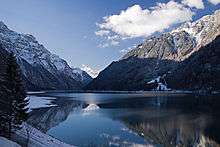
- A large, landlocked stretch of water.
- 1898, Winston Churchill, chapter 4, in The Celebrity:
- Judge Short had gone to town, and Farrar was off for a three days' cruise up the lake. I was bitterly regretting I had not gone with him when the distant notes of a coach horn reached my ear, and I descried a four-in-hand winding its way up the inn road from the direction of Mohair.
-
- A large amount of liquid; as, a wine lake.
- 1991, Robert DeNiro (actor), Backdraft:
- So you punched out a window for ventilation. Was that before or after you noticed you were standing in a lake of gasoline?
- 1991, Robert DeNiro (actor), Backdraft:
- (obsolete) A pit, or ditch
Usage notes
As with the names of rivers, mounts and mountains, the names of lakes are typically formed by adding the word before or after the unique term: Lake Titicaca or Great Slave Lake. Generally speaking, names formed using adjectives or attributives see lake added to the end, as with Reindeer Lake; lake is usually added before proper names, as with Lake Michigan. This derives from the earlier but now uncommon form lake of ~: for instance, the 19th-century Lake of Annecy is now usually simply Lake Annecy. It frequently occurs, however, that foreign placenames are misunderstood as proper nouns, as with the Chinese Taihu (“Great Lake”) and Qinghai (“Blue Sea”) being frequently rendered as Lake Tai and Qinghai Lake.
Synonyms
- See also Thesaurus:lake
Derived terms
Translations
|
|
See also
References
- Astell, Ann W. (1999) Political Allegory in Late Medieval England, Cornell University Press, →ISBN, page 192.
- Cameron, Kenneth (1961) English Place Names, B. T. Batsford Limited, →ISBN, page 164.
- Ferguson, Robert (1858) English Surnames: And their Place in the Teutonic Family, G. Routledge & Co., page 368.
- Maetzner, Eduard Adolf Ferdinand (2009) An English Grammar; Methodical, Analytical, and Historical, BiblioBazaar, LLC, →ISBN, page 200.
- Rissanen, Matti (1992) History of Englishes: New Methods and Interpretations in Historical Linguistics, Walter de Gruyter, →ISBN, pages 513–514.
- Sisam, Kenneth (2009) Fourteenth Century Verse and Prose, BiblioBazaar, →ISBN.
Etymology 2
From Middle English lake, lak, lac (also loke, laik, layke), from Old English lāc (“play, sport, strife, battle, sacrifice, offering, gift, present, booty, message”), from Proto-Germanic *laiką (“play, fight”), *laikaz (“game, dance, hymn, sport”), from Proto-Indo-European *leyg-, *loig-, *leig- (“to bounce, shake, tremble”). Cognate with Old High German leih (“song, melody, music”). Verb form partly from Middle English laken, from Old English lacan, from Proto-Germanic *laikaną, from Proto-Indo-European *leyg-. More at lay.
Noun
lake (plural lakes)
Derived terms
Verb
lake (third-person singular simple present lakes, present participle laking, simple past and past participle laked)
Etymology 3
From Middle English lake, from Old English *lacen or Middle Dutch laken; both from Proto-Germanic *lakaną (“linen; cloth; sheet”). Cognate with Dutch lake (“linen”), Dutch laken (“linen; bedsheet”), German Laken, Danish lagan, Swedish lakan, Icelandic lak, lakan.
Noun
lake (plural lakes)
- (obsolete) A kind of fine, white linen.
Etymology 4
From French laque (“lacquer”), from Persian لاک (lāk), from Hindi लाख (lākh), from Sanskrit लक्ष (lakṣa, “one hundred thousand”), referring to the number of insects that gather on the trees and make the resin seep out.
Noun
lake (plural lakes)
- In dyeing and painting, an often fugitive crimson or vermillion pigment derived from an organic colorant (cochineal or madder, for example) and an inorganic, generally metallic mordant.
Derived terms
- lake-red
Translations
Verb
lake (third-person singular simple present lakes, present participle laking, simple past and past participle laked)
- To make lake-red.
Anagrams
Dutch
Pronunciation
Audio (file)
Verb
lake
- (archaic) singular present subjunctive of laken
Anagrams
Mauritian Creole
Etymology
Noun
lake
Reference
- Baker, Philip & Hookoomsing, Vinesh Y. 1987. Dictionnaire de créole mauricien. Morisyen – English – Français
Norwegian Bokmål
Etymology 1
From Low German lake
Noun
lake m (definite singular laken, indefinite plural laker, definite plural lakene)
Etymology 2
Noun
lake m (definite singular laken, indefinite plural laker, definite plural lakene)
Etymology 3
As for Etymology 1.
Verb
lake
References
- “lake” in The Bokmål Dictionary.
Norwegian Nynorsk
Etymology 1
From Low German lake
Noun
lake m (definite singular laken, indefinite plural lakar, definite plural lakane)
Etymology 2
Noun
lake m (definite singular laken, indefinite plural lakar, definite plural lakane)
Etymology 3
As for Etymology 1.
Verb
lake
References
- “lake” in The Nynorsk Dictionary.
Seychellois Creole
Etymology
Noun
lake
Reference
- Danielle D’Offay et Guy Lionnet, Diksyonner Kreol - Franse / Dictionnaire Créole Seychellois - Français
Swahili
Adjective
lake
- Ji class inflected form of -ake.
Swedish
Noun
lake c
Declension
| Declension of lake | ||||
|---|---|---|---|---|
| Singular | Plural | |||
| Indefinite | Definite | Indefinite | Definite | |
| Nominative | lake | laken | lakar | lakarna |
| Genitive | lakes | lakens | lakars | lakarnas |