乏
| ||||||||
Translingual
Han character
乏 (radical 4 丿+4, 4 strokes, cangjie input 竹戈弓人 (HINO), four-corner 20307, composition ⿱丿之)
References
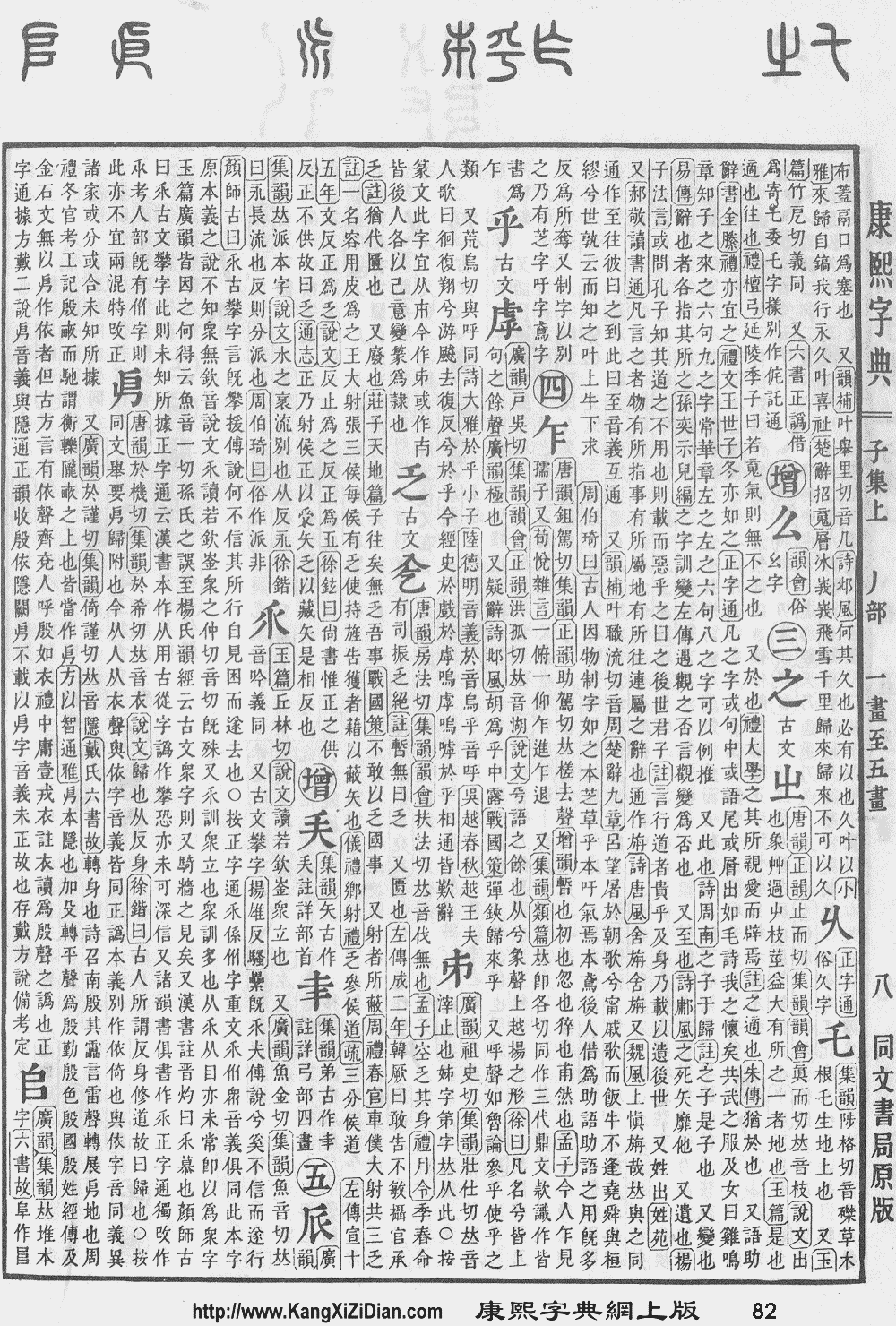
- KangXi: page 82, character 10
- Dai Kanwa Jiten: character 133
- Hanyu Da Zidian: volume 1, page 34, character 3
- Unihan data for U+4E4F
Chinese
| simp. and trad. |
乏 | |
|---|---|---|
Glyph origin
| Historical forms of the character 乏 | |||||
|---|---|---|---|---|---|
| |||||
|
References: Mostly from Richard Sears' Chinese Etymology site (authorisation),
|


| Characters in the same phonetic series (乏) (Zhengzhang, 2003) | |
|---|---|
| Old Chinese | |
| 砭 | *prom, *proms |
| 貶 | *promʔ |
| 窆 | *proms |
| 泛 | *pʰoms, *bob |
| 姂 | *pʰoms, *bob, *kpʰob |
| 䒦 | *pʰom, *pʰoms |
| 柉 | *bom |
| 覂 | *poŋʔ |
| 眨 | *sproːb |
| 鴔 | *brub |
| 乏 | *bob |
Perhaps an ideogram (指事) generated by replacing uppermost stroke of 正 (“straight; right”) with a slanted stroke 丿 — not right; lacking.
Pronunciation
Definitions
乏
Synonyms
| Dialectal synonyms of 累 (“tired”) [map] | ||
|---|---|---|
| Variety | Location | Words |
| Formal (Written Standard Chinese) | 疲倦、疲乏、疲累、疲憊 | |
| Mandarin | Beijing | 累、乏 |
| Taiwan | 累 | |
| Jinan | 累、乏 | |
| Xi'an | 乏、累 | |
| Wuhan | 累 | |
| Chengdu | 累 | |
| Yangzhou | 累、痿 | |
| Hefei | 累 | |
| Cantonese | Guangzhou | 攰 |
| Hong Kong | 攰 | |
| Yangjiang | 攰 | |
| Gan | Nanchang | 累 |
| Hakka | Meixian | 𤸁 |
| Miaoli (N. Sixian) | 𤸁、悿 | |
| Liudui (S. Sixian) | 𤸁、悿 | |
| Hsinchu (Hailu) | 悿 | |
| Dongshi (Dabu) | 悿、𤸁 | |
| Zhuolan (Raoping) | 悿 | |
| Yunlin (Zhao'an) | 悿 | |
| Jin | Taiyuan | 乏、累 |
| Min Bei | Jian'ou | 累、軟 |
| Min Dong | Fuzhou | 弱 |
| Min Nan | Xiamen | 𤺪、厭 |
| Quanzhou | 𤺪、厭 | |
| Zhangzhou | 𤺪、厭 | |
| Taipei | 𤺪、忝 | |
| Philippines (Manila) | 𤺪 | |
| Chaozhou | 乏 | |
| Shantou | 乏 | |
| Wu | Suzhou | 吃力 |
| Wenzhou | 㾯、吃力 | |
| Xiang | Changsha | 傫 |
| Shuangfeng | 鶴累 | |
Compounds
Japanese
Kanji
乏
Readings
- Goon: ぼう (bō, Jōyō)←ぼふ (bofu, historical)
- Kan’on: ほう (hō)←はふ (fafu, historical)
- Kan’yōon: ぼう (bō, Jōyō)←ばふ (bafu, historical)
- Kun: とぼしい (toboshii, 乏しい, Jōyō)
Korean
Hanja
乏 • (pip)
- Eumhun:
- Sound (hangeul): 핍
- Name (hangeul): 모자랄 (revised: mojaral, McCune–Reischauer: mojaral)
- This term needs a translation to English. Please help out and add a translation, then remove the text
{{rfdef}}.
References
Vietnamese
Han character
乏 (phạp)
- This term needs a translation to English. Please help out and add a translation, then remove the text
{{rfdef}}.
This article is issued from
Wiktionary.
The text is licensed under Creative Commons - Attribution - Sharealike.
Additional terms may apply for the media files.