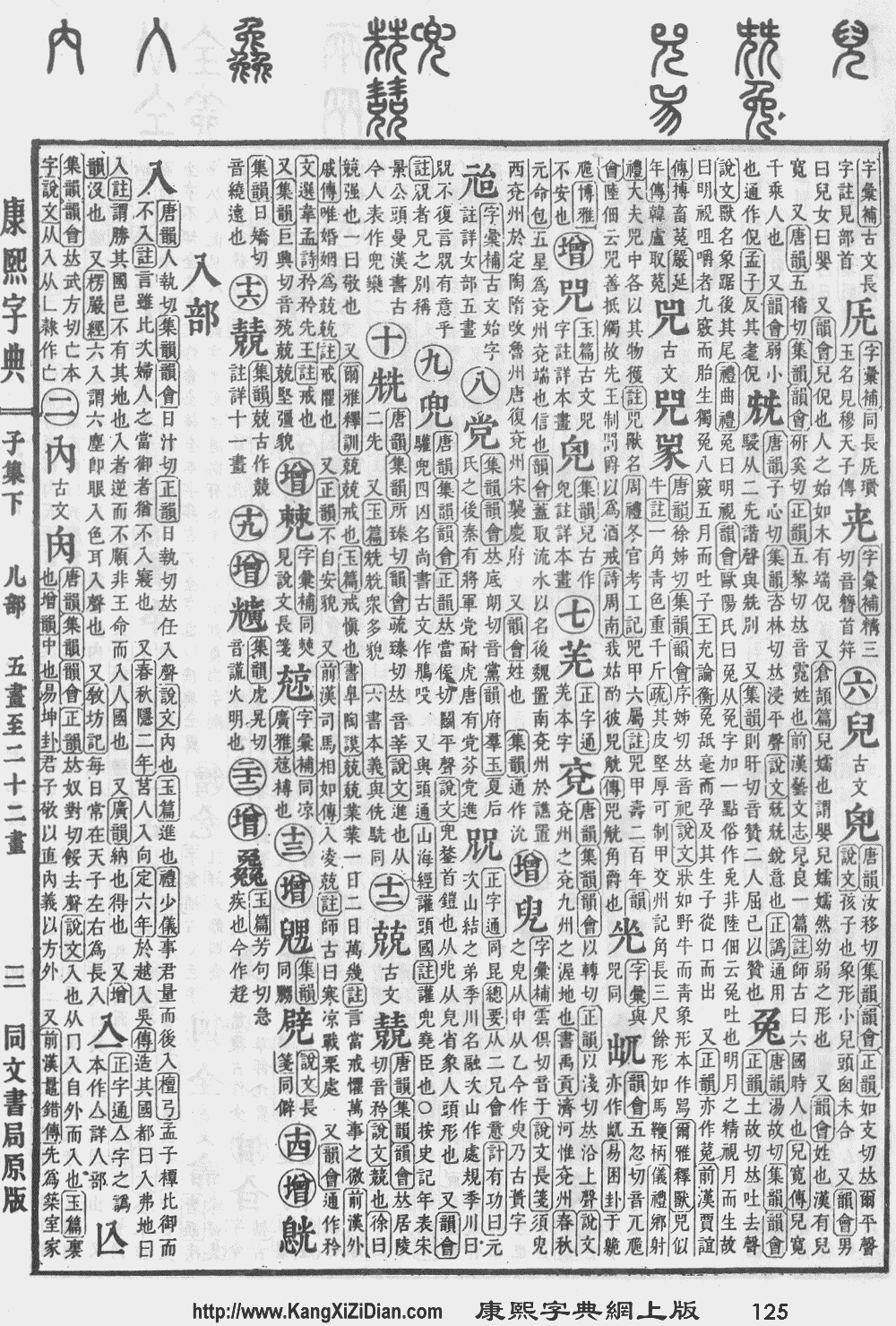
U+515C, 兜
CJK UNIFIED IDEOGRAPH-515C

[U+515B]
CJK Unified Ideographs
[U+515D]

Translingual

Han character

(radical 10 +9, 11 strokes, cangjie input 竹女竹山 (HVHU), four-corner 77217) .

Derived characters

References

  • KangXi: page 125, character 20
  • Dai Kanwa Jiten: character 1386
  • Dae Jaweon: page 265, character 27
  • Hanyu Da Zidian: volume 1, page 273, character 16
  • Unihan data for U+515C

Chinese

simp. and trad.
alt. forms

Glyph origin

Historical forms of the character


References:

Mostly from Richard Sears' Chinese Etymology site (authorisation),
which in turn draws data from various collections of ancient forms of Chinese characters, including:

  • Shuowen Jiezi (small seal),
  • Jinwen Bian (bronze inscriptions),
  • Liushutong (Liushutong characters) and
  • Yinxu Jiaguwen Bian (oracle bone script).
Characters in the same phonetic series () (Zhengzhang, 2003) 
Old Chinese
*toː
*toː

Ideogrammic compound (會意) : 𠑹 (cover) +  (head): a helmet.

Pronunciation


Note:
  • tau - vernacular;
  • to͘ - literary.

Rime
Character
Reading # 1/1
Initial () (5)
Final () (137)
Tone (調) Level (Ø)
Openness (開合) Open
Division () I
Fanqie
Reconstructions
Zhengzhang
Shangfang
/təu/
Pan
Wuyun
/təu/
Shao
Rongfen
/təu/
Edwin
Pulleyblank
/təw/
Li
Rong
/tu/
Wang
Li
/təu/
Bernard
Karlgren
/tə̯u/
Expected
Mandarin
Reflex
dōu
BaxterSagart system 1.1 (2014)
Character
Reading # 1/1
Modern
Beijing
(Pinyin)
dōu
Middle
Chinese
‹ tuw ›
Old
Chinese
/*tˤo/
English helmet, hood

Notes for Old Chinese notations in the Baxter–Sagart system:

* Parentheses "()" indicate uncertain presence;
* Square brackets "[]" indicate uncertain identity, e.g. *[t] as coda may in fact be *-t or *-p;
* Angle brackets "<>" indicate infix;
* Hyphen "-" indicates morpheme boundary;

* Period "." indicates syllable boundary.
Zhengzhang system (2003)
Character
Reading # 1/1
No. 2449
Phonetic
component
Rime
group
Rime
subdivision
0
Corresponding
MC rime
Old
Chinese
/*toː/

Definitions

  1. helmet; hood
  2. helmet-shaped
  3. to wrap; to encase
  4. armor
  5. to carry in a wrap
  6. bag; pouch
  7. plastic bag
  8. pocket
  9. to pocket; to keep; to retain; to acquire dishonestly
  10. to reach
  11. to move around; to move in a circle; to canvass; to solicit
  12. to take responsibility for
  13. to relate in detail
  14. to peddle; to hawk
  15. (Min Nan) home
  16. (Min Nan) nearby

Synonyms

Compounds

  • 傴兜伛兜
  • 兜來兜去兜来兜去
  • 兜兒兜儿 (dōur)
  • 兜兜 (dōudōu)
  • 兜兜嘴兒兜兜嘴儿
  • 兜兜答答
  • 兜兜褲兒兜兜裤儿
  • 兜剿
  • 兜售 (dōushòu)
  • 兜喜神方
  • 兜嘴
  • 兜圈子 (dōu quānzi)
  • 兜子
  • 兜底
  • 兜底兒兜底儿
  • 兜得轉兜得转
  • 兜抄
  • 兜拖
  • 兜捕
  • 兜搭
  • 兜攬兜揽 (dōulǎn)
  • 兜攬生意兜揽生意
  • 兜率天 (Dōushuàitiān)
  • 兜率天宮兜率天宫
  • 兜率宮兜率宫
  • 兜的
  • 兜答
  • 兜籠兜笼
  • 兜紗兜纱
  • 兜羅兜罗 (dōuluó)
  • 兜翻
  • 兜老底
  • 兜肚 (dōudù)
  • 兜肚兒兜肚儿
  • 兜胸
  • 兜膝
  • 兜臉兜脸
  • 兜襠兜裆
  • 兜轎兜轿
  • 兜銷兜销
  • 兜鍪 (dōumóu)
  • 兜頭兜头
  • 兜頭蓋臉兜头盖脸
  • 兜風兜风 (dōufēng)
  • 冤兜
  • 圍兜围兜 (wéidōu)
  • 帽兜子
  • 慲兜
  • 暖雲兜暖云兜
  • 漏兜
  • 肚兜 (dùdōu)
  • 觀音兜观音兜
  • 阿兜眼
  • 露兜樹露兜树

Japanese

Kanji

(“Jinmeiyō” kanji used for names)

Readings

Etymology

Kanji in this term
かぶと
Jinmeiyō
kun’yomi

Pronunciation

Noun

(hiragana かぶと, rōmaji kabuto)

  1. helmet

Derived terms

References

  1. 2006, 大辞林 (Daijirin), Third Edition (in Japanese), Tōkyō: Sanseidō, →ISBN
  2. 1998, NHK日本語発音アクセント辞典 (NHK Japanese Pronunciation Accent Dictionary) (in Japanese), Tōkyō: NHK, →ISBN

Korean

Hanja

(du) (hangeul , revised du, McCuneReischauer tu)

  1. (투구 두, tugu-): helmet (especially, made of iron)

Synonyms

See also


Vietnamese

Han character

(đâu)

  1. This term needs a translation to English. Please help out and add a translation, then remove the text {{rfdef}}.
This article is issued from Wiktionary. The text is licensed under Creative Commons - Attribution - Sharealike. Additional terms may apply for the media files.