牙
| ||||||||
Translingual
| Stroke order | |||
|---|---|---|---|
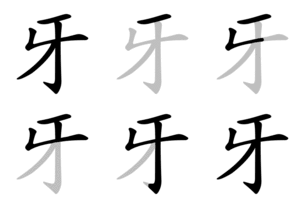 | |||
Han character
牙 (radical 92, 牙+0, 4 strokes, cangjie input 一女木竹 (MVDH), four-corner 10240)
- Kangxi radical #92, ⽛.
Derived characters
References
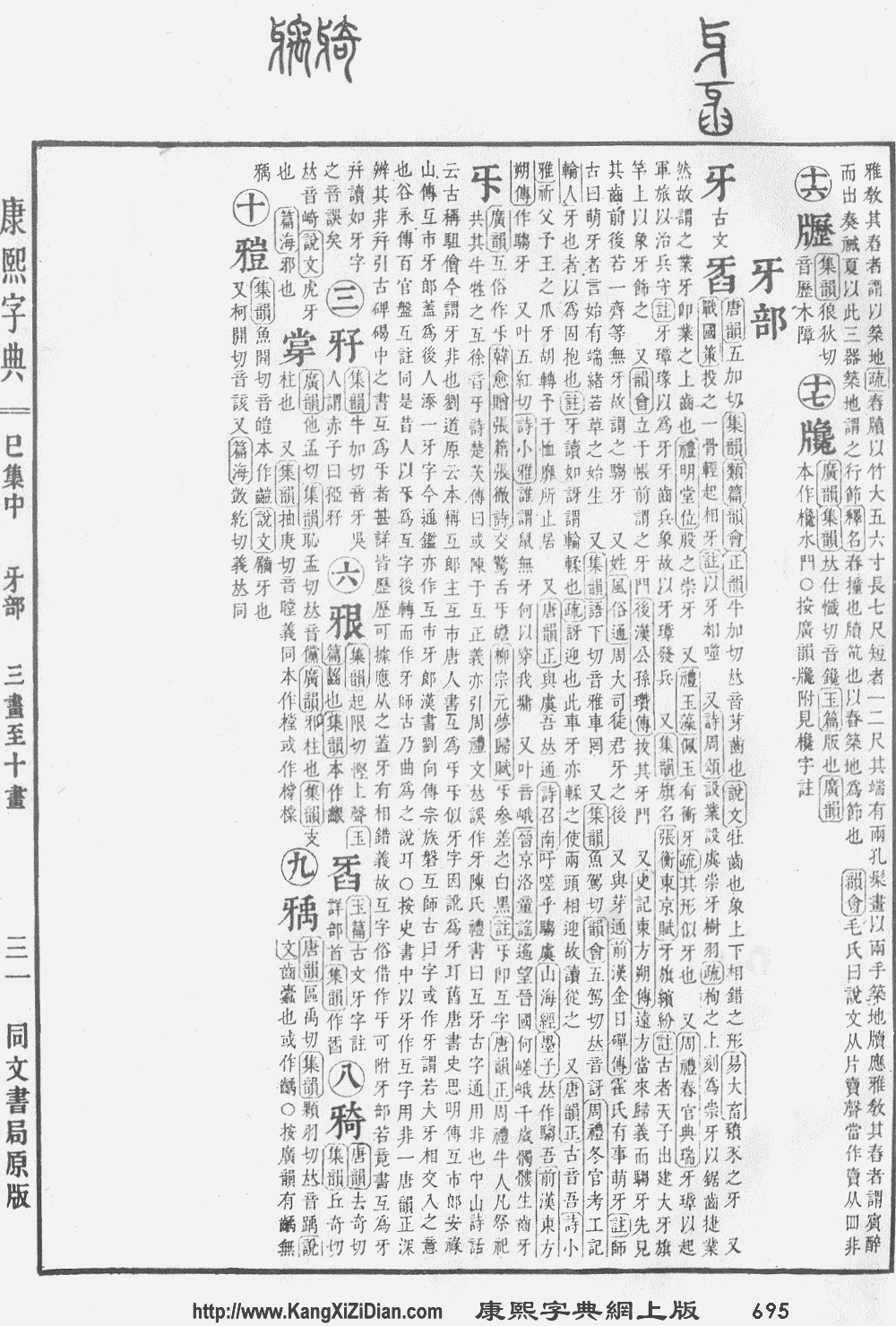
- KangXi: page 695, character 3
- Dai Kanwa Jiten: character 19909
- Dae Jaweon: page 1108, character 6
- Hanyu Da Zidian: volume 2, page 1419, character 8
- Unihan data for U+7259
Chinese
| simp. and trad. |
牙 | |
|---|---|---|
Glyph origin
| Historical forms of the character 牙 | ||
|---|---|---|
| Western Zhou | Shuowen Jiezi (compiled in Han) | Liushutong (compiled in Ming) |
| Bronze inscriptions | Small seal script | Transcribed ancient scripts |
 |
 |
 |
| Characters in the same phonetic series (牙) (Zhengzhang, 2003) | |
|---|---|
| Old Chinese | |
| 邪 | *ljaː, *laː |
| 衺 | *ljaː |
| 牙 | *ŋraː |
| 芽 | *ŋraː |
| 齖 | *ŋraː, *ŋraːs |
| 呀 | *ŋraː, *hŋraː |
| 枒 | *ŋraː, *ŋraːs |
| 雅 | *ŋraːʔ |
| 厊 | *ŋraːʔ |
| 庌 | *ŋraːʔ |
| 訝 | *ŋraːs |
| 迓 | *ŋraːs |
| 砑 | *ŋraːs |
| 犽 | *ŋraːs |
| 疨 | *hŋraː |
| 岈 | *hŋraː |
| 谺 | *hŋraː |
| 颬 | *hŋraː |
| 鴉 | *qraː |
| 釾 | *laː |
Etymology
Norman and Mei (1976) proposed that this was a substrate loan; cf. Proto-Vietic *ŋaː (“ivory”) (Vietnamese ngà), Proto-Tai *ŋaːᴬ (“tusk; ivory”) (Thai งา (ngaa)).
Pulleyblank (1983) disagreed with Norman and Mei's hypothesis, and considered Old Chinese to be the donor of this Wanderwort instead.
Pronunciation
Definitions
牙
- (anatomy) tooth (Classifier: 隻/只 c; 棚 c)
- (anatomy) fang; tusk; canine tooth
- (anatomy) ivory; tusk of elephant
- 牙雕 ― yádiāo ― ivory sculpture
- screw thread
- (historical) broker
Synonyms
| Dialectal synonyms of 牙齒 (“tooth”) [map] | ||
|---|---|---|
| Variety | Location | Words |
| Classical Chinese | 齒 | |
| Formal (Written Standard Chinese) | 牙齒 | |
| Mandarin | Beijing | 牙 |
| Taiwan | 牙 | |
| Jinan | 牙 | |
| Xi'an | 牙 | |
| Wuhan | 牙齒、才調子 | |
| Chengdu | 牙齒 | |
| Yangzhou | 牙子 | |
| Hefei | 牙、牙齒 | |
| Cantonese | Guangzhou | 牙 |
| Hong Kong | 牙 | |
| Taishan | 牙 | |
| Yangjiang | 牙 | |
| Gan | Nanchang | 牙齒 |
| Hakka | Meixian | 牙齒 |
| Miaoli (N. Sixian) | 牙齒 | |
| Liudui (S. Sixian) | 牙齒 | |
| Hsinchu (Hailu) | 牙齒 | |
| Dongshi (Dabu) | 牙齒 | |
| Zhuolan (Raoping) | 牙齒 | |
| Yunlin (Zhao'an) | 牙、牙齒 | |
| Jin | Taiyuan | 牙 |
| Min Bei | Jian'ou | 牙齒 |
| Min Dong | Fuzhou | 牙 |
| Min Nan | Xiamen | 喙齒、齒 |
| Quanzhou | 喙齒、齒 | |
| Zhangzhou | 喙齒、齒 | |
| Taipei | 喙齒、齒 | |
| Kaohsiung | 喙齒、齒 | |
| Philippines (Manila) | 喙齒 | |
| Chaozhou | 齒 | |
| Wu | Shanghai | 牙子、牙齒 |
| Suzhou | 牙子 | |
| Wenzhou | 牙齒、牙 | |
| Xiang | Changsha | 牙齒 |
| Shuangfeng | 牙齒 | |
Compounds
|
|
|
Descendants
Others:
Japanese
Kanji
Readings
Etymology 1
| Kanji in this term |
|---|
| 牙 |
| き Grade: S |
| kun’yomi |
From Old Japanese. Appears in the Man'yōshū.[1]
Pronunciation
Noun
Usage notes
Although this term is no longer used in isolation, it does persist in certain compounds.
Derived terms
Etymology 2
| Kanji in this term |
|---|
| 牙 |
| きば Grade: S |
| kun’yomi |
Compound of Old Japanese elements 牙 (ki, “fang, tusk”) + 歯 (ha, “tooth”).[2] The ha changes to ba as an instance of rendaku (連濁).
Pronunciation
Noun
牙 (hiragana きば, rōmaji kiba)
- fang, tusk, tooth (particularly the canines)
- (falconry) dog (primarily used for counting hunting dogs)
Usage notes
This is the most common term for fang in modern Japanese.
Derived terms
Idioms
- 牙を噛む (kiba o kamu): “to bite one's fangs” → to gnash one's teeth
- 牙を研ぐ (kiba o togu): “to sharpen one's fangs” → to prepare to hurt one's opponent. Compare sharpen one's claws
- 牙を鳴らす (kiba o narasu): “to clash one's fangs” → to gnash one's teeth; to get angry; to bare one's fangs
- 牙を剥く (kiba o muku): “to bare one's fangs”
- 牙あるものは角無し (kiba aru mono wa tsuno nashi): “the one with fangs has no horns” → a metaphor for how no one is endowed with every advantage
See also
Etymology 3
| Kanji in this term |
|---|
| 牙 |
| かび Grade: S |
| kun’yomi |
Cognate with, and probably the noun derivation of, verb 黴びる (kabiru, “to go moldy”), from the root idea of something sprouting.[2] Used in the Kojiki.
Pronunciation
Noun
Derived terms
Etymology 4
| Kanji in this term |
|---|
| 牙 |
| は Grade: S |
| kun’yomi |
Non-standard alternate spelling for 歯 (ha, “tooth”).[2]
Pronunciation
Noun
Etymology 5
| Kanji in this term |
|---|
| 牙 |
| げ Grade: S |
| on’yomi |
From Middle Chinese 牙 (ngæ). Compare modern Min Nan reading ge5.
The goon reading, so probably the reading as first imported into Japanese.
Pronunciation
Noun
Usage notes
The tooth meaning is much more commonly expressed using the word 歯 (ha).
Derived terms
- 牙の笏 (ge no shaku): an ivory mace or scepter, used by certain social classes in ancient Japan
- 牙歯 (geshi): teeth, tusks, or fangs
- 牙軸 (gejiku): the inner edge of a scroll around which the scroll is wound, or an edge of a folding book to which pages are bound, made of ivory
- 牙床, 牙象 (げしょう, geshō): a kind of cutout decorative carving technique for panels, wherein the corners are left intact to reinforce the structure of the panel
- 牙彫 (gebori): a carving made from a tusk or fang, more specifically made of elephant ivory
- 牙笏 (geshaku): an ivory mace or scepter, used by certain social classes in ancient Japan
Etymology 6
| Kanji in this term |
|---|
| 牙 |
| が Grade: S |
| on’yomi |
From Middle Chinese 牙 (ngæ). Compare modern Cantonese reading ngaa4.
The kan'on reading, so probably a later importation.
Pronunciation
Affix
Usage notes
The ga reading is only used in compounds, and is never used in isolation.
Derived terms
- 牙営 (gaei): the headquarters of a general in a field camp
- 牙音 (gaon): a velar consonant (obsolete)
- 牙関緊急 (gakan kinkyū): lockjaw, a common symptom in the early stages of tetanus
- 牙旗 (gaki): a flag raised at the site of an emperor's or general's field camp
- 牙行 (gakō): in China, a middleman or go-between in a commercial transaction
- 牙山 (Gazan): the city of Asan, a port in South Korea
- 牙商 (gashō): a middleman or go-between in a commercial transaction
- 牙城 (gajō): the keep or main residence within a castle; a headquarters, a base, a stronghold
- 牙人 (gajin): in China, a middleman or go-between in a commercial transaction
- 牙銭 (gasen): a fee or commission charged by a 牙行 (gakō)
- 牙虫 (gamushi): a water scavenger beetle of family Hydrophilidae
- 牙斧 (gafu): a small axe or hatchet made from boar tusk
- 牙保 (gaho): a middleman or go-between in a commercial transaction
- 牙保罪 (gahozai): the crime of fencing goods known to be stolen
- 牙保犯 (gahohan): the crime of fencing goods known to be stolen
- 牙門 (gamon): a gate on which a general's flag is flying; an army's headquarters
- 牙籌 (gachū): an abacus; more specifically, an ivory abacus
- 牙籤, 牙籖 (がせん, gasen): a small placard or label made of ivory; a small claw-shaped ivory clasp for holding a book closed
- 牙纛 (gatō): the flag of a general's army, the pole of which was traditionally decorated with ivory on the end
- 牙儈 (gakai): in China, a middleman or go-between in a commercial transaction
References
Korean
Hanja
牙 • (a) (hangeul 아)
- This term needs a translation to English. Please help out and add a translation, then remove the text
{{rfdef}}.
Vietnamese
Han character
- This term needs a translation to English. Please help out and add a translation, then remove the text
{{rfdef}}.