家鴨
See also: 家鸭
Chinese
home; family; ‑ist; ‑er; ‑ian; measure word for stores and schools |
duck | ||
|---|---|---|---|
| trad. (家鴨) | 家 | 鴨 | |
| simp. (家鸭) | 家 | 鸭 | |
Pronunciation
- Mandarin
- Cantonese
- (Standard Cantonese, Guangzhou)+
- Jyutping: gaa1 aap3
- Yale: gā aap
- Cantonese Pinyin: gaa1 aap8
- Guangdong Romanization: ga1 ab3
- IPA (key): /kɑː⁵⁵ ɑːp̚³/
- (Standard Cantonese, Guangzhou)+
Noun
家鴨
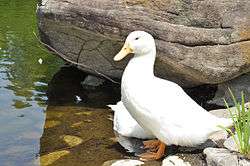
- domestic duck (the domesticated variety of mallard)
Japanese
Etymology 1
| Kanji in this term | |
|---|---|
| 家 | 鴨 |
| Grade: 2 | Jinmeiyō |
| Irregular | |
Appears in texts from the late Muromachi period. Various theories exist regarding the derivation; one of the more common derives this as a sound shift from ahiro, appearing around the same time as a compound of 足 (a, “foot, feet”) + 広 (hiro, stem of adjective 広い (hiroi, “broad, wide”)).
The kanji spelling is jukujikun (熟字訓), from Chinese 家鴨.
Pronunciation
Alternative forms
Noun
家鴨 (hiragana あひる, katakana アヒル, rōmaji ahiru)
- a domestic duck (a domesticated variety of mallard)
- アヒルの子
- ahiru no ko
- a baby duck, a duckling
- アヒルの子
- (slang, often derogatory) a woman who is short and has a large butt
- an academic grade of “B” (from the way the 乙 (otsu) character, used to indicate this grade, looks vaguely like a duck)
- (military) an amphibious truck (from the English duck)
Usage notes
As with many terms that name organisms, this term is often spelled in katakana, especially in biological contexts, as アヒル.
Derived terms
Derived terms
- 家鴨下駄 (ahiru geta): literally, “duck clogs”: a style of 下駄 (geta, “traditional wooden clogs”) with short “teeth” (the wooden supports underneath) and a short distance between the “teeth”, so named for the way it makes the wearer walk
Idioms
Idioms
- 家鴨が文庫を背負う (ahiru ga bunko o seō): “a duck carries a collection of books” → metaphor for the appearance of a short woman with a large butt, walking along
- 家鴨の火事見舞い (ahiru no kajimimai)" “a duck going to visit someone after a fire” → a metaphor for a short, unattractive woman with a large butt, walking quickly
- 家鴨の脚絆 (ahiru no kyahan): “(like) a duck's gaiters” → metaphor for something unsuited to someone's nature
- 家鴨も鴨の気位 (ahiru mo kamo no kigurai): “the domestic duck is also as proud as the wild duck” → a metaphor for putting on airs, from the general sense that a domestic duck is not as pretty as a wild duck
Etymology 2
| Kanji in this term | |
|---|---|
| 家 | 鴨 |
| か Grade: 2 |
おう Jinmeiyō |
| on’yomi | |
*/ka apu/ → /kaafu/ → */kaawu/ → /kaau/ → /kaɔː/ → /kaoː/
From Middle Chinese 家鴨 (MC kˠa ʔˠap̚).
Pronunciation
Noun
家鴨 (hiragana かおう, rōmaji kaō, historical hiragana かあふ)
References
Further reading
This article is issued from
Wiktionary.
The text is licensed under Creative Commons - Attribution - Sharealike.
Additional terms may apply for the media files.