器
| ||||||||
| ||||||||
Translingual
| Japanese | 器 |
|---|---|
| Simplified | 器 |
| Traditional | 器 |
| Stroke order | |||
|---|---|---|---|
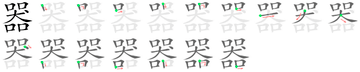 | |||
Alternative forms
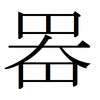
Note the missing dot in Japanese shinjitai usage.
Han character
器 (radical 30 口+13 in Chinese, 口+12 in Japanese, in Chinese 16 strokes, in Japanese 15 strokes, cangjie input 口口戈大口 (RRIKR), four-corner 66663, composition ⿱哭吅 or ⿳吅大吅)
References
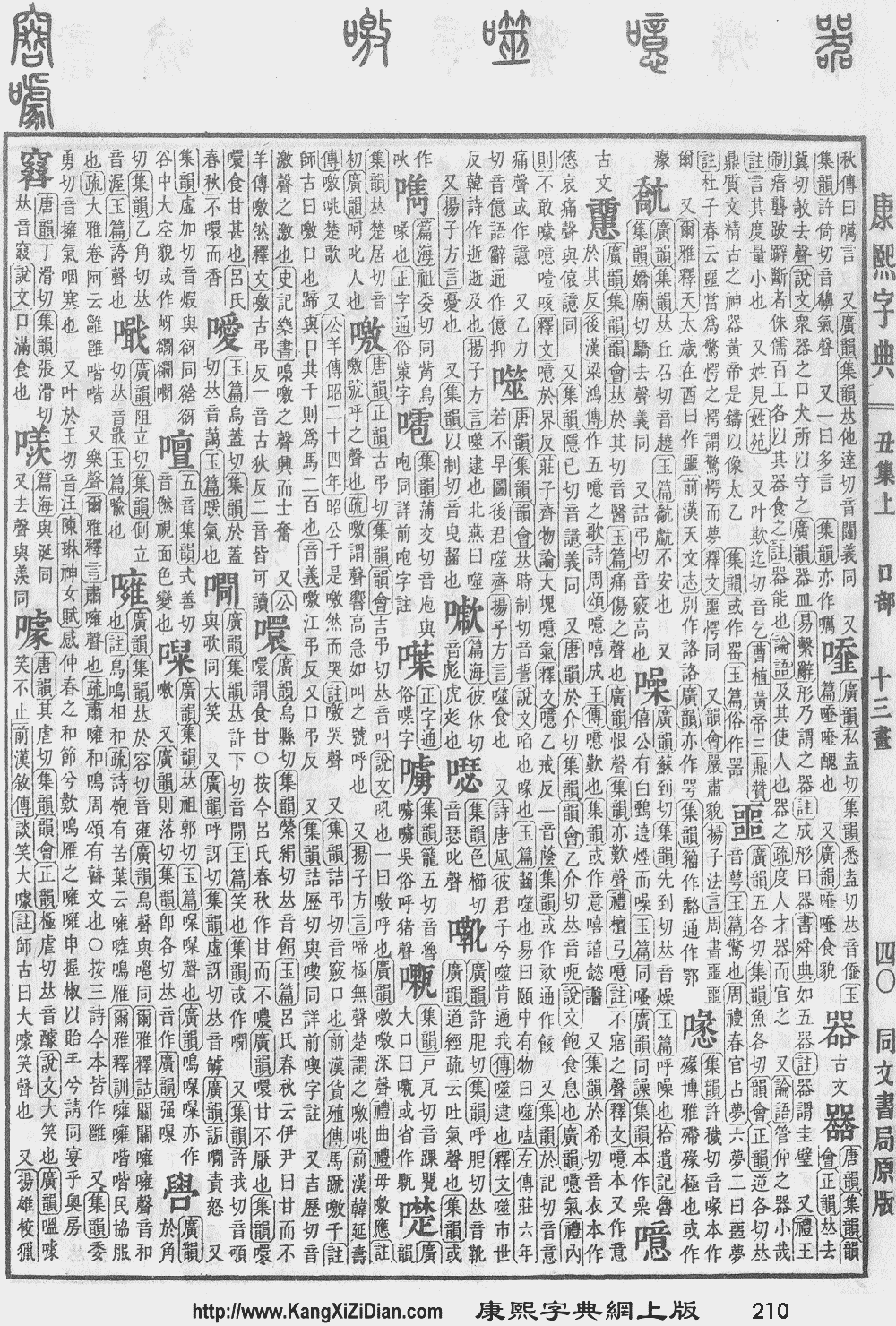
- KangXi: page 210, character 2
- Dai Kanwa Jiten: character 4349
- Dae Jaweon: page 432, character 26
- Hanyu Da Zidian: volume 1, page 690, character 7
- Unihan data for U+5668
Chinese
| simp. and trad. |
器 | |
|---|---|---|
| alt. forms | 噐 𡄛 𦈯 𠾖 𫩏 second round simplified | |
Glyph origin
| Historical forms of the character 器 | ||
|---|---|---|
| Western Zhou | Shuowen Jiezi (compiled in Han) | Liushutong (compiled in Ming) |
| Bronze inscriptions | Small seal script | Transcribed ancient scripts |
 |
 |
 |
Uncertain.
Possibly an ideogrammic compound (會意) : a 犬 (“dog”) guarding four 口 (“vessel”) – containers, or a phonetically borrowed character for the modern meanings with the original meaning being “to bark” (Compare 狺).
Pronunciation
Definitions
器
Compounds
|
|
|
Descendants
- → Korean: 그릇 (geureut, “receptacle; bowl; capacity; tolerance”) (Pan, 2006)
Japanese
| 器 | |
 |
Kanji
Readings
Etymology 1
| Kanji in this term |
|---|
| 器 |
| き Grade: 4 |
| on’yomi |
From Middle Chinese 器 (khijH, “vessel; instrument”).
Pronunciation
- On’yomi
- IPA(key): [kʲi]
- When used as a suffix, the resulting term has a downstep either right before, or one mora before, the ki.
- If the preceding syllable has only one mora (as in ga or tsu), the downstep occurs just after that mora:
- 瓦器 (“unglazed earthenware”): がき [gáꜜkì]
- 空気予熱器 (kūki yonetsuki, “air pre-heater”): くうきよねつき [kùúkí yónétsúꜜkì]
- If the preceding syllable has two morae (as in zen or tei), the downstep occurs between the two morae:
- 安全器 (anzenki, “safety cut-out”): あんぜんき [àńzéꜜǹkì]
- 円弧測定器 (enko sokuteiki, “cyclometer”): えんこそくていき [èńkó sókútéꜜèkì]
Affix
Usage notes
Often used interchangeably with 機 (ki) in compounds to indicate “machine”, with the subtlety that 器 implies a smaller device, perhaps hand-held, while 機 implies a larger machine, such as an airplane. Compare 食器 (shokki, “tableware”) and 飛行機 (hikōki, “airplane”), or homophones 機械 (kikai, “machine”, generally larger) and 器械 (kikai, “machine, tool”, generally smaller).
Derived terms
Suffix
Usage notes
Can attach to various nouns that can be used as verbs, to indicate a device for carrying out the action. Examples:
- 計量 (keiryō, “measurement, measuring, gauging”) + 器 (-ki) = 計量器 (keiryōki, “a measuring device, a gauge”)
- 尿 (nyō, “urine”) + 器 (-ki) = 尿器 (nyōki, “urinal”)
- 印字 (inji, “print, type”, literally “stamp + character”) + 器 (-ki) = 印字器 (injiki, “a printer”, a smaller device, such as a handheld number and letter puncher)
Derived terms
Etymology 2
| Kanji in this term |
|---|
| 器 |
| うつわ Grade: 4 |
| kun’yomi |
/ut͡supa/ → /ut͡suɸa/ → /ut͡suwa/
From Old Japanese.[1] Cognate with 空 (utsuo, ancient utsupo, utsubo), signifying a hollowness. Appears to be a compound of 空, 内 (utsu, “hollow”, combining form, standalone form uchi, “inside”) + は (ha). The derivation of this ha element is unclear.
Pronunciation
Noun
器 (hiragana うつわ, rōmaji utsuwa, historical hiragana うつは)
- container, vessel
- a tool, a utensil
- one's degree of ability: talent, caliber
- female genitalia: a vagina
Derived terms
- 器物 (utsuwamono): a container; ability, talent; a musical instrument
Synonyms
References
Korean
Hanja
器 • (gi) (hangeul 기, McCune–Reischauer ki)
- This term needs a translation to English. Please help out and add a translation, then remove the text
{{rfdef}}.
Vietnamese
Han character
器 (khí)
- This term needs a translation to English. Please help out and add a translation, then remove the text
{{rfdef}}.