花
| ||||||||
Translingual
| Stroke order | |||
|---|---|---|---|
 | |||
Han character
花 (radical 140, 艸+4, 7 strokes, cangjie input 廿人心 (TOP), four-corner 44214, composition ⿱艹化)
Derived characters
References
- KangXi: page 1020, character 21
- Dai Kanwa Jiten: character 30734
- Dae Jaweon: page 1478, character 5
- Hanyu Da Zidian: volume 5, page 3181, character 7
- Unihan data for U+82B1
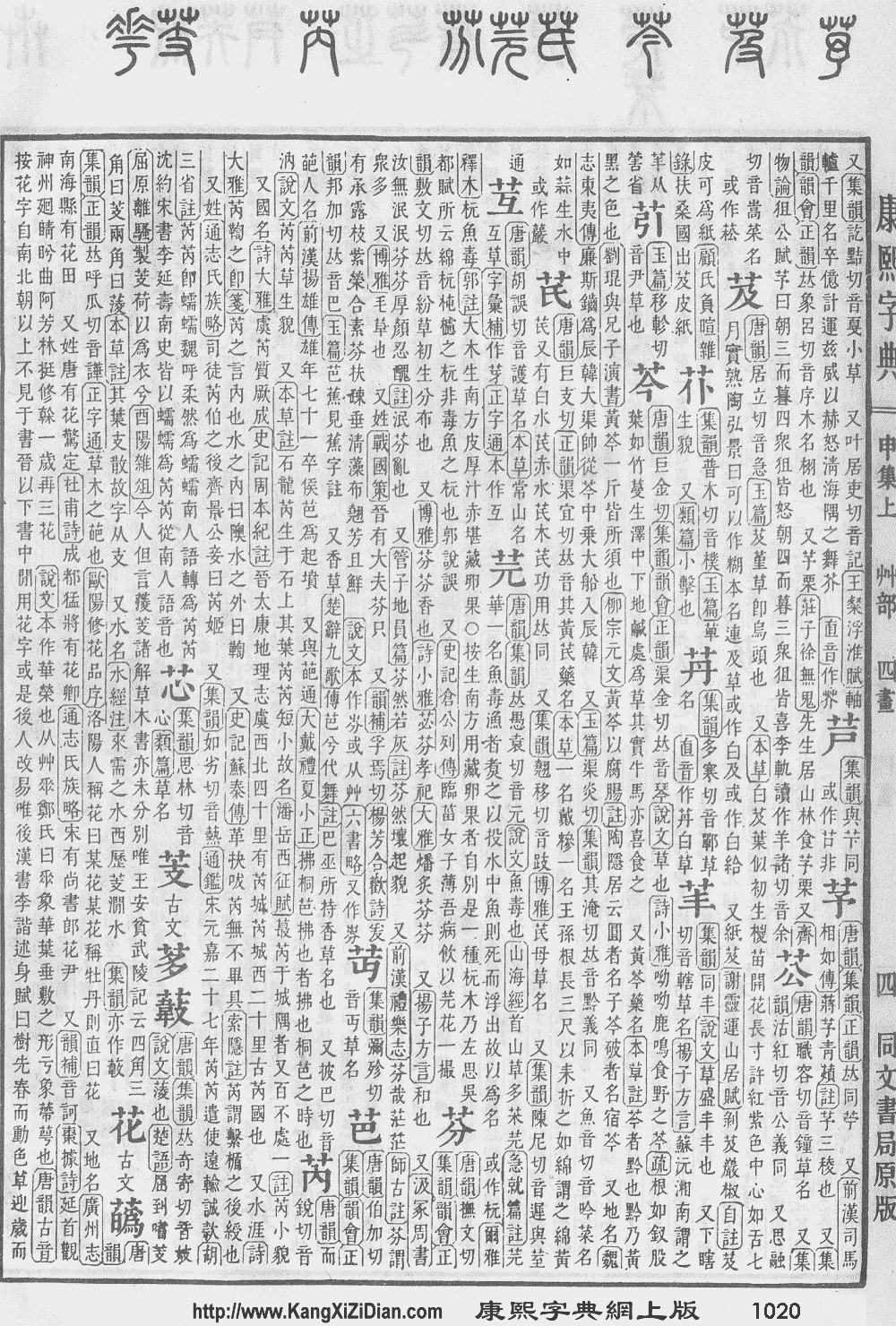
Chinese
| trad. | 花 | |
|---|---|---|
| simp. # | 花 | |
Glyph origin
| Historical forms of the character 花 | ||
|---|---|---|
| Western Zhou | Shuowen Jiezi (compiled in Han) | Liushutong (compiled in Ming) |
| Bronze inscriptions | Small seal script | Transcribed ancient scripts |
 |
 |
 |
| Characters in the same phonetic series (化) (Zhengzhang, 2003) | |
|---|---|
| Old Chinese | |
| 訛 | *ŋʷaːl |
| 吪 | *ŋʷaːl |
| 鈋 | *ŋʷaːl |
| 囮 | *lu, *ŋʷaːl |
| 魤 | *ŋʷaːl |
| 靴 | *hʷa |
| 貨 | *hŋʷaːls |
| 花 | *hʷraː |
| 化 | *hŋʷraːls |
| 杹 | *hŋʷraːls |
| 匕 | *pilʔ |
Phono-semantic compound (形聲, OC *hʷraː) : semantic 艹 (“grass; plant”) + phonetic 化 (OC *hŋʷraːls). Originally 𠌶 or 華 before the Han dynasty.
Pronunciation
Definitions
花
- flower; blossom (Classifier: 朵 m; 支 m; 束 m; 把 m; 盆 m; 簇 m)
- florid, flowery
- pattern, design
- blurred
- fireworks
- essence, cream
- wound
- smallpox
- courtesan, prostitute
- to spend (money, time, etc.)
- profligate
- (slang) randy, lecherous
- (slang) to be horny; to womanize
- false
- (Cantonese) scratched
- A surname. Hua
Synonyms
| Dialectal synonyms of 花朵 (“flower”) [map] | ||
|---|---|---|
| Variety | Location | Words |
| Classical Chinese | 花、華 | |
| Formal (Written Standard Chinese) | 花朵 | |
| Mandarin | Beijing | 花兒 |
| Taiwan | 花 | |
| Jinan | 花 | |
| Muping | 花 | |
| Xi'an | 花 | |
| Lanzhou | 花兒 | |
| Ürümqi | 花 | |
| Wuhan | 花 | |
| Chengdu | 花 | |
| Yangzhou | 花 | |
| Hefei | 花 | |
| Cantonese | Guangzhou | 花 |
| Hong Kong | 花 | |
| Hong Kong (Weitou) | 花 | |
| Taishan | 花 | |
| Yangjiang | 花 | |
| Gan | Nanchang | 花 |
| Lichuan | 花 | |
| Pingxiang | 花 | |
| Hakka | Meixian | 花 |
| Miaoli (N. Sixian) | 花 | |
| Liudui (S. Sixian) | 花 | |
| Hsinchu (Hailu) | 花 | |
| Dongshi (Dabu) | 花 | |
| Zhuolan (Raoping) | 花 | |
| Yunlin (Zhao'an) | 花 | |
| Hong Kong | 花 | |
| Huizhou | Jixi | 花 |
| Jin | Taiyuan | 花兒 |
| Min Bei | Jian'ou | 花 |
| Min Dong | Fuzhou | 花 |
| Fuqing | 花 | |
| Matsu | 花 | |
| Min Nan | Xiamen | 花、花蕊 |
| Quanzhou | 花、花蕊 | |
| Zhangzhou | 花、花蕊 | |
| Taipei | 花、花蕊 | |
| Penang | 花 | |
| Singapore | 花 | |
| Philippines (Manila) | 花 | |
| Chaozhou | 花 | |
| Haikou | 花 | |
| Leizhou | 花 | |
| Pinghua | Nanning | 花朵 |
| Wu | Shanghai | 花 |
| Suzhou | 花 | |
| Hangzhou | 花 | |
| Wenzhou | 花 | |
| Chongming | 花 | |
| Jinhua | 花 | |
| Ningbo | 花 | |
| Xiang | Changsha | 花 |
| Shuangfeng | 花 | |
Compounds
Derived terms from 花
|
|
|
Japanese
Kanji
花
Readings
Compounds
- 花火 (hanabi): fireworks
- 花暦 (hanagoyomi): flower calendar
- 花見 (hanami): flower contemplation/viewing
- 花輪 (hanawa): a garland of flowers; a wreath
- 花婿 (hanamuko): groom
- 花嫁 (hanayome): bride
- 花束 (hanataba): bouquet
- 花屋 (hanaya): florist
- 火花 (hibana): spark
- 花茶 (hanacha): flower tea
- 生け花 (ikebana): Japanese floral arranging
Etymology
| Kanji in this term |
|---|
| 花 |
| はな Grade: 1 |
| kun’yomi |
From Old Japanese.
Pronunciation
Alternative forms
Noun
- flower
- 花が咲く頃
- hana ga saku goro
- when the flowers bloom
- 1999 February 4, “火炎草 [Fire Grass]”, in Vol.1 (in Japanese), Konami:
- 火山の近くに生息する草。花から火炎を吹き攻撃する。
- Kazan no chikaku ni seisoku suru kusa. Hana kara kaen o fuki kōgeki suru.
- A grass that grows near volcanoes. It breathes fire from its flowers.
- 火山の近くに生息する草。花から火炎を吹き攻撃する。
- 1999 March 1, “ダーク・プラント [Dark Plant]”, in BOOSTER 1 (in Japanese), Konami:
- 汚染された土と闇の力で育てられた花。とても凶暴。
- Osen sareta tsuchi to yami no chikara de sodaterareta hana. Totemo kyōbō.
- A flower that grows from polluted soil and dark powers. It is very nasty.
- 汚染された土と闇の力で育てられた花。とても凶暴。
- 1999 May 25, “深淵に咲く花 [The Flower That Blooms in the Abyss]”, in BOOSTER 2 (in Japanese), Konami:
- 光の届かない深淵にひっそりと咲く、あまり見かけない花。
- Hikari no todokanai shin'en ni hissori to saku, amari mikakenai hana.
- A rarely seen flower that silently blooms in the depths of the abyss where the sun never shines.
- 光の届かない深淵にひっそりと咲く、あまり見かけない花。
- 1999 July 5, “命ある花瓶 [Living Vase]”, in BOOSTER 3 (in Japanese), Konami:
- 生けてある花から、花粉を飛ばし噛みついてくる生きている花瓶。
- Iketearu hana kara, kafun o tobashi kamitsuitekuru ikiteiru kabin.
- A living vase that bites and releases pollen from its living flowers.
- 生けてある花から、花粉を飛ばし噛みついてくる生きている花瓶。
- 花が咲く頃
- flower arrangement
- Japanese playing cards
- the best days of one's life
- the best thing
- essence
Derived terms
Korean
Hanja
- This term needs a translation to English. Please help out and add a translation, then remove the text
{{rfdef}}.
Vietnamese
Han character
花
(hoa, huê, hân)
- This term needs a translation to English. Please help out and add a translation, then remove the text
{{rfdef}}.
This article is issued from
Wiktionary.
The text is licensed under Creative Commons - Attribution - Sharealike.
Additional terms may apply for the media files.