靴
| ||||||||
Translingual
Han character
靴 (radical 177 革+4, 13 strokes, cangjie input 廿十人心 (TJOP), four-corner 44510, composition ⿰革化)
Derived characters
- 㗾, 𢶤, 𬩑, 𫫸, 𬆌
References
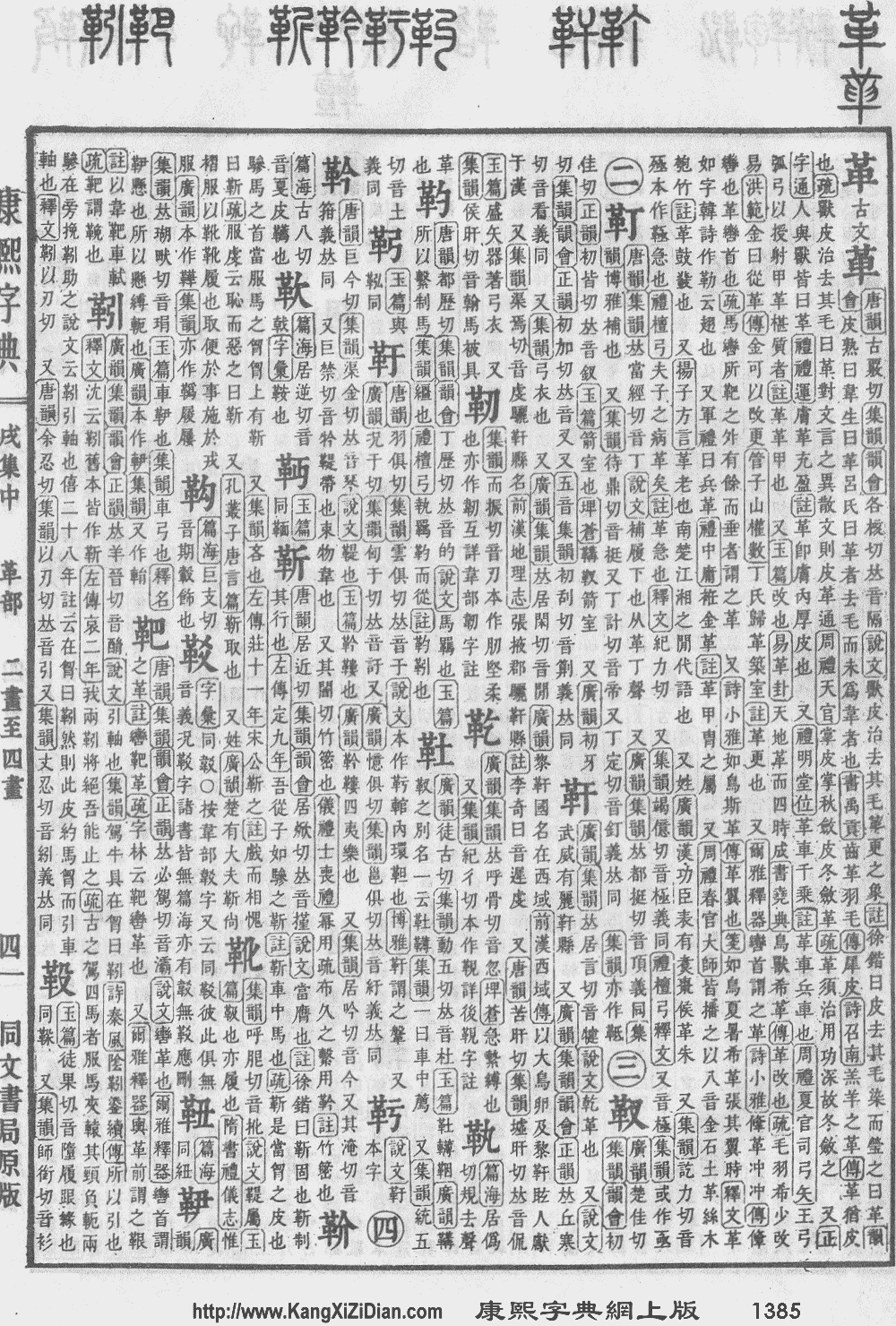
- KangXi: page 1385, character 19
- Dai Kanwa Jiten: character 42729
- Dae Jaweon: page 1900, character 10
- Hanyu Da Zidian: volume 7, page 4327, character 21
- Unihan data for U+9774
Chinese
| simp. and trad. |
靴 | |
|---|---|---|
| alt. forms | ||
Glyph origin
| Characters in the same phonetic series (化) (Zhengzhang, 2003) | |
|---|---|
| Old Chinese | |
| 訛 | *ŋʷaːl |
| 吪 | *ŋʷaːl |
| 鈋 | *ŋʷaːl |
| 囮 | *lu, *ŋʷaːl |
| 魤 | *ŋʷaːl |
| 靴 | *hʷa |
| 貨 | *hŋʷaːls |
| 花 | *hʷraː |
| 化 | *hŋʷraːls |
| 杹 | *hŋʷraːls |
| 匕 | *pilʔ |
Phono-semantic compound (形聲, OC *hʷa) : semantic 革 (“leather”) + phonetic 化 (OC *hŋʷraːls).
Pronunciation
Definitions
靴
- boot (footwear)
Synonyms
| Dialectal synonyms of 靴子 (“boot”) [map] | ||
|---|---|---|
| Variety | Location | Words |
| Classical Chinese | 靴 | |
| Formal (Written Standard Chinese) | 靴子 | |
| Mandarin | Beijing | 靴子 |
| Taiwan | 靴子 | |
| Jinan | 靴子 | |
| Luoyang | 靴仔 | |
| Jiedian | 靴子 | |
| Xi'an | 靴子 | |
| Xining | 靴子 | |
| Yinchuan | 靴子 | |
| Lanzhou | 靴子 | |
| Wuhan | 靴子 | |
| Chengdu | 靴子 | |
| Yangzhou | 靴子 | |
| Hefei | 深筒鞋、深筒靴 | |
| Cantonese | Guangzhou | 靴 |
| Hong Kong | 靴 | |
| Dongguan | 靴 | |
| Yangjiang | 靴 | |
| Gan | Nanchang | 靴子 |
| Lichuan | 靴仔 | |
| Hakka | Meixian | 靴仔 |
| Huizhou | Jixi | 靴 |
| Jin | Taiyuan | 靴子 |
| Xinzhou | 靴兒子 | |
| Min Bei | Jian'ou | 靴 |
| Min Dong | Fuzhou | 靴 |
| Min Nan | Xiamen | 靴 |
| Chaozhou | 靴 | |
| Wu | Shanghai | 靴 |
| Suzhou | 靴 | |
| Wenzhou | 靴 | |
| Danyang | 靴 | |
| Xiang | Changsha | 靴子 |
| Shuangfeng | 靴子 | |
Compounds
Derived terms from 靴
Japanese
Kanji
靴
Readings
Etymology
⟨kutu⟩: */kutu/ → /kut͡su/
From Old Japanese. Found in the Man'yōshū poetry compilation, completed circa 759.[1]
Ultimate derivation unclear. Some Japanese sources suggest a borrowing from or cognate with Korean 구두 (gudu, “shoes”), but then some Korean sources suggest that the Korean term was borrowed from Japanese 靴 (kutsu, “shoes”).
Pronunciation
Alternative forms
Noun
- footwear, footgear: a shoe, (a pair of) shoes
- c. 759, Man'yōshū (book 14, poem 3399), text here:
- 信濃道者 伊麻能波里美知 可里婆祢尓 安思布麻之<奈牟> 久都波氣和我世
- 信濃道は 今の墾り道 刈りばねに 足踏ましなむ 沓はけ我が背
- shinanuji wa ima no harimichi karibane ni ashi fumashinamu kutsu hake wagase
- the Shinano road has just been opened; wear shoes, my brother / my dear, so you do not step on the brush stubble [in your bare feet]
- c. 759, Man'yōshū (book 14, poem 3399), text here:
Synonyms
- シューズ (shūzu)
Derived terms
References
- ↑ 1988, 国語大辞典(新装版) (Kokugo Dai Jiten, Revised Edition) (in Japanese), Tōkyō: Shogakukan
- ↑ 2006, 大辞林 (Daijirin), Third Edition (in Japanese), Tōkyō: Sanseidō, →ISBN
- ↑ 1998, NHK日本語発音アクセント辞典 (NHK Japanese Pronunciation Accent Dictionary) (in Japanese), Tōkyō: NHK, →ISBN
- ↑ 1997, 新明解国語辞典 (Shin Meikai Kokugo Jiten), Fifth Edition (in Japanese), Tōkyō: Sanseidō, →ISBN
Korean
Hanja
靴 • (hwa) (hangeul 화, McCune–Reischauer hwa, Yale hwa)
Compounds
- 木靴 (목화, mokhwa) The courtesy footwear in the Eastern tradition, as worn by courtiers, somewhat similar to the moccasin made of deerskin.
- 洋靴 (양화, yanghwa) Western shoes, boots
- 長靴 (장화, janghwa) boots
Okinawan
Etymology
Attested in the 沖縄語典 (Okinawa Goten, “Okinawan Dictionary”) as ふや.[1]
Noun
References
- ↑ 1896: 沖縄語典 (Okinawa Goten, “Okinawan Dictionary”). In Japanese. http://kindai.ndl.go.jp/info:ndljp/pid/992016/33
Vietnamese
Han character
靴 (ngoa)
- This term needs a translation to English. Please help out and add a translation, then remove the text
{{rfdef}}.
This article is issued from
Wiktionary.
The text is licensed under Creative Commons - Attribution - Sharealike.
Additional terms may apply for the media files.