冇
| ||||||||
Translingual
Han character
冇 (radical 13, 冂+2, 4 strokes, cangjie input 大月 (KB) or X大月 (XKB), four-corner 40227, composition ⿱𠂇冂)
References
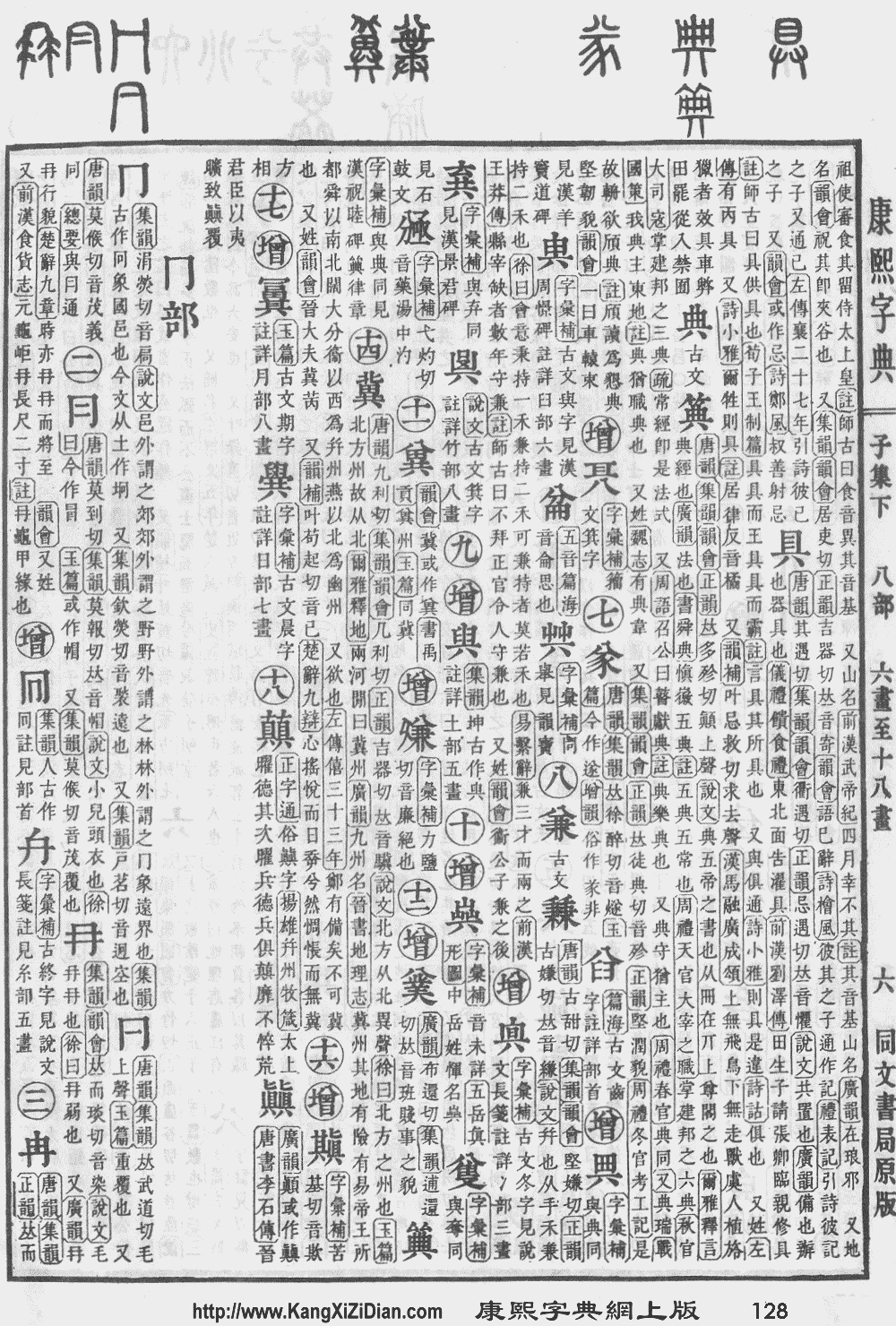
- KangXi: not present, would follow page 128, character 35
- Hanyu Da Zidian: volume 1, page 96, character 17
- Unihan data for U+5187
Chinese
Glyph origin
From the removal of the two inner strokes from 有 (“to have”).
Etymology 1
| simp. and trad. |
冇 | |
|---|---|---|
| alt. forms | 無/无 冒 Xiang | |
From 無 (MC mɨo, “to not have”), fused with 有 (MC ɦɨuX, “to have”) (Schuessler, 2007).
Pronunciation
Definitions
冇
- (dialectal Mandarin, Cantonese, dialectal Gan, Hakka, dialectal Wu, Xiang) to not have; to not exist
- 你冇女朋友?梗係唔信啦!……或者有。你唔知啫。 [Cantonese, trad.]
- From: 陳慧嫻, 紅茶館
- Nei5 mou5 neoi5 pang4 jau5? Gang2 hai6 m4 seon3 laa1!...... Waak6 ze2 jau5. Nei5 m4 zi1 ze1. [Jyutping]
- You don't have a girlfriend? Of course I don't believe you! ... Maybe you do have one, but you just don't know it.
你冇女朋友?梗系唔信啦!……或者有。你唔知啫。 [Cantonese, simp.]
- (dialectal Mandarin, Cantonese, Xiang) have not; did not (do something) (indicating non-completion of a verb)
Usage notes
- Originally from Cantonese, the meaning of this character is now passively understood by many Mandarin speakers.
Synonyms
| Dialectal synonyms of 沒有 (“to not have (+ noun)”) [map] | ||
|---|---|---|
| Variety | Location | Words |
| Classical Chinese | 無 | |
| Formal (Written Standard Chinese) | 沒有 | |
| Mandarin | Beijing | 沒有、沒 |
| Taiwan | 沒有、沒 | |
| Jinan | 沒有、沒 | |
| Xi'an | 沒有 | |
| Wuhan | 冇得 | |
| Chengdu | 沒得 | |
| Yangzhou | 不得、沒得 | |
| Hefei | 沒 | |
| Cantonese | Guangzhou | 冇、冇有 |
| Hong Kong | 冇 | |
| Taishan | 冇 | |
| Gan | Nanchang | 冒有 |
| Hakka | Meixian | 無 |
| Miaoli (N. Sixian) | 無 | |
| Liudui (S. Sixian) | 無 | |
| Hsinchu (Hailu) | 無 | |
| Dongshi (Dabu) | 無 | |
| Zhuolan (Raoping) | 無 | |
| Yunlin (Zhao'an) | 無 | |
| Jin | Taiyuan | 沒、沒啦 |
| Min Dong | Fuzhou | 無 |
| Min Nan | Xiamen | 無 |
| Quanzhou | 無 | |
| Zhangzhou | 無 | |
| Taipei | 無 | |
| Kaohsiung | 無 | |
| Tainan | 無 | |
| Taichung | 無 | |
| Hsinchu | 無 | |
| Lukang | 無 | |
| Sanxia | 無 | |
| Yilan | 無 | |
| Kinmen | 無 | |
| Magong | 無 | |
| Penang | 無 | |
| Singapore | 無 | |
| Philippines (Manila) | 無 | |
| Chaozhou | 無 | |
| Shantou | 無 | |
| Thailand (Bangkok) | 無 | |
| Wu | Shanghai | 嘸沒 |
| Suzhou | 嘸不 | |
| Wenzhou | 冇 | |
| Xiang | Changsha | 冇得、冇 |
| Shuangfeng | 冇得 | |
Etymology 2
| simp. and trad. |
冇 | |
|---|---|---|
Compare Saek [script needed] (phoongC2, “hollow; hole (in a tree, bamboo)”), Proto-Bahnaric *pɔːŋ (“hollow; flattened”) (Schuessler, 2007).
This etymology is incomplete. You can help Wiktionary by elaborating on the origins of this term.
Pronunciation
Definitions
冇
- (Min, Hakka) empty; hollow; spongy; not sturdy
- (Min, Hakka) unreliable; undependable; casual
- (Min Nan) extravagant; generous
- (Hakka) insufficient; lacking
Vietnamese
Han character
冇 (mậu)
- This term needs a translation to English. Please help out and add a translation, then remove the text
{{rfdef}}.
This article is issued from
Wiktionary.
The text is licensed under Creative Commons - Attribution - Sharealike.
Additional terms may apply for the media files.