昆
| ||||||||
Translingual
Han character
昆 (radical 72 日+4, 8 strokes, cangjie input 日心心 (APP), four-corner 60711, composition ⿱日比)
Derived terms
References
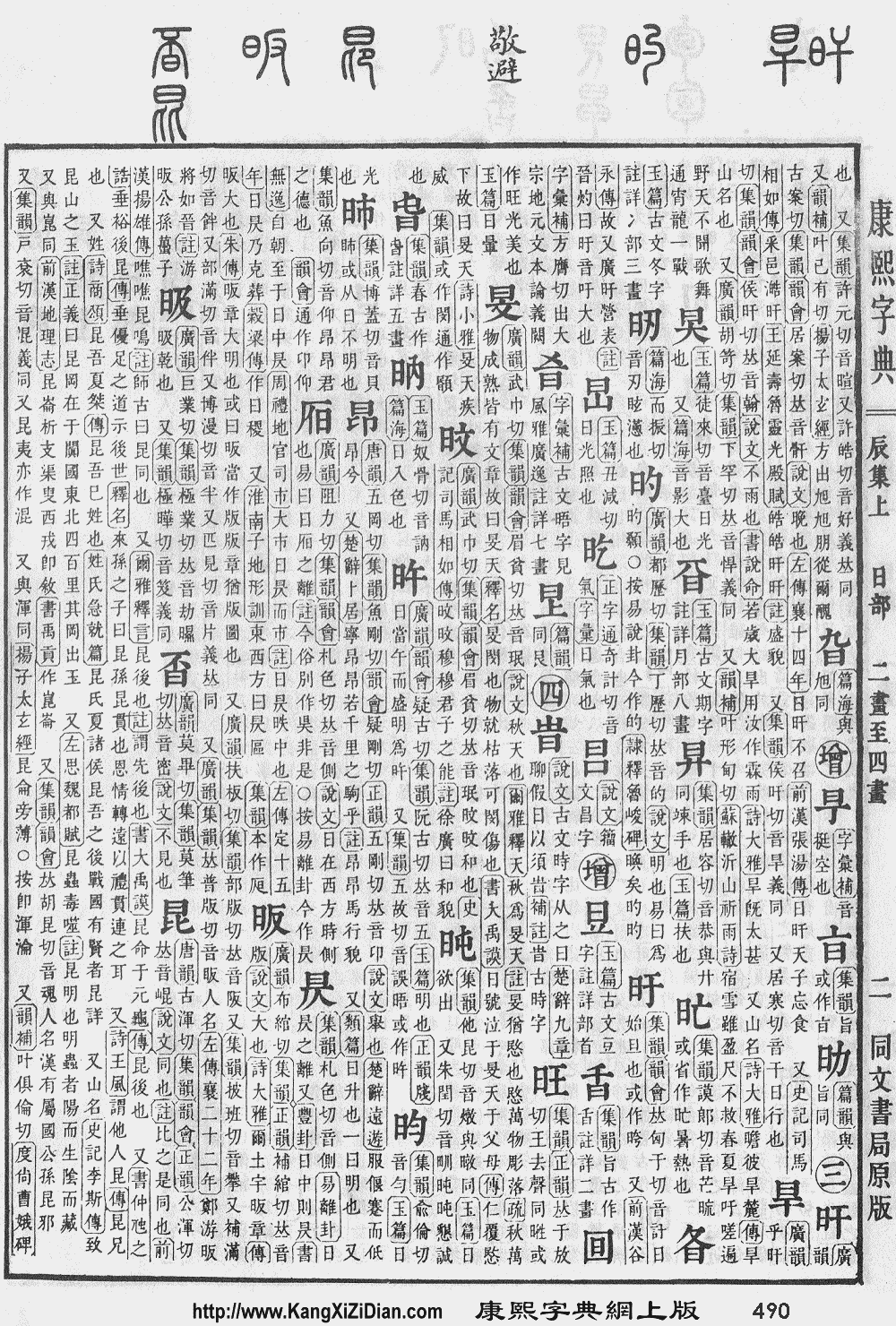
- KangXi: page 490, character 39
- Dai Kanwa Jiten: character 13792
- Dae Jaweon: page 852, character 9
- Hanyu Da Zidian: volume 2, page 1489, character 9
- Unihan data for U+6606
Chinese
| simp. and trad. |
昆 | |
|---|---|---|
Glyph origin
| Characters in the same phonetic series (昆) (Zhengzhang, 2003) | |
|---|---|
| Old Chinese | |
| 昆 | *kuːn |
| 琨 | *kuːn |
| 鯤 | *kuːn |
| 菎 | *kuːn |
| 崐 | *kuːn |
| 蜫 | *kuːn |
| 惃 | *kuːn, *kuːnʔ |
| 錕 | *kuːn, *kuːnʔ |
| 猑 | *kuːn |
| 騉 | *kuːn |
| 緄 | *kuːnʔ |
| 輥 | *kuːnʔ |
| 棍 | *kuːns, *ɡuːnʔ |
| 餛 | *ɡuːn |
| 混 | *ɡuːnʔ |
| 焜 | *ɡuːnʔ |
| 倱 | *ɡuːnʔ |
| 掍 | *ɡuːnʔ |
| 箟 | *kʰrun |
Etymology 1
- “elder brother”
- From Proto-Sino-Tibetan *(g/k)əw-n (“elder brother; senior male relative”); cognate with 舅 (OC *ɡuʔ, “maternal uncle”) (Benedict, 1972; STEDT).
- Alternatively, it may be related to Middle Mon ko² (“elder brother”), with nominal suffix -n added (Schuessler, 2007).
- “descendants; later”
- Perhaps from Proto-Mon-Khmer *kuun (“child”); cognate with Min 囝 (“son; child”) (Schuessler, 2007).
- “many; numerous”
- From Proto-Sino-Tibetan *m-kul (“twenty; all”); cognate with 群 (OC *ɡlun, “herd; all”) (Schuessler, 2007; STEDT).
This etymology is incomplete. You can help Wiktionary by elaborating on the origins of this term.
Pronunciation
Definitions
昆
- † simultaneously
- † elder brother
- † descendants
- † later
- † many; numerous
- † Alternative form of 焜 (kūn).
- Short for 昆明 (Kūnmíng).
- A surname.
Compounds
Etymology 2
Pronunciation
Definitions
昆
Etymology 3
Pronunciation
Definitions
昆
- † Alternative form of 混 (hùn, “to unite”).
- 54th tetragram of the Taixuanjing; "unity"
Etymology 4
| For pronunciation and definitions of 昆 – see 崑 (“dot=”). (This character, 昆, is the simplified and variant traditional form of 崑.) |
Notes:
|
References
Japanese
Kanji
昆
- A swarm of or an organism that swarms (e.g. bugs), an organism that forms in large groups (e.g. kombu)
- elder brother
- descendants, great-great-great-great grandchild
Readings
Compounds
Korean
Hanja
昆 • (gon, hon) (hangeul 곤, 혼, revised gon, hon, McCune–Reischauer kon, hon, Yale kon, hon)
- (맏형 곤, mat-hyeong-): the eldest brother
See also
- 鵾 (곤, gon) swan, among the largest birds
- 猑 (곤, gon) dog, the big one
- 鯤 (곤, gon) fish, the largest, legendary creature
- 混 (곤, gon) maybe, Huns or Hünen "giants"
Vietnamese
Han character
- This term needs a translation to English. Please help out and add a translation, then remove the text
{{rfdef}}.
This article is issued from
Wiktionary.
The text is licensed under Creative Commons - Attribution - Sharealike.
Additional terms may apply for the media files.