swan
English
Pronunciation
- (Received Pronunciation) IPA(key): /swɒn/
- (General American) IPA(key): /swɑn/
Audio (US) (file) - Rhymes: -ɒn
Etymology 1
From Middle English swan, from Old English swan, from Proto-Germanic *swanaz. Cognate with West Frisian swan, Low German Swaan, swan, Dutch zwaan, German Schwan, Norwegian svane, Swedish svan, probably literally “the singing bird”, from a Proto-Indo-European *swon-/*swen- (“to sing, make sound”). Related to Old English geswin (“melody, song”) and swinsian (“to make melody”). Compare Latin sonus (“sound”) and Russian звон (zvon, “ringing”) and звук (zvuk, “sound”).
Noun
swan (plural swans or swan)
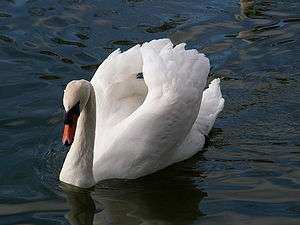
- Any of various species of large, long-necked waterfowl, of genus Cygnus (bird family: Anatidae), most of which have white plumage.
- (figuratively) One whose grace etc. suggests a swan.
- (heraldry) This bird used as a heraldic charge, sometimes with a crown around its neck (e. g. the arms of Buckinghamshire).
Derived terms
|
|
|
Translations
|
|
See also
- cob (adult male)
- cygnet (epicene, young)
- lamentation
- pen (adult female)
Verb
swan (third-person singular simple present swans, present participle swanning, simple past and past participle swanned)
- (Britain, intransitive) To travel or move about in an aimless, idle, or pretentiously casual way.
- 2010, Lee Rourke, The Canal, Melville House Publishing (2010), →ISBN, unnumbered page:
- He swans around that stinking office in his expensive clothes that are a little too tight for comfort, he swans around that stinking office without a care in the world.
- 2013, Tilly Bagshawe, One Summer’s Afternoon, HarperCollins (2013), →ISBN, unnumbered page:
- One of the few strokes of good luck Emma had had in recent days was the news that Tatiana Flint-Hamilton, her only real rival for top billing as 'most photographable girl' at today's event had decided to swan off to Sardinia instead, leaving the limelight entirely to Emma.
- 2010, Lee Rourke, The Canal, Melville House Publishing (2010), →ISBN, unnumbered page:
Usage notes
- In the sense “to travel”, usually used as part of the phrase “to swan about” or “to swan around”.
Etymology 2
Probably from dialectal I s’wan, contraction of “I shall warrant”; later seen as a minced form of I swear.
Alternative forms
Verb
swan (third-person singular simple present swans, present participle swanning, simple past and past participle swanned)
- (US, dialectal or colloquial) To declare (chiefly in first-person present constructions).
- 1907 December, J. D. Archer, Foiling an eavesdropper, in Telephony, volume 14, page 345:
- "Well, I swan, man, I had a better opinion of you than that."
- 1940, Raymond Chandler, Farewell, My Lovely, Penguin 2010, page 214:
- ‘She slammed the door so hard I figured a window'd break […] .’ ‘I swan,’ I said.
- 1907 December, J. D. Archer, Foiling an eavesdropper, in Telephony, volume 14, page 345:
Anagrams
Middle English
Etymology 1
From Old English swan, from Proto-Germanic *swanaz.
Alternative forms
Pronunciation
- IPA(key): /swan/
Noun
swan (plural swannes)
- swan (A bird that is part of the genus Cygnus)
- The meat of a a swan.
- (heraldry) A swan as a heraldic symbol.
Descendants
References
- “swan (n.)” in MED Online, Ann Arbor, Mich.: University of Michigan, 2007, retrieved 2018-06-11.
Etymology 2
From Old English swān.
Noun
swan
- Alternative form of swon
Old English
Etymology 1
From Proto-Germanic *swanaz, probably from Proto-Indo-European *swen- (“to sound, resound”). Compare Old Saxon swan (Low German Swaan), Dutch zwaan, Old High German swan (German Schwan), Old Norse svanr (Swedish svan).
Alternative forms
Pronunciation
- IPA(key): /ˈswɑn/
Noun
swan m
Declension
Synonyms
Descendants
Etymology 2
From Proto-Germanic *swainaz, whence also Old High German swein, Old Norse sveinn, English swain (through Old Norse).
Pronunciation
- IPA(key): /ˈswɑːn/
Noun
swān m
Descendants
West Frisian
Etymology
From Old Frisian *swan, from Proto-Germanic *swanaz (“swan”), probably from Proto-Indo-European *swen- (“to sound, resound”). Compare English swan, Dutch zwaan, Low German Swaan, German Schwan, Swedish svan.
Noun
swan c