dog
English
Alternative forms
Pronunciation
- (Received Pronunciation) IPA(key): /dɒɡ/
Audio (UK) (file) - (US) enPR: dôg, IPA(key): /dɔɡ/
Audio (US) (file) - (US, Canada, cot–caught merger) IPA(key): /dɑɡ/
- Rhymes: -ɒɡ
Etymology
From Middle English dogge, from Old English docga (“hound, powerful breed of dog”), a pet-form diminutive with suffix -ga (compare frocga (“frog”), *picga (“pig”)). Cognate with Scots dug (“dog”). The base to which the suffix was added is unclear. One possibility is Old English *docce (“muscle”) (found in compound fingerdocce (“finger-muscle”)), possibly from Proto-Germanic *dukkǭ (“power, strength, muscle”); another is Old English dox (“dark, swarthy”).[1]
In 14th-century England, hound (from Old English hund) was the general word for all domestic canines, and dog referred to a subtype of hound, a group including the mastiff. It is believed this dog type was so common that it eventually became the prototype of the category "hound".[2] By the 16th century, dog had become the general word, and hound had begun to refer only to dog types used for hunting.[3] In the 16th century dog was also adopted by several continental European languages as their word for mastiff.[4]
Noun
dog (plural dogs)
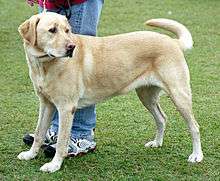
- A mammal, Canis lupus familiaris, that has been domesticated for thousands of years, of highly variable appearance due to human breeding.
- 1918, W. B. Maxwell, chapter 16, in The Mirror and the Lamp:
- The preposterous altruism too! […] Resist not evil. It is an insane immolation of self—as bad intrinsically as fakirs stabbing themselves or anchorites warping their spines in caves scarcely large enough for a fair-sized dog.
- 1963, Margery Allingham, chapter 19, in The China Governess:
- When Timothy and Julia hurried up the staircase to the bedroom floor, where a considerable commotion was taking place, Tim took Barry Leach with him. […] . The captive made no resistance and came not only quietly but in a series of eager little rushes like a timid dog on a choke chain.
- The dog barked all night long.
-
- A male dog, wolf or fox, as opposed to a bitch (often attributive).
- 1928, Siegfried Sassoon, Memoirs of a Fox-Hunting Man, Penguin 2013, page 149:
- Firstly, he was there to encourage and assist the hounds (a scratch pack – mostly dog-hounds drafted from fox-hound kennels because they were over-sized) […].
- 1928, Siegfried Sassoon, Memoirs of a Fox-Hunting Man, Penguin 2013, page 149:
- (slang, derogatory) A dull, unattractive girl or woman.
- She’s a real dog.
- (slang) A man (derived from definition 2).
- You lucky dog!
- He's a silly dog.
- (slang, derogatory) A coward.
- Come back and fight, you dogs!
- (derogatory) Someone who is morally reprehensible.
- Bible, 2 Kings viii. 13 (Rev. Ver.)
- What is thy servant, which is but a dog, that he should do this great thing?
- 1599, Robert Greene, Alphonsus, King of Aragon (1599). Act 3.
- Blasphemous dog, I wonder that the earth / Doth cease from renting vnderneath thy feete, / To swallow vp those cankred corpes of thine.
- You dirty dog.
- Bible, 2 Kings viii. 13 (Rev. Ver.)
- (slang) A sexually aggressive man (cf. horny).
- Any of various mechanical devices for holding, gripping, or fastening something, particularly with a tooth-like projection.
- (Can we clean up(+) this sense?) A click or pallet adapted to engage the teeth of a ratchet-wheel, to restrain the back action; a click or pawl. (See also: ratchet, windlass)
- A metal support for logs in a fireplace.
- 1902, Arthur Conan Doyle, The Hound of the Baskervilles
- In the great old-fashioned fireplace behind the high iron dogs a log-fire crackled and snapped.
- The dogs were too hot to touch.
- 1902, Arthur Conan Doyle, The Hound of the Baskervilles
- (cartomancy) The eighteenth Lenormand card.
- A hot dog.
- 1994 July 21, Faye Fiore, “Congress relishes another franking privilege: Meat lobby puts on the dog with exclusive luncheon for lawmakers – experts on pork”, in Los Angeles Times:
- Congressmen gleefully wolfed down every imaginable version of the hot dog – smoked kielbasas, jumbo grillers, Big & Juicy's, kosher dogs and spiced dogs […]
-
- (poker slang) Underdog.
- (slang, almost always in the plural) Foot.
- My dogs are barking! ― My feet hurt!
- (Cockney rhyming slang) Phone or mobile phone.
- My dog is dead.
- My mobile-phone battery has run out of charge and is no longer able to function.
Synonyms
- (animal): taxonomic names: Canis familiaris, Canis domesticus, Canis familiarus domesticus, Canis canis, Canis aegyptius, Canis familiarus aegyptius, Canis melitaeus, Canis familiarus melitaeus, Canis molossus, Canis familiarus molossus, Canis saultor, Canis familiaris saultor
- (animal): domestic dog, hound, canine; see also Thesaurus:dog
- (male): stud, sire
- (man): bloke (British), chap (British), dude, fellow, guy, man; see also Thesaurus:man
- (morally reprehensible person): cad, bounder, blackguard, fool, hound, heel, scoundrel
- (mechanical device): click, detent, pawl
- (metal support for logs): andiron, firedog, dogiron
Coordinate terms
Hyponyms
- (animal): Afghan hound, bloodhound, chihuahua, coonhound, dachshund, deerhound, foxhound, gazehound, German shepherd, greyhound, hound, Irish Wolfhound, Norwegian Elkhound, otterhound, pointer, poodle, retriever, Russian Wolfhound, scenthound, setter, sheepdog, shepherd, sighthound, spaniel, staghound, terrier, wolfhound
Hypernyms
- (animal): canid
Derived terms
Descendants
Translations
Verb
dog (third-person singular simple present dogs, present participle dogging, simple past and past participle dogged)
- (transitive) To pursue with the intent to catch.
- (transitive) To follow in an annoying or harassing way.
- The woman cursed him so that trouble would dog his every step.
- 1749, Henry Fielding, The History of Tom Jones, a Foundling
- […] they were discovered in a very improper manner by the husband of the gypsy, who, from jealousy it seems, had kept a watchful eye over his wife, and had dogged her to the place, where he found her in the arms of her gallant.
- 2012 January 1, Michael Riordan, “Tackling Infinity”, in American Scientist, volume 100, number 1, page 86:
- Some of the most beautiful and thus appealing physical theories, including quantum electrodynamics and quantum gravity, have been dogged for decades by infinities that erupt when theorists try to prod their calculations into new domains. Getting rid of these nagging infinities has probably occupied far more effort than was spent in originating the theories.
- (transitive, nautical) To fasten a hatch securely.
- It is very important to dog down these hatches...
- (intransitive, emerging usage in Britain) To watch, or participate, in sexual activity in a public place.
- I admit that I like to dog at my local country park.
- (intransitive, transitive) To intentionally restrict one's productivity as employee; to work at the slowest rate that goes unpunished.
- A surprise inspection of the night shift found that some workers were dogging it.
Synonyms
Translations
|
|
See also
- Category:en:Canids
- bark
- canine
- cynomorphic
- cynomorphism
- flea bag
References
- Michael Weisenberg (2000), The Official Dictionary of Poker (MGI/Mike Caro University, →ISBN



References
Anagrams
Afrikaans
Pronunciation
- IPA(key): /dɔχ/
Verb
dog
Danish
Adverb
dog
- however
- Det er dog ikke sikkert, at de taler sandt.
- It is, however, not certain that they are telling the truth.
- Det er dog ikke sikkert, at de taler sandt.
- Used emphatically.
Conjunction
dog
Kriol
Etymology
Noun
dog
Mbabaram
Etymology
From *dwog(a), from *udwoga, from *gudwaga, from Proto-Pama-Nyungan *gudaga. Related to Dyirbal guda, Yidiny gudaga. Not related to English dog; it is a false cognate.[1][2]
Pronunciation
Noun
dog
References
- ↑ Language Hat, excerpting Dixon's Memoirs of a Field Worker
- 1 2 Stephen R. Anderson, Languages: A Very Short Introduction (Oxford 2012), 36.
Navajo
Etymology
Interjection
dog
- thump, dub (sound of a heartbeat; thumping sound of a person walking on the roof of a house as heard by someone in the house)
Synonyms
- tsʼidog
Norwegian Bokmål
Adverb
dog
Conjunction
dog
Portuguese
Pronunciation
- (Brazil) IPA(key): /ˈdɔɡ/, /ˈdɔ.ɡi/
Noun
dog m (plural dogs)
- Clipping of hot dog.
Swedish
Verb
dog
- past tense of dö.
Torres Strait Creole
Etymology
Noun
dog
Volapük
Pronunciation
- IPA(key): [doɡ]
Noun
dog (plural dogs)
- (male or female) dog
Declension
Derived terms
|
Related terms
- doeg
- toradoeg
Westrobothnian
Adjective
dog