axe
English
Etymology 1
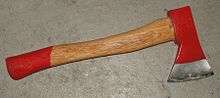
From Middle English ax, axe, ex, from Old English æx, from Proto-Germanic *akwisī, probably from a Proto-Indo-European *h₂egʷs-ih₂- (“axe”), from *h₂eḱ- (“sharp, pointed”). Compare German Axt, Danish økse, Icelandic öxi, and also Latin ascia.
Alternative forms
- ax (largely US)
Pronunciation
- enPR: ăks, IPA(key): /æks/
Audio (US) (file) - Rhymes: -æks
Noun
axe (plural axes)
- A tool for felling trees or chopping wood etc. consisting of a heavy head flattened to a blade on one side, and a handle attached to it.
- An ancient weapon consisting of a head that has one or two blades and a long handle.
- (informal) A dismissal or rejection.
- His girlfriend/boss/schoolmaster gave him the axe.
- 1975, Bob Dylan, Tangled Up in Blue
- I had a job in the great North Woods
- Workin' as a cook for a spell.
- But I never did like it all that much
- And one day the axe just fell.
- (slang, music) A gigging musician's particular instrument, especially a guitar in rock music or a saxophone in jazz.
- (finance) A position, interest, or reason in buying and selling stock, often with ulterior motives.[1]
- A financial dealer has an axe in a stock that his buyers don't know about, giving him an advantage in making the most profit.
- Those stocks are losing value quickly; he's axed to sell now before they drop even lower.
Usage notes
- In the United States, this spelling is sometimes used to distinguish the weapon from the tool, though most people use either "ax" or less commonly "axe" for both senses.
Derived terms
Translations
|
|
|
|
|
- The translations below need to be checked and inserted above into the appropriate translation tables, removing any numbers. Numbers do not necessarily match those in definitions. See instructions at Wiktionary:Entry layout#Translations.
See also
Verb
axe (third-person singular simple present axes, present participle axing, simple past and past participle axed)
- (transitive) To fell or chop with an axe.
- (transitive) To lay off, terminate or drastically reduce, especially in a rough or ruthless manner.
Translations
Etymology 2
Alternative forms
Noun
axe (plural axes)
Verb
axe (third-person singular simple present axes, present participle axing, simple past and past participle axed)
- To furnish with an axle.
Etymology 3
Verb
axe (third-person singular simple present axes, present participle axing, simple past and past participle axed)
- (now obsolete outside dialects, especially African American Vernacular) Alternative form of ask
- 1395, John Wycliffe, trans. Bible, 1 Corinthis 14:35:
- But if thei wolen ony thing lerne, at home axe thei her hosebondis; for it is foule thing to a womman to speke in chirche.
- 1526, William Tyndale, trans. Bible, Luke IIi:
- And the people axed hym, sayinge: What shall we do then.
- 1395, John Wycliffe, trans. Bible, 1 Corinthis 14:35:
References
- ↑ Shedding the correlation ‘axe’, Risk magazine
Anagrams
French
Etymology
Borrowed from Latin axis. Compare the inherited doublet ais.
Pronunciation
- IPA(key): /aks/
audio (file)
Noun
axe m (plural axes)
Further reading
- “axe” in le Trésor de la langue française informatisé (The Digitized Treasury of the French Language).
Interlingua
Noun
axe (plural axes)
- Straight line that crosses the center of a body and around which it turns.
- Bar connecting parallel wheels of a kart, wagon, etc.
Latin
Noun
axe
- ablative singular of axis
Middle English
Etymology 1
From Old English æx.
Noun
axe
- Alternative form of ax
Etymology 2
From Old English ǣsce, from Proto-Germanic *aiskijǭ.
Alternative forms
Pronunciation
- IPA(key): /aks/
Noun
axe
Descendants
- English: ask (if not formed from the verb)
References
- “axe (n.(3))” in MED Online, Ann Arbor, Mich.: University of Michigan, 2007, retrieved 2018-04-24.