pole
English
Pronunciation
- (UK) IPA(key): /pəʊl/, /pɔʊl/
- (US) IPA(key): /poʊl/
- (General Australian) IPA(key): /pɔːl/
Audio (US) (file) - Rhymes: -əʊl
- Homophones: Pole, poll
Etymology 1
From Middle English pole, pal, from Old English pāl (“a pole, stake, post; a kind of hoe or spade”), from Proto-Germanic *palaz, *pālaz (“pole”), from Latin pālus (“stake, pale, prop, stay”) from Old Latin *paglus, from Proto-Indo-European *pāǵe- (“to nail, fasten”).
Noun
pole (plural poles)
- Originally, a stick; now specifically, a long and slender piece of metal or (especially) wood, used for various construction or support purposes.
- 1913, Joseph C. Lincoln, chapter 1, in Mr. Pratt's Patients:
- For a spell we done pretty well. Then there came a reg'lar terror of a sou'wester same as you don't get one summer in a thousand, and blowed the shanty flat and ripped about half of the weir poles out of the sand.
-
- (fishing) A type of basic fishing rod.
- A long sports implement used for pole-vaulting; now made of glassfiber or carbon fiber, formerly also metal, bamboo and wood have been used.
- (slang, spotting) A telescope used to identify birds, aeroplanes or wildlife.
- (historical) A unit of length, equal to a perch (¼ chain or 5½ yards).
- (motor racing) Pole position.
- (US, rap music, slang) A gun.
Synonyms
- See also Thesaurus:stick
- (unit of length): rod
Derived terms
Related terms
Translations
|
|
Verb
pole (third-person singular simple present poles, present participle poling, simple past and past participle poled)
- To propel by pushing with poles, to push with a pole.
- Huck Finn poled that raft southward down the Mississippi because going northward against the current was too much work.
- To identify something quite precisely using a telescope.
- He poled off the serial of the Gulfstream to confirm its identity.
- (transitive) To furnish with poles for support.
- to pole beans or hops
- (transitive) To convey on poles.
- to pole hay into a barn
- (transitive) To stir, as molten glass, with a pole.
Translations
Etymology 2
From Middle French pole, pôle, and its source, Latin polus, from Ancient Greek πόλος (pólos, “axis of rotation”).
Noun
pole (plural poles)
- Either of the two points on the earth's surface around which it rotates; also, similar points on any other rotating object.
- A point of magnetic focus, especially each of the two opposing such points of a magnet (designated north and south).
- (geometry) A fixed point relative to other points or lines.
- (electricity) A contact on an electrical device (such as a battery) at which electric current enters or leaves.
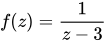
- (complex analysis) For a meromorphic function
, any point
for which
as
.
- The function has a single pole at.
- (obsolete) The firmament; the sky.
- 1634, John Milton, Comus, 1817, Paradise Regained... To which is added a complete collection of his miscellaneous poems, page 211,
- And the slope sun his upward beam / Shoots against the dusky pole,
- 1634, John Milton, Comus, 1817, Paradise Regained... To which is added a complete collection of his miscellaneous poems, page 211,
- Either of the states that characterize a bipolar disorder.



Antonyms
- (complex analysis): zero
Derived terms
Translations
|
|
|
- The translations below need to be checked and inserted above into the appropriate translation tables, removing any numbers. Numbers do not necessarily match those in definitions. See instructions at Wiktionary:Entry layout#Translations.
Verb
pole (third-person singular simple present poles, present participle poling, simple past and past participle poled)
- (transitive) To induce piezoelectricity in (a substance) by aligning the dipoles.
Anagrams
Aiwoo
Verb
pole
- to work (in a garden or field)
References
- Greenhill, S.J., Blust. R, & Gray, R.D. (2008). The Austronesian Basic Vocabulary Database: From Bioinformatics to Lexomics. Evolutionary Bioinformatics, 4:271-283.
Alemannic German
Etymology
From Middle High German boln.
Verb
pole
References
- Abegg, Emil (1911) Die Mundart von Urseren [The Dialect of Urseren], Frauenfeld, Switzerland: Huber & co., page 35.
Czech
Pronunciation
audio (file)
Noun
pole n
- (agriculture) field
- (physics) field
- (algebra) field
- (computing) field
- (programming) array
Declension
Synonyms
- komutativní těleso n (algebra)
Further reading
- pole in Příruční slovník jazyka českého, 1935–1957
- pole in Slovník spisovného jazyka českého, 1960–1971, 1989
Esperanto
Adverb
pole
Estonian
Etymology
Contraction of ep ole (Modern: ei ole). ep is the old 3rd person singular form of the negative verb.
Verb
pole
Galician
Etymology 1
Noun
pole m (plural poles)
- pollen
- (motor racing) Pole position.
Synonyms
Etymology 2
See pulir.
Verb
pole
Latin
Noun
pole
- vocative singular of polus
References
- pole in Charles du Fresne du Cange’s Glossarium Mediæ et Infimæ Latinitatis (augmented edition, 1883–1887)
- pole in Harry Thurston Peck, editor (1898) Harper's Dictionary of Classical Antiquities, New York: Harper & Brothers
Polish
Etymology
From Proto-Slavic *pȍlje.
Pronunciation
- IPA(key): /ˈpɔlɛ/
audio (file)
Noun
pole n
- field (land area; wide open space)
- (regional, singular only) outside
- (geometry) area
- (physics) field
Declension
Derived terms
- pole namiotowe
- szukać wiatru w polu
Spanish
Noun
pole m (plural poles)
- (motor racing) Pole position.
Synonyms
Verb
pole
- Informal second-person singular (tú) affirmative imperative form of polir.
- Formal second-person singular (usted) present indicative form of polir.
- Third-person singular (él, ella, also used with usted?) present indicative form of polir.
Swahili
Adverb
pole
Adjective
pole
- slow (not quick in motion)