port
English
Pronunciation
- (General American) IPA(key): /pɔɹt/
- (Received Pronunciation) IPA(key): /pɔːt/
- (rhotic, without the horse–hoarse merger) IPA(key): /po(ː)ɹt/
- (non-rhotic, without the horse–hoarse merger) IPA(key): /poət/
Audio - 'a port' (UK) (file) Audio (US) (file) - Rhymes: -ɔː(ɹ)t
Etymology 1
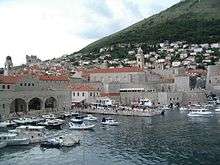
From Old English port, from Latin portus (“port, harbour”), ultimately from Proto-Indo-European *pértus (“crossing”) (and thus distantly cognate with ford).
Noun
port (plural ports)
- A place on the coast at which ships can shelter, or dock to load and unload cargo or passengers.
- (Can we date this quote?), Shakespeare, (Please provide the book title or journal name):
- peering in maps for ports and piers and roads
- 2013 June 8, “The new masters and commanders”, in The Economist, volume 407, number 8839, page 52:
- From the ground, Colombo’s port does not look like much. Those entering it are greeted by wire fences, walls dating back to colonial times and security posts. For mariners leaving the port after lonely nights on the high seas, the delights of the B52 Night Club and Stallion Pub lie a stumble away.
-
- A town or city containing such a place, a port city.
- (nautical, uncountable) The left-hand side of a vessel, including aircraft, when one is facing the front. Port does not change based on the orientation of the person aboard the craft.
Synonyms
Antonyms
- (right-hand side of a vessel): starboard
Derived terms
Related terms
Translations
|
|
|
|
- The translations below need to be checked and inserted above into the appropriate translation tables, removing any numbers. Numbers do not necessarily match those in definitions. See instructions at Wiktionary:Entry layout#Translations.
Adjective
port (not comparable)
- (nautical) Of or relating to port, the left-hand side of a vessel.
- on the port side
Synonyms
Antonyms
Translations
Verb
port (third-person singular simple present ports, present participle porting, simple past and past participle ported)
Translations
|
Etymology 2
Inherited from the Old English port, from the Latin porta (“passage, gate”), reinforced by the Old French porte.
Noun
port (plural ports)
- (now Scotland, historical) An entryway or gate.
- 1485, Thomas Malory, Le Morte Darthur, book X:
- And whan he cam to the porte of the pavelon, Sir Palomydes seyde an hyghe, ‘Where art thou, Sir Trystram de Lyones?’
- 1590, Edmund Spenser, The Faerie Queene, III.1:
- Long were it to describe the goodly frame, / And stately port of Castle Joyeous […] .
- 1623, Shakespeare, Coriolanus, V.vi:
- Him I accuse / The city ports by this hath enter'd
- 1667, Milton, Paradise Lost, book IV:
- And from their ivory port the Cherubim, / Forth issuing at the accustomed hour
-
- An opening or doorway in the side of a ship, especially for boarding or loading; an embrasure through which a cannon may be discharged; a porthole.
- (Can we date this quote?), Sir W. Raleigh, (Please provide the book title or journal name):
- […] her ports being within sixteen inches of the water […]
-
- (curling, bowls) A space between two stones wide enough for a delivered stone or bowl to pass through.
- An opening where a connection (such as a pipe) is made.
- (computing) A logical or physical construct in and from which data are transferred.

- (computing) A female connector of an electronic device, into which a cable's male connector can be inserted.
Hyponyms
Derived terms
- backport
- porthole
- (computing): port forwarding
Translations
|
Etymology 3
From Old French porter, from Latin portāre (“carry”). Akin to transport, portable.
Verb
port (third-person singular simple present ports, present participle porting, simple past and past participle ported)
- To carry, bear, or transport. See porter.
- (Can we date this quote?), Fuller, The History of the Worthies of England:
- They are easily ported by boat into other shires.
-
- (military) To hold or carry (a weapon) with both hands so that it lays diagonally across the front of the body, with the barrel or similar part near the left shoulder and the right hand grasping the small of the stock; or, to throw (the weapon) into this position on command.
- Port arms!
- 1667, Milton, Paradise Lost, book IV:
- […] the angelic squadron...began to hem him round with ported spears.
- (computing, video games) To adapt, modify, or create a new version of, a program so that it works on a different platform.
- (telephony) To carry or transfer an existing telephone number from one telephone service provider to another.
- (governmental jargon, United States) To transfer a voucher or subsidy from one jurisdiction to another.
Derived terms
Translations
Noun
port (plural ports)
- Something used to carry a thing, especially a frame for wicks in candle-making.
- (archaic) The manner in which a person carries himself; bearing; deportment; carriage. See also portance.
- late 14th c., Chaucer, “General Prologue”, in Canterbury Tales, line 69:
- And of his port as meeke as is a mayde.
- 1590, Edmund Spenser, The Faerie Queene, II.iii:
- Those same with stately grace, and princely port / She taught to tread, when she her selfe would grace […]
- (Can we date this quote?), South, (Please provide the book title or journal name):
- the necessities of pomp, grandeur, and a suitable port in the world
-
- (military) The position of a weapon when ported; a rifle position executed by throwing the weapon diagonally across the front of the body, with the right hand grasping the small of the stock and the barrel sloping upward and crossing the point of the left shoulder.
- (computing) A program that has been adapted, modified, or recoded so that it works on a different platform from the one for which it was created; the act of this adapting.
- Gamers can't wait until a port of the title is released on the new system.
- The latest port of the database software is the worst since we made the changeover.
- (computing, BSD) A set of files used to build and install a binary executable file from the source code of an application.
Derived terms
- (military): at the high port
Translations
Etymology 4
Named from Portuguese Porto, a city in Portugal from whence the wines were originally shipped.
Noun
port (countable and uncountable, plural ports)
- A type of very sweet fortified wine, mostly dark red, traditionally made in Portugal.
Synonyms
Translations
|
|
Etymology 5
Abbreviation of portmanteau.
Noun
port (plural ports)
- (Australia, Queensland, northern New South Wales and elsewhere, colloquial) A suitcase, particularly a schoolbag.
- 1964, George Johnston, My Brother Jack:
- No, she just paid up proper-like t' the end of the week, an' orf she went with 'er port, down t' the station, I suppose.
-
Anagrams
Albanian
Noun
port m (indefinite plural porte, definite singular porti, definite plural portet)
Catalan
Pronunciation
Etymology 1
Noun
port m (plural ports)
Related terms
Etymology 2
From portar.
Noun
port m (plural ports)
- This term needs a translation to English. Please help out and add a translation, then remove the text
{{rfdef}}.
Further reading
- “port” in Diccionari de la llengua catalana, segona edició, Institut d’Estudis Catalans.
Danish
Etymology
Pronunciation
- IPA(key): /port/, [pʰoɐ̯ˀd̥]
Noun
port c (singular definite porten, plural indefinite porte)
Inflection
Dutch
Pronunciation
Audio (file) - Rhymes: -ɔrt
Etymology 1
Noun
port m, n (plural porten)
Etymology 2
Named from Portuguese Oporto, a city in Portugal from whence the wines were originally shipped.
Noun
port m (uncountable, diminutive portje n)
Etymology 3
See porren.
Verb
port
- second- and third-person singular present indicative of porren
- (archaic) plural imperative of porren
French
Pronunciation
- IPA(key): /pɔʁ/
audio (file)
Etymology 1
From Old French port, from Latin portus, from Proto-Italic *portus, from Proto-Indo-European *pértus (“crossing”), from *per- (“to go forth, to cross”).
Noun
port m (plural ports)
Etymology 2
Deverbal of porter. Ultimately from the same source as etymology 1 above.
Noun
port m (plural ports)
- wearing (act of wearing something)
Anagrams
Further reading
- “port” in le Trésor de la langue française informatisé (The Digitized Treasury of the French Language).
Hungarian
Pronunciation
- IPA(key): [ˈport]
- Hyphenation: port
Etymology 1
Noun
port (plural portok)
Declension
| Inflection (stem in -o-, back harmony) | ||
|---|---|---|
| singular | plural | |
| nominative | port | portok |
| accusative | portot | portokat |
| dative | portnak | portoknak |
| instrumental | porttal | portokkal |
| causal-final | portért | portokért |
| translative | porttá | portokká |
| terminative | portig | portokig |
| essive-formal | portként | portokként |
| essive-modal | — | — |
| inessive | portban | portokban |
| superessive | porton | portokon |
| adessive | portnál | portoknál |
| illative | portba | portokba |
| sublative | portra | portokra |
| allative | porthoz | portokhoz |
| elative | portból | portokból |
| delative | portról | portokról |
| ablative | porttól | portoktól |
| Possessive forms of port | ||
|---|---|---|
| possessor | single possession | multiple possessions |
| 1st person sing. | portom | portjaim |
| 2nd person sing. | portod | portjaid |
| 3rd person sing. | portja | portjai |
| 1st person plural | portunk | portjaink |
| 2nd person plural | portotok | portjaitok |
| 3rd person plural | portjuk | portjaik |
Etymology 2
Noun
port
- accusative singular of por
Icelandic
Etymology
Pronunciation
- IPA(key): /pʰɔr̥t/
- Rhymes: -ɔr̥t
Noun
port n (genitive singular ports, nominative plural port)
Declension
Synonyms
- (gate): hlið
Irish
Etymology 1
From Old Irish port (“tune, melody”).
Noun
port m (genitive singular poirt, nominative plural poirt)
- (music) tune
- Is buaine port ná glór na n-éan; is buaine focal ná toice an tsaoil.
- A tune is more lasting than the song of birds; a word is more lasting than the wealth of the world.
- jig (dance)
Declension
First declension
|
Bare forms:
|
Forms with the definite article:
|
Etymology 2
From Old Irish port (“bank, shore (of river or sea); landing-place, haven; bank, mound, entrenchment; place, spot, locality; stead, abode; stronghold, fortress”), from Latin portus (“harbour, port; haven, refuge, asylum, retreat”).
Noun
port m (genitive singular poirt, nominative plural poirt)
- landing-place
- harbor, port
- bank (of river, etc.)
- mound, embankment
- refuge, haven, resort
- stopping-place
- place, locality
- fortified place, stronghold
- occupied place, seat, center
Declension
First declension
|
Bare forms:
|
Forms with the definite article:
|
Derived terms
- taobhfort m (“traverse”)
Mutation
| Irish mutation | ||
|---|---|---|
| Radical | Lenition | Eclipsis |
| port | phort | bport |
| Note: Some of these forms may be hypothetical. Not every possible mutated form of every word actually occurs. | ||
References
- "port" in Foclóir Gaeilge-Béarla, An Gúm, 1977, by Niall Ó Dónaill.
- “1 port” in Dictionary of the Irish Language, Royal Irish Academy, 1913–76.
- “2 port” in Dictionary of the Irish Language, Royal Irish Academy, 1913–76.
Ladin
Etymology
Noun
port m (plural porc)
Norman
Etymology
Noun
port m (plural ports)
Synonyms
Norwegian Bokmål
Etymology
From Middle Norwegian portr m, from late Old Norse port n, from Latin porta f.
Pronunciation
- IPA(key): /puʈ/
- Rhymes: -uʈ
Noun
port m (definite singular porten, indefinite plural porter, definite plural portene)
References
- “port” in The Bokmål Dictionary.
Norwegian Nynorsk
Etymology
From Middle Norwegian portr m, from late Old Norse port n, from Latin porta f.
Noun
port m (definite singular porten, indefinite plural portar, definite plural portane)
References
- “port” in The Nynorsk Dictionary.
Old English
Pronunciation
- IPA(key): /port/
Etymology 1
Borrowed from Latin portus (“harbour”, “port”, “haven”, “warehouse”).
Noun
port m
Declension
This noun needs an inflection-table template.
Derived terms
- portcwēn f
- Portesmūþa m
- portgeat n
- portġerēfa m
- portgeriht n
- portherepaþ m
- portmann m
- portstrǣt f
- portwara m
- portweall m
- portweg m
- portwer m
Descendants
References
- “port” on pages 776–777 of the Bosworth–Toller Anglo-Saxon Dictionary (1898)
Etymology 2
Borrowed from Latin porta (“gate”, “entrance”, “passage”, “door”).
Noun
port m
Declension
This noun needs an inflection-table template.
Descendants
References
- “port” on page 777/1 of the Bosworth–Toller Anglo-Saxon Dictionary (1898)
Old French
Etymology
Pronunciation
- IPA(key): /pɔrt/
- Rhymes: -ɔrt
Noun
port m (oblique plural porz or portz, nominative singular porz or portz, nominative plural port)
- port (for watercraft)
- circa 1150, Turoldus, La Chanson de Roland:
- As porz d'Espaigne en est passet Rollant
- Roland went to the ports of Spain
- As porz d'Espaigne en est passet Rollant
-
Descendants
- French: port
Polish
Pronunciation
- IPA(key): /pɔrt/
Audio (file)
Noun
port m inan
Declension
Derived terms
- portowy
Romanian
Etymology 1
From French port, Italian porto, Latin portus.
Noun
port n (plural porturi)
- port (town with port)
Declension
Related terms
- portuar
See also
Etymology 2
Verb
port
- first-person singular present indicative of purta.
- first-person singular present subjunctive of purta.
Scottish Gaelic
Etymology 1
From Old Irish port (“tune, melody”).
Noun
Synonyms
Etymology 2
From Old Irish port (“bank, shore (of river or sea); landing-place, haven; bank, mound, entrenchment; place, spot, locality; stead, abode; stronghold, fortress”), from Latin portus (“harbour, port; haven, refuge, asylum, retreat”).
Noun
port m (genitive singular puirt, plural puirt or portan)
Synonyms
Derived terms
Mutation
| Scottish Gaelic mutation | |
|---|---|
| Radical | Lenition |
| port | phort |
| Note: Some of these forms may be hypothetical. Not every possible mutated form of every word actually occurs. | |
References
- “1 port” in Dictionary of the Irish Language, Royal Irish Academy, 1913–76.
- “2 port” in Dictionary of the Irish Language, Royal Irish Academy, 1913–76.
Swedish
Etymology
From late Old Norse port n, portr m, from Latin porta f. Computing sense loan-translation from English.
Pronunciation
audio (file)
Noun
port c
- an entrance (into a building), a gate, a portal, a door, a doorway
- (computing) a port (logical or physical construct in and from which data are transferred)
Declension
| Declension of port | ||||
|---|---|---|---|---|
| Singular | Plural | |||
| Indefinite | Definite | Indefinite | Definite | |
| Nominative | port | porten | portar | portarna |
| Genitive | ports | portens | portars | portarnas |
Related terms
See also
References
- port in Svenska Akademiens Ordlista över svenska språket (13th ed., online)
Turkish
Etymology
Noun
port (definite accusative portu, plural portlar)
- (computer hardware, networking) port
Declension
| Inflection | ||||||||||||||||||||||||||
|---|---|---|---|---|---|---|---|---|---|---|---|---|---|---|---|---|---|---|---|---|---|---|---|---|---|---|
| Nominative | port | |||||||||||||||||||||||||
| Definite accusative | portu | |||||||||||||||||||||||||
| Singular | Plural | |||||||||||||||||||||||||
| Nominative | port | portlar | ||||||||||||||||||||||||
| Definite accusative | portu | portları | ||||||||||||||||||||||||
| Dative | porta | portlara | ||||||||||||||||||||||||
| Locative | portta | portlarda | ||||||||||||||||||||||||
| Ablative | porttan | portlardan | ||||||||||||||||||||||||
| Genitive | portun | portların | ||||||||||||||||||||||||
| ||||||||||||||||||||||||||