後
| ||||||||
Translingual
| Stroke order | |||
|---|---|---|---|
 | |||
Han character
後 (radical 60, 彳+6, 9 strokes, cangjie input 竹人女戈水 (HOVIE), four-corner 22247, composition ⿰彳⿱幺夊)
Derived characters
- 䵈, 𠷴, 𢖕/𢖖
References
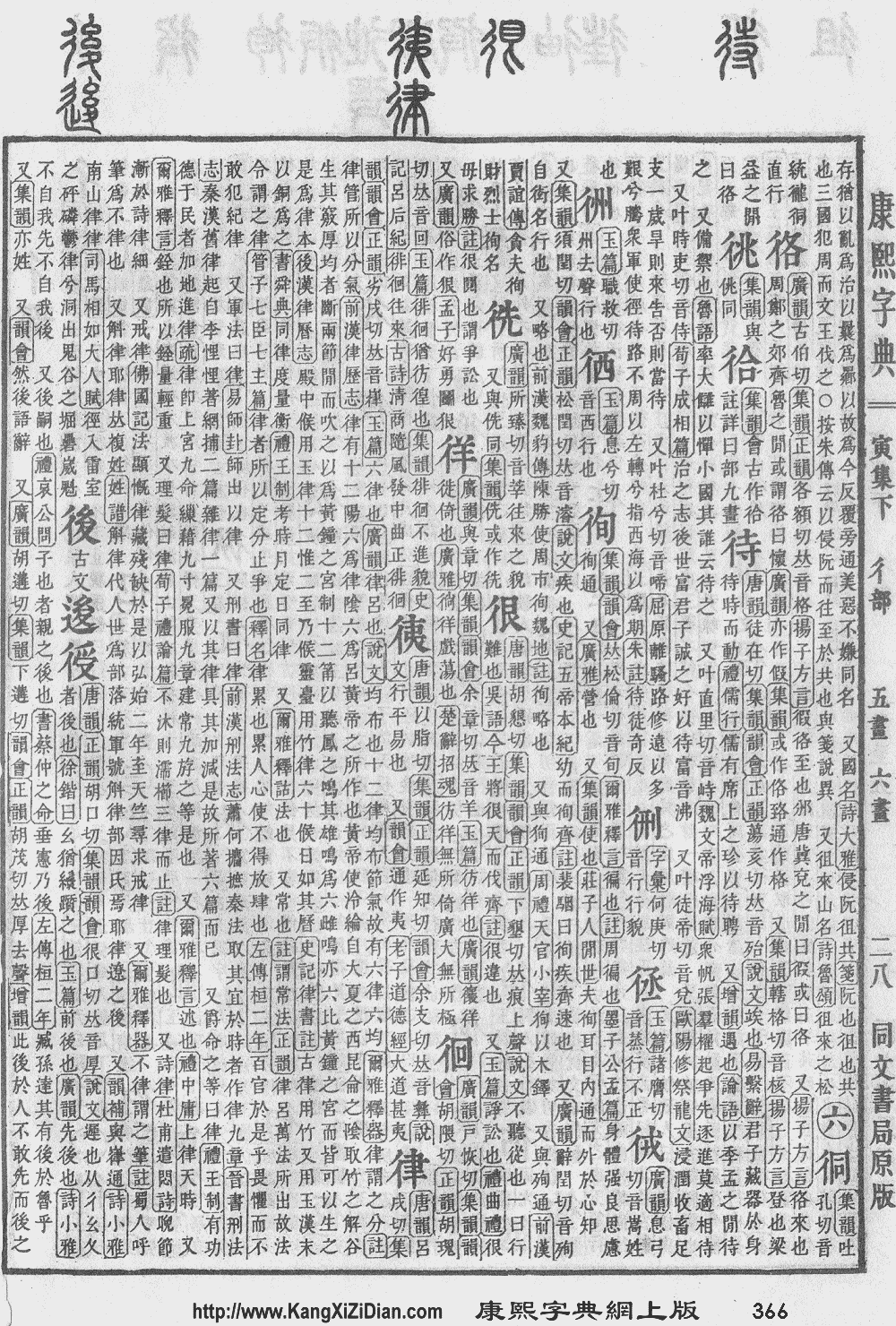
- KangXi: page 366, character 18
- Dai Kanwa Jiten: character 10098
- Dae Jaweon: page 688, character 1
- Hanyu Da Zidian: volume 2, page 822, character 3
- Unihan data for U+5F8C
Chinese
| trad. | 後 | |
|---|---|---|
| simp. | 后* | |
Glyph origin
| Historical forms of the character 後 | |||
|---|---|---|---|
| Shang | Western Zhou | Shuowen Jiezi (compiled in Han) | Liushutong (compiled in Ming) |
| Oracle bone script | Bronze inscriptions | Small seal script | Transcribed ancient scripts |
 |
 |
 |
 |
Ideogrammic compound (會意) : 彳 + 幺 + 夊.
Note that the simplified form 后 (OC *ɡoːʔ, *ɡoːs) is also a traditional character on its own, with a different meaning.
Pronunciation
Definitions
後
- behind; rear; back
- Antonyms: 前 (qián)
- later; after; afterwards
- descendants; offsprings
- anus
- A surname.
Compounds
|
|
|
Japanese
Kanji
Readings
Compounds
Etymology 1
| Kanji in this term |
|---|
| 後 |
| あと Grade: 2 |
| kun’yomi |
Originally an extension of 跡 (ato, “footprint; leftover”), itself a compound of 足 (a, “foot”) + 所 (to, “place”).[1][2][3]
Pronunciation
Noun
Etymology 2
| Kanji in this term |
|---|
| 後 |
| うしろ Grade: 2 |
| kun’yomi |
Probably from Old Japanese [Term?]. Usage examples appear in texts from at least the 900s.[1] Ultimate derivation unknown.
Pronunciation
Alternative forms
- 後ろ (more common)
Noun
Etymology 3
| Kanji in this term |
|---|
| 後 |
| おくれ Grade: 2 |
| kun’yomi |
The 連用形 (ren'yōkei, “continuative or stem form”) of verb 遅れる (okureru, “to be late; to be delayed; to come after something else”). Examples appear from at least the 1300s.[1]
Pronunciation
Alternative forms
Noun
後 (hiragana おくれ, rōmaji okure)
- something later, after, or behind
- inferiority
- uncertainty, nervousness, indecision
Etymology 4
| Kanji in this term |
|---|
| 後 |
| しり Grade: 2 |
| kun’yomi |
From Old Japanese [Term?]. Ultimate derivation unknown.
Pronunciation
Alternative forms
- 尻 (much more common)
Noun
Etymology 5
| Kanji in this term |
|---|
| 後 |
| しりえ Grade: 2 |
| kun’yomi |
From Old Japanese [Term?]. Compound of 尻 (shiri, “butt, tail, rear”) + 方 (e, “side, facing, way, direction”).
Pronunciation
Alternative forms
Noun
後 (hiragana しりえ, rōmaji shirie)
Etymology 6
| Kanji in this term |
|---|
| 後 |
| のち Grade: 2 |
| kun’yomi |
From Old Japanese [Term?]. Ultimate derivation unknown.
Pronunciation
Noun
- later, afterwards, some time after the present
Etymology 7
| Kanji in this term |
|---|
| 後 |
| ゆり Grade: 2 |
| kun’yomi |
From Old Japanese [Term?]. Ultimate derivation unknown. May be cognate with より (yori, “from; after”).
Pronunciation
Noun
- (obsolete) later, afterwards, some time after the present
Etymology 8
| Kanji in this term |
|---|
| 後 |
| ご Grade: 2 |
| on’yomi |
From Middle Chinese 後 (ɦəuX, ɦəuH)||after}}. Classified as the tōon or "Tang sound", so likely borrowed from the dialects spoken during the Tang dynasty.
Pronunciation
Noun
- later, afterwards, some time after the present
Suffix
Etymology 9
| Kanji in this term |
|---|
| 後 |
| こう Grade: 2 |
| on’yomi |
From Middle Chinese 後 (ɦəuX, “after”). Classified as the kan'on, so likely a later borrowing. Compare modern Mandarin reading hòu.
Pronunciation
Prefix
後 (hiragana こう, rōmaji kō-)
Usage notes
Only used in compounds. Never used in isolation.
References
- 1 2 3 1988, 国語大辞典(新装版) (Kokugo Dai Jiten, Revised Edition) (in Japanese), Tōkyō: Shogakukan
- 1 2 3 4 5 6 7 8 9 10 2006, 大辞林 (Daijirin), Third Edition (in Japanese), Tōkyō: Sanseidō, →ISBN
- ↑ 1995, 大辞泉 (Daijisen) (in Japanese), Tōkyō: Shogakukan, →ISBN
- 1 2 3 4 5 6 7 8 1997, 新明解国語辞典 (Shin Meikai Kokugo Jiten), Fifth Edition (in Japanese), Tōkyō: Sanseidō, →ISBN
Korean
Hanja
後 • (hu) (hangeul 후, McCune–Reischauer hu, Yale hwu)
- This term needs a translation to English. Please help out and add a translation, then remove the text
{{rfdef}}.
Vietnamese
Han character
後 (hậu)
- This term needs a translation to English. Please help out and add a translation, then remove the text
{{rfdef}}.